One Sharpa Wave Hand Caps a Bottle, Syringe, and Marker
Most robot assembly still looks like a vise plus a gripper. Assembling Two Parts in One Hand, a CoRL 2026 paper from the University of Hong Kong, HKUST Guangzhou, and ETH Zurich, throws the fixture out. A single 22-DoF Sharpa Wave on a Franka Research 3 mates two rigid parts with no second arm.
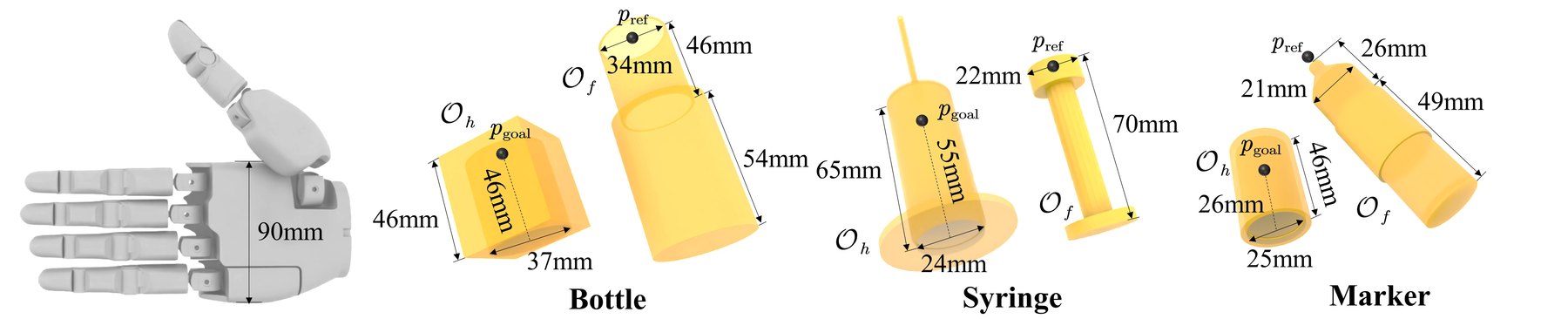
The same reinforcement-learning recipe covers three plug-in tasks: Bottle, Syringe, and Marker. Policies train only in Isaac Sim and transfer zero-shot to hardware, using one RealSense D435 and FoundationPose.
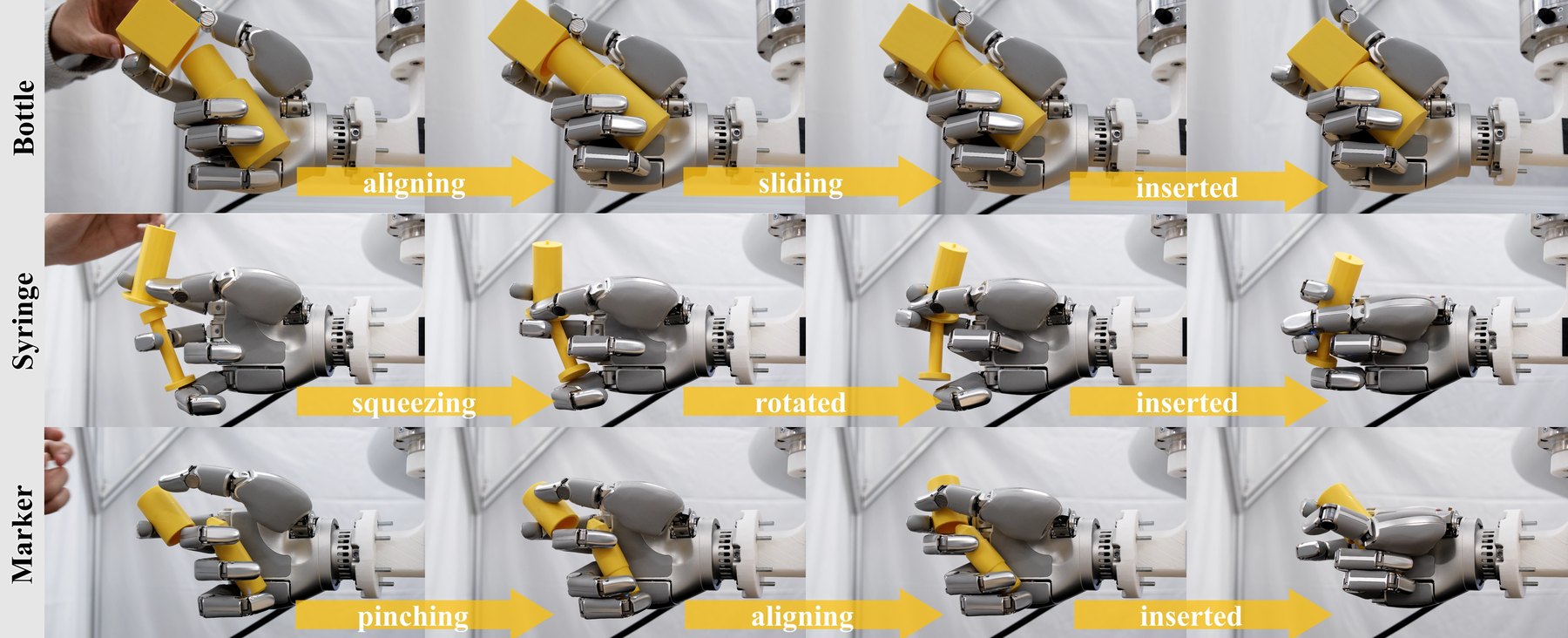
Finger jobs, not a blob grasp
The observation is a 34-D vector: each object’s centroid and symmetry axis, plus 22 joint angles. Actions are 0.1 rad joint-target deltas at 15 Hz. Thumb and index pinch the moving part. Middle, ring, and little cage the other. A single human snapshot seeds initialization; objects then settle under a short random wrench so training does not memorize one pose.
Closed-loop control versus open-loop replay of successful sim trajectories, 20 consecutive real trials:
| Task | Closed-loop alignment | Closed-loop assembly | Open-loop assembly |
|---|---|---|---|
| Bottle | 18/20 | 15/20 | 2/20 |
| Syringe | 18/20 | 17/20 | 1/20 |
| Marker | 16/20 | 16/20 | 0/20 |
Alignment means insertion deeper than 1 cm. Assembly means the final depth is within 1 cm of the target. Without feedback, early sim-to-real drift kills the mate.
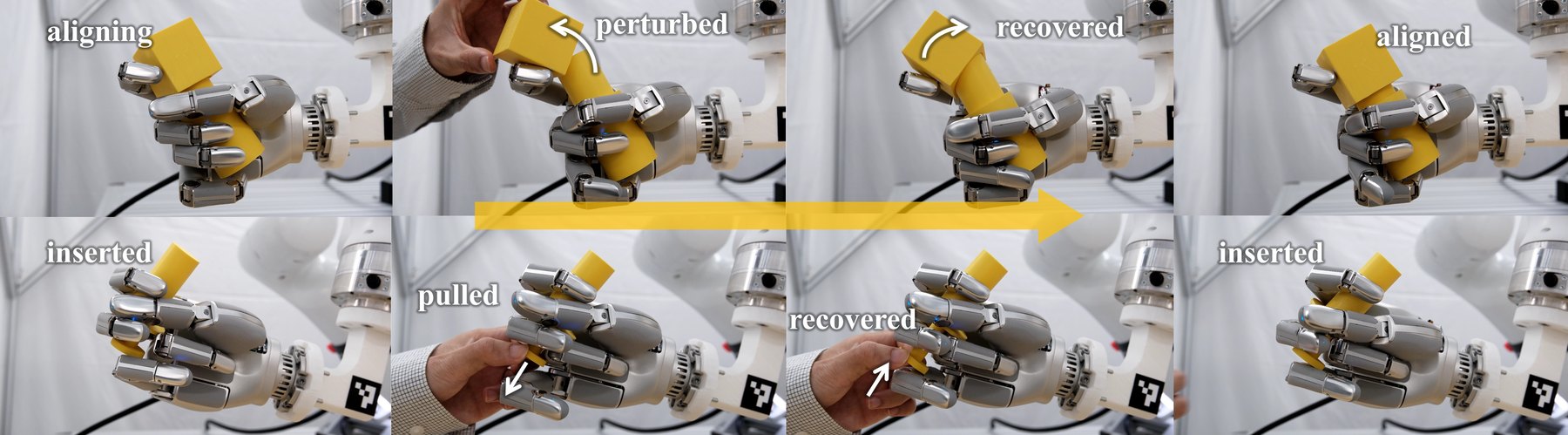
Push the cap off axis and the index finger puts it back. Pull the syringe plunger against the grasp and the hand reseats it. A policy trained across wrist tilts still works when gravity changes direction, until pinch contact goes near-horizontal. Rigid-body sim turns a pad grasp into two points, so some tilts never learn a stable pinch.
Hands are not interchangeable
The same pipeline in simulation on the Syringe task is a morphology bench. Sharpa and Wuji (human-scale, high DoF, wide joint range) align and insert. Allegro (four large fingers) can line up in the plane but cannot drive insertion along z without a fifth finger. XHand (fewer abduction joints) fails both alignment and insertion.
Limits the authors flag: both objects start already in the hand, sometimes with a human holding them until the policy engages. Pickup is out of scope. Only plug-in geometries; threading and friction-fit wait on better contact sim.
A Human’s Take
Capping a marker with the hand that holds it is the kind of boring dexterity factories actually pay for, and almost nobody demos it because two arms plus a fixture is easier to score. The open-loop collapse is the receipt: this is closed-loop contact, not a replayed flourish. I will care more when the hand picks the parts off the table itself. Until then, treat the morphology table as the real product: if your five-finger demo cannot insert a syringe plunger, it is not a hand, it is a fancy gripper.