INSPECT Learns Where to Look at a Gearbox From Smart-Glass Assistants
A robot checking an assembly does not need a prettier picture. It needs the camera pose that makes a claim decidable: is that gear in the slot, or only nearby? INSPECT, from Karlsruhe Institute of Technology and Hunan University, trains that choice on records from a smart-glasses assistant, then transfers it to a robot that never sees candidate images at selection time.
The paper is arXiv:2609.20615, submitted 17 September. Code: github.com/Kratos-Wen/INSPECT.
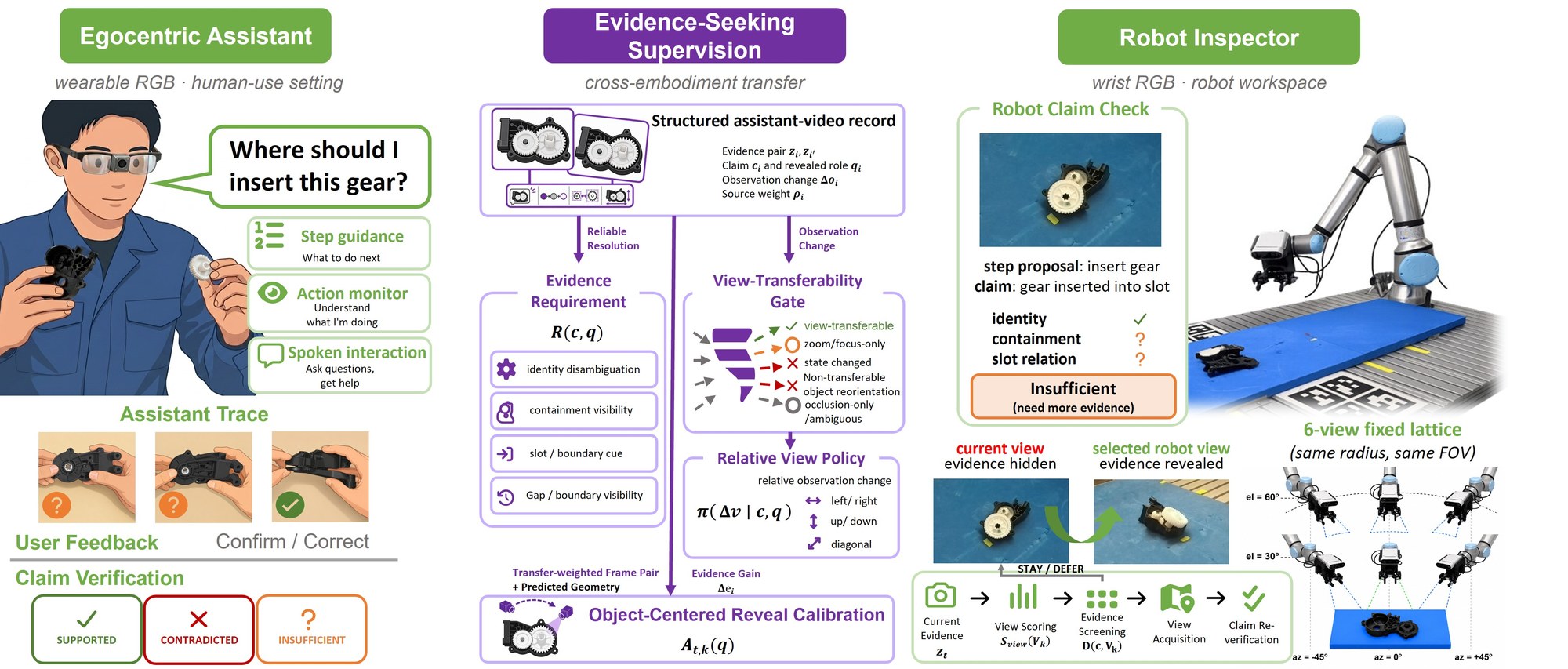
Claims, not camera mimicry
The assistant answers part queries and next-step questions. When the wearer confirms or corrects a state, the system logs the RGB, the claim, and the head motion. That is useful only if you split two events the paper is careful about:
- The claim got resolved because new evidence appeared.
- The assembly itself changed because the operator moved a part.
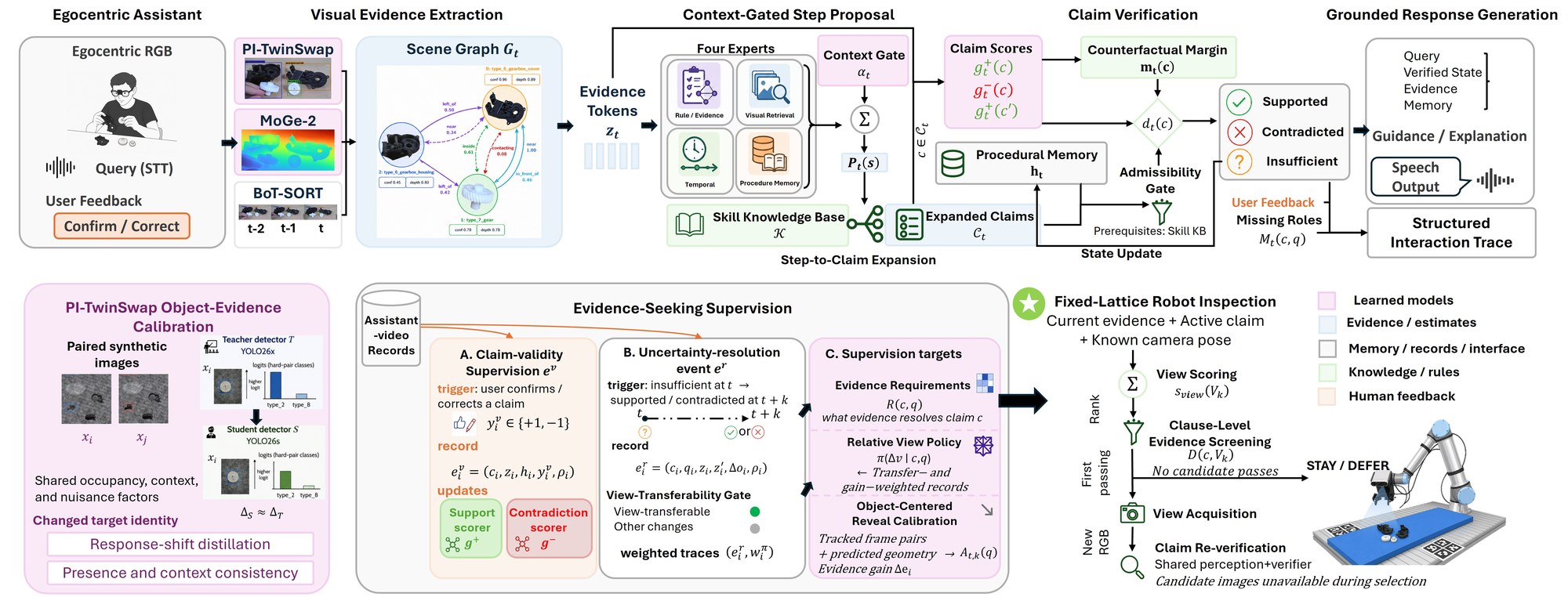
Only the first kind should teach a robot camera. Presence-Invariant TwinSwap (PI-TwinSwap) then trains a detector on paired images that swap part identity while holding placement and occlusion fixed. Object-centered calibration maps relative view preferences onto robot poses. Clause-level screening checks that the predicted view actually supplies the missing evidence role.
The robot picks a pose from known geometry and the current RGB. No candidate photos in the loop.
Gearboxes and grinders
On images of physical gearbox assemblies, INSPECT posts the highest view utility among the non-oracle policies in the paper and lifts human-rated full verifiability from 34.8% to 41.7% versus keeping the current view.
On IMPACT commercial angle-grinder recordings, a transferred relative-view selector moves correct-decision rate from 50.6% to 54.3% with a frozen perception head. Current-view baseline utility on that transfer table is 1.043 and 0.506; the relative-view selector is 1.098 and 0.543.
A supporting verifier diagnostic uses 1,315 annotated claim states from 37 videos. Single-frame support precision is 0.793; a past-only temporal filter raises that to 0.903 while cutting false support from 0.053 to 0.017. Against Qwen3-VL on a 60-frame matched set, the verifier finds 11 of 20 contradicted claims; both Qwen3-VL protocols find none.
PI-TwinSwap, on 304 images and 905 boxes, lifts correctly localized-and-identified objects from 88 to 190 versus real-image training.
A Human’s Take
A seven-point bump in “I can actually see if the gear is seated” is small and specific, which is why I trust it more than a 90% demo. The method’s real claim is the split: don’t copy the operator’s hands, copy the camera move that revealed the answer. If that holds on a live cell instead of replayed assistant video, this is how inspection robots stop taking the pretty view and start taking the useful one.