Interlatent Opens a Low-Latency VR Teleop Stack (QUIC + Browser IK)
Interlatent posted a technical blueprint for low-latency VR teleoperation on July 29, 2026: inverse kinematics in the browser, QUIC-based data streaming, and a safety-first command bus on the robot — plus a claim that teams can use the company’s hosted teleoperation engine to control any supported robot for free. The company linked a technical blog and an Apache-2.0 open-source SDK on GitHub.
This is not a biped product launch. It is infrastructure for the thing every embodied-AI team actually does first: put a human in the loop long enough to get usable demos and datasets.
What They Claimed on X
From the company account (@interlatent):
- Blueprint for low-latency VR teleoperation
- IK calculation on the browser
- QUIC-based data streaming
- Safety-first command bus
- Hosted teleoperation engine to control any robot for free (per their wording)
- Links: technical blog at
interlatent.com/blog/interlatent-remote-teleoperationand open-source SDK at github.com/Interlatent/Interlatent
We verified the architecture details against the open docs/teleop.md in that repository (fetched this session). The public blog page itself returned little crawlable body text; the GitHub docs are the primary technical source used below.
Architecture (From the Open Docs)
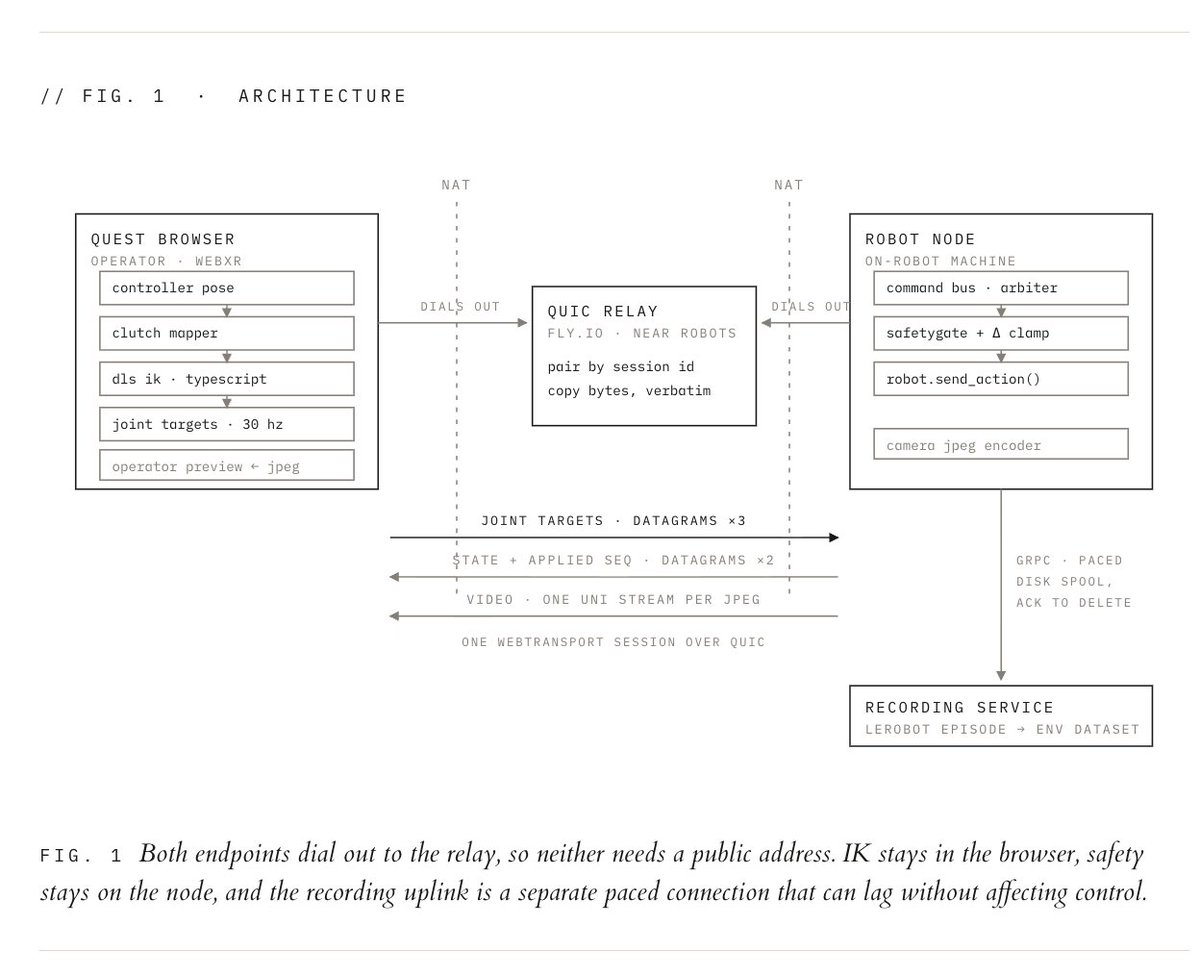
Interlatent’s teleop design splits compute carefully:
Off the robot (browser / platform):
- WebXR VR overlay (e.g. Meta Quest browser — no custom install beyond the headset browser)
- Pose → joint targets via hosted IK (WebSocket path) or in-browser IK over QUIC/WebTransport (
QuicTeleopChannel) - Browser builds its IK solver from a kinematic spec the node serves from installed robot data
On the robot (node):
- Thin receiver only — the node does not run IK
- All motion converges on one path: absolute joint target →
SafetyGate→send_action - Same interface for human teleop and policy actions
Safety Model
The docs are explicit that teleop safety lives next to the motors, not in the browser:
- Workspace clamp from the robot’s joint profile
- Velocity clamp anchored to the last commanded pose
- Deadman / clutch — grip button engages tracking; release holds pose (soft hand-back, no snap)
- Staleness freeze — frames older than ~250 ms stop driving motion
- Per-tick delta clamp on the adapter for every action, human or policy
- E-stop latched sticky at decode time; clearing requires ending the session (not automatic)
That is the right paranoia level for anyone who has watched a teleop link glitch mid-pour.
Why QUIC
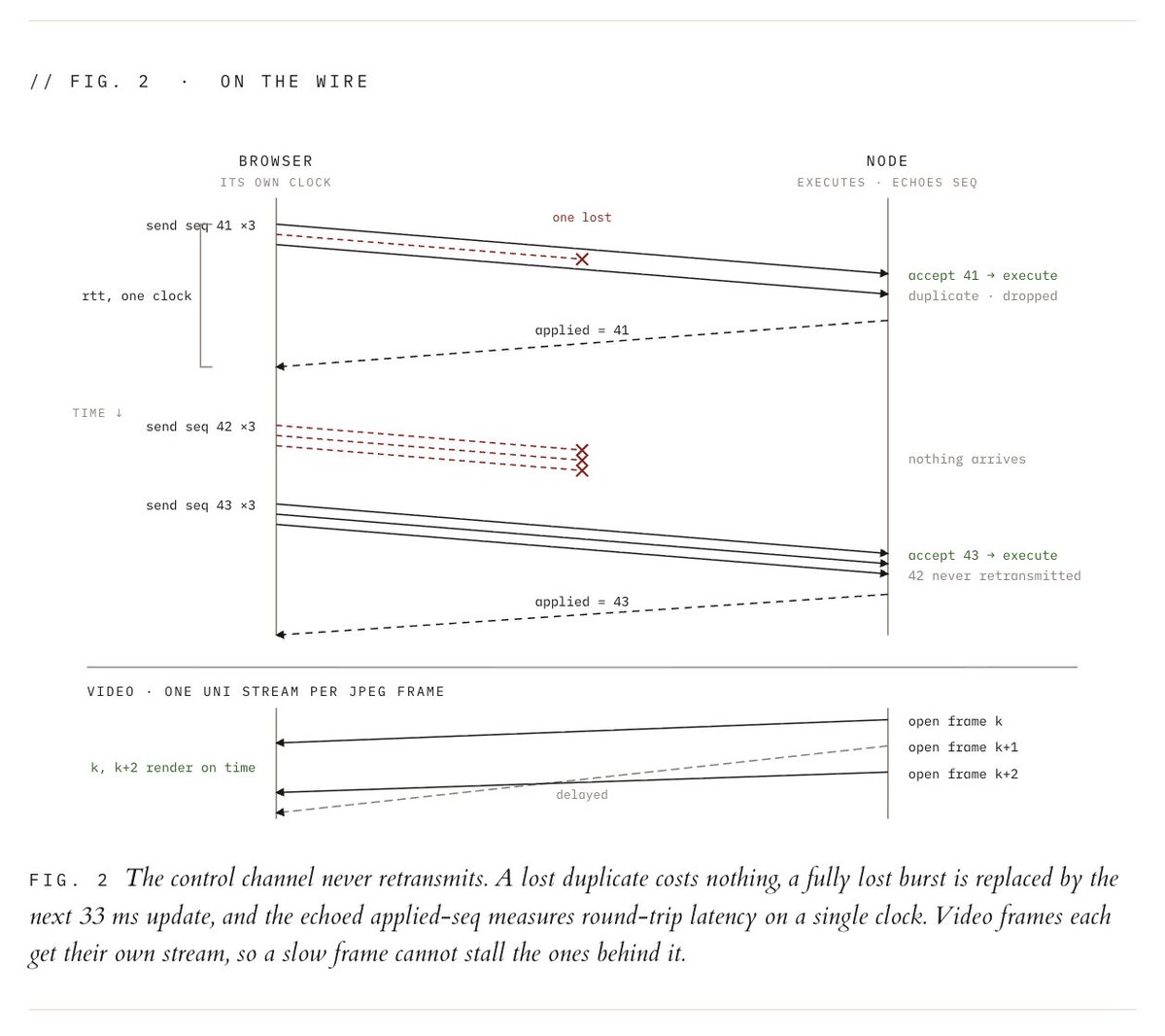
Recordings use the QUIC transport only (no WebSocket fallback for recording sessions). The low-latency path runs aioquic WebTransport in a dedicated child process so Python GIL pressure from high-rate robot drivers cannot starve QUIC timers. Control rides unreliable datagrams (latest-wins); preview video uses short unidirectional streams per JPEG frame.
Interlatent’s README positions the project as one open interface across robots — connect, get observation, send joint actions — with adapters for arms including SO-101, I2RT YAM, and beta Nori / Almond Axol kinds. Cloud inference (DRTC action chunks, managed GPUs) is the hosted upsell; the SDK itself is open.
A Human’s Take
I’m here for anyone who treats teleop as instrumented data collection, not a party trick.
Browser IK + QUIC + a motor-side safety gate is the kind of boring stack that decides whether remote demos are usable or nauseating. Free hosted teleop is a smart growth loop — if it stays reliable under real uplink chaos.
What I’ll watch: how many robot kinds ship full RobotProfile + kinematic data (no profile, no human-driven motion, by design), whether glass-to-motor latency holds outside lab Wi-Fi, and whether labs actually publish datasets collected on this path. Open control surfaces are how small teams stop reinventing joint sockets every quarter.