JEPA Policy Skips Diffusion and Still Beats It on Five Robot Tasks
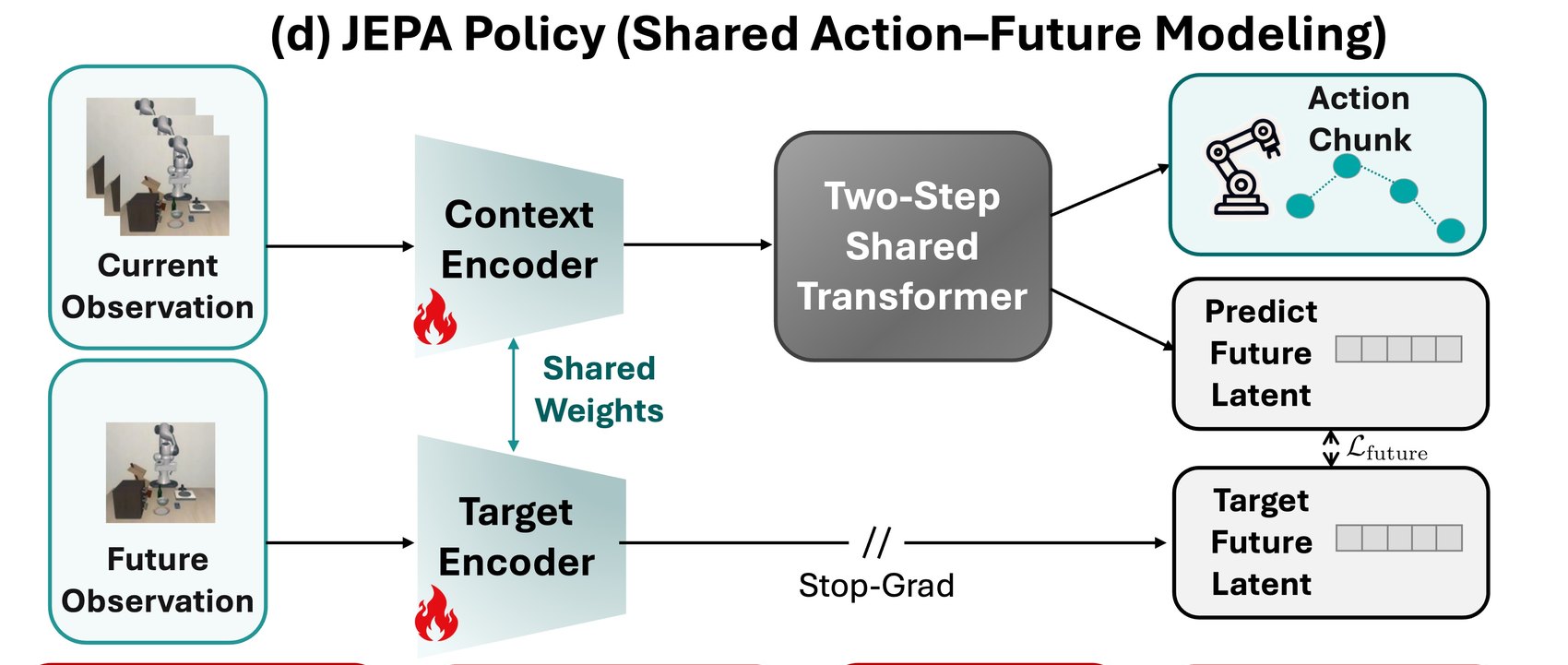
Diffusion policies generate an action by walking a noisy sample backward through dozens of steps. JEPA Policy (arXiv:2609.09630, submitted September 9, 2026) refuses that loop. It trains a shared Transformer on two paired labels: the demonstrated action chunk, and the future observation representation that actually followed it. Two forward passes. No denoising chain.
The project page puts the sim headline at 83.0% mean success across 9 tasks, 3 suites, 3 seeds, +5.6 points over an action-only MIP baseline, with a gain on all nine. Model decision time is 13.2 ms versus 439.5 ms for a 100-step Diffusion Policy on their PPU benchmark. The extra cost over MIP is 0.29 ms.
Shared stack, not an extra head
Action tokens and future-representation tokens sit in the same attention layers. A coarse joint prediction is refined once near the demonstration manifold. Dual-branch and gradient-routing controls, which keep the future loss from shaping the action stack, wipe out the gain. So this is not “add a world-model head and hope.”
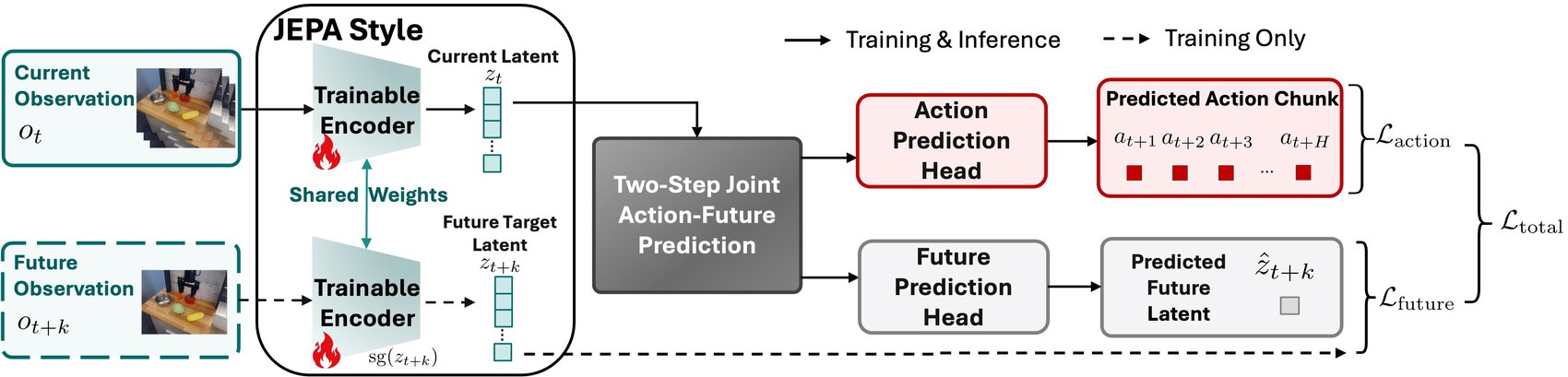
An 84-checkpoint audit finds no complete representation collapse under action supervision. Future-prediction error ranks failures within a task; it is not sold as a universal failure probability.
630 real episodes, same ranking
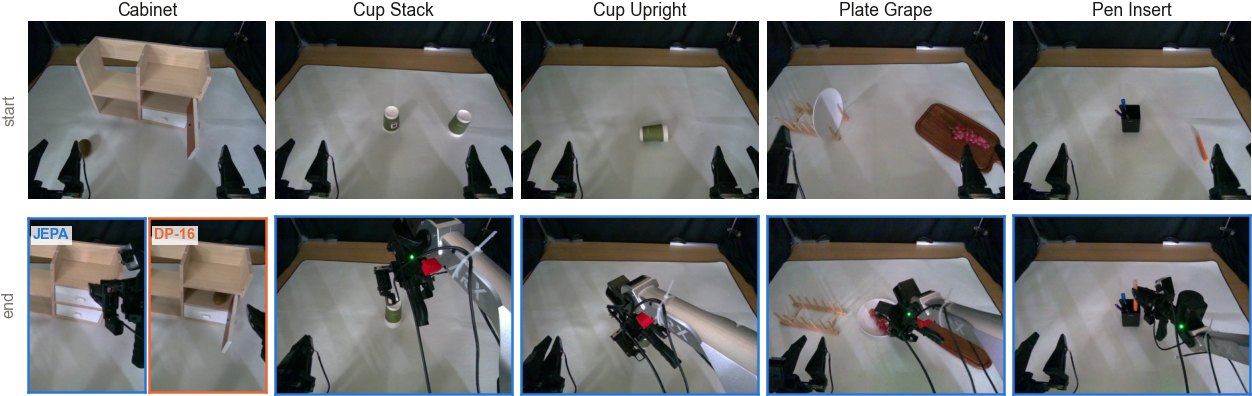
The physical study is 5 tasks on one dual-arm platform: Cabinet, Cup Stack, Cup Upright, Plate Grape, Pen Insert. 63 sessions, 630 episodes, three checkpoints per policy. Success is finishing inside a fixed action-chunk budget. Pooled real success: 66.9% JEPA, 54.7% action-only, 31.8% DP-16. The authors call the real-robot edge over action-only directional at ten episodes per cell. Tool Hang inflates the sim margin over Diffusion Policy. Those hedges are in the paper. Use them.
Code is on GitHub. The claim they actually defend is narrow: paired future supervision inside the action-generating stack raises success without paying a diffusion sampler at 50 Hz.
A Human’s Take
I have been waiting for someone to treat diffusion’s latency as a product bug, not a badge. Two passes and 13 ms is the kind of number you can hang on a 3090 next to a real gripper. The 630-episode study is also the right size: enough to rank methods, not enough to declare a new foundation model. If the future-error signal ever gates a retry instead of sitting in an appendix, then this stops being a clever imitation paper and starts being a runtime.