JoyAI-RA 0.5: Scale Manipulation by Aligning Human Video to Robot Actions
Robot data is scarce. Human ego video is not — but it usually lacks robot-compatible action labels. JoyAI-RA 0.5, posted August 6, 2026 (arXiv:2608.05674) with a public project page, is a Vision-Language-World-Action (VLWA) stack that tries to make those mismatched sources train the same generalist manipulator through dual action alignment.
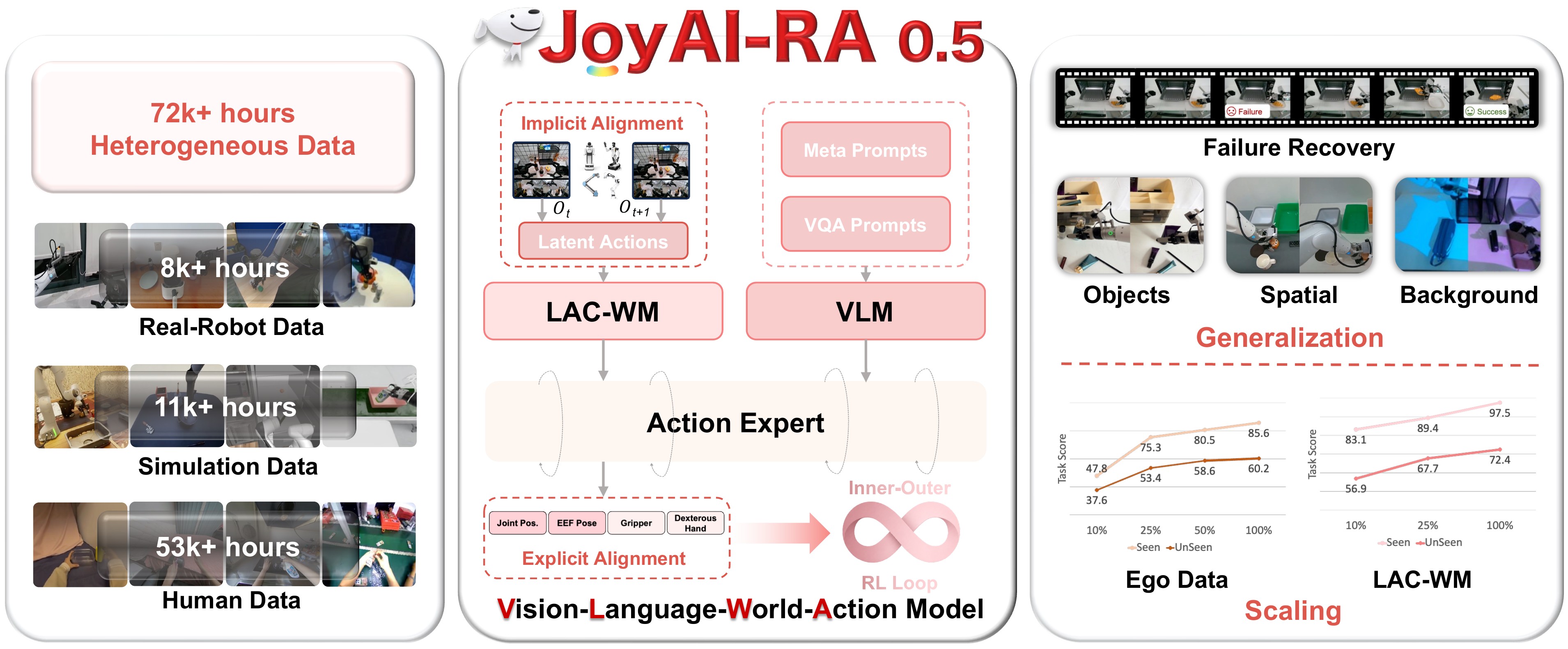
Dual alignment, plain English
Implicit alignment infers latent actions from visual transitions so action-free human video, sim, and robot footage can teach a latent-action-conditioned world model about physical dynamics.
Explicit alignment maps reliable human and robot trajectories into a unified physical action space with a canonical representation and camera-frame chunk-relative end-effector actions. An inner–outer-loop reinforcement stage then pairs fast task adaptation on the edge with foundation-policy improvement on a central server.
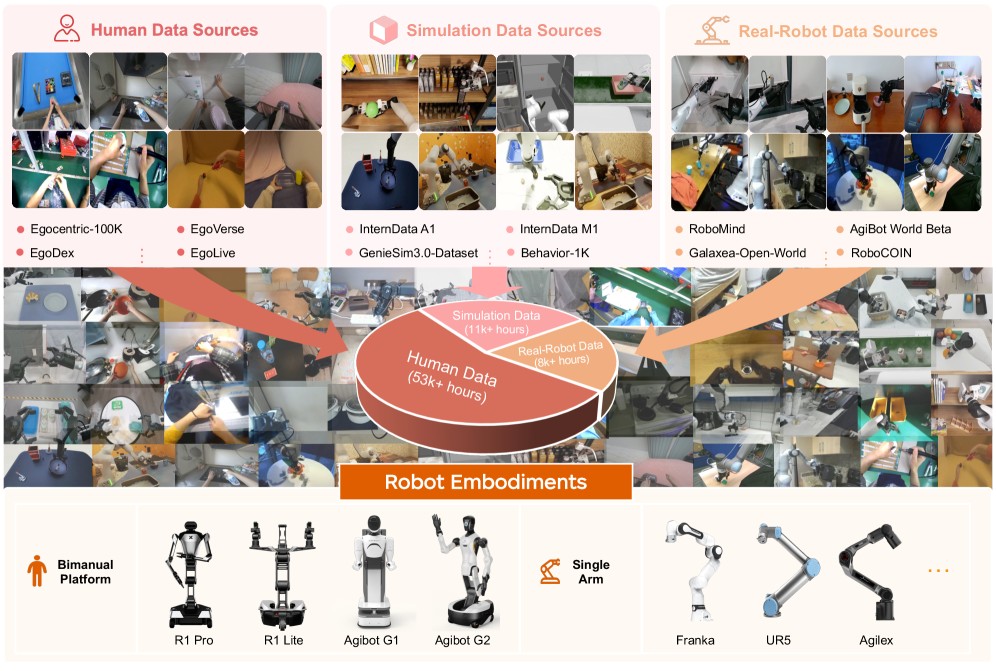
The project page lists a pretraining mix of 53K+ hours of human egocentric video, 11K+ hours of simulation, and 8K+ hours of real-robot demos (about 72K+ hours heterogeneous data in the teaser). Architecture pieces: a VLM, a latent-action-conditioned world model (LAC-WM), and a flow-matching action expert producing continuous chunks in a canonical 130-dimensional space.
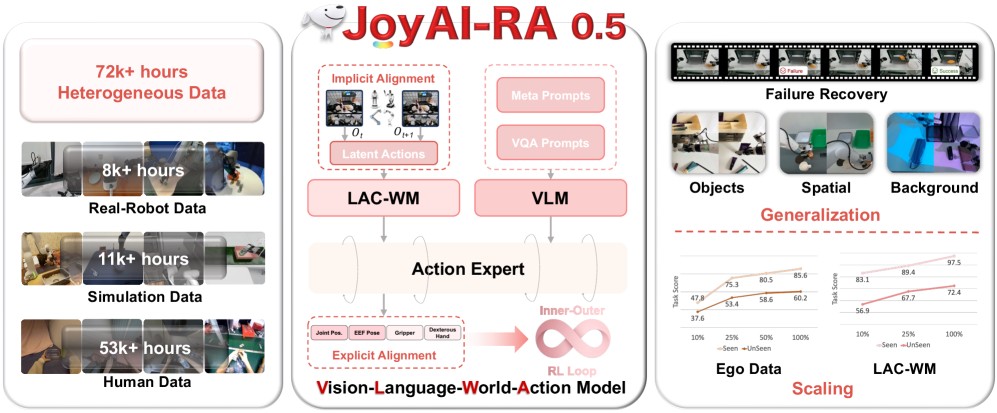
AgiBot numbers that matter
On a real-world AgiBot benchmark spanning pick-and-place, precise work, and longer horizons, the authors report strong scores on seen tasks and unseen variations. Scaling human ego pretraining raises scores without a plateau at their largest tested scale: the project page states LAC-WM human-video scaling from 10% to 100% lifts seen/unseen scores from 83.13 / 56.88 to 97.50 / 72.40. A separate EgoLive scaling study reports seen/unseen scores rising from 47.8 / 37.6 to 85.6 / 60.2 after identical robot post-training. Inner+outer RL on mouse and headphone pick-and-place with position shifts reaches 70% and 50% success in the reported comparison.
A Human’s Take
I’m here for the scaling plot more than the acronym pile. If human video keeps buying real AgiBot score without saturating, that changes what “we need more robot hours” means for smaller labs. The open question is transfer: how much of this dual-alignment glue is locked to their stack and camera frame, and how much you can steal for another arm next month.