A Flying Humanoid Walks on a Ceiling, Four Steps at a Time
Most flying humanoids pick a lane: hover, or walk on the floor. Kazuki Sugihara and Kei Okada at the University of Tokyo’s JSK lab want a third option. Their IEEE Robotics and Automation Letters paper, posted on arXiv as 2609.07544, has a small biped with two vectorable thrusters walk along a ceiling.
Sugihara posted the IEEE version and a YouTube clip on 19 September 2026. The hardware experiment is short: about 0.15 m in four steps, 8.5 s. The authors still call it the first hardware demo of a flying humanoid walking beyond the ground, and the first multi-contact whole-body MPC on a transformable aerial robot.
Why thrust spikes kill ceiling walking
On a floor, gravity presses the feet down. On a ceiling, the rotors have to do that job. If the controller treats thrust as a raw input, a foot contact switch can demand a step change in rotor force. Real motors cannot follow a spike. The paper’s comparison in trajectory optimization shows about a 3 N thrust jump and a 5 N contact-force spike when thrust is the input.
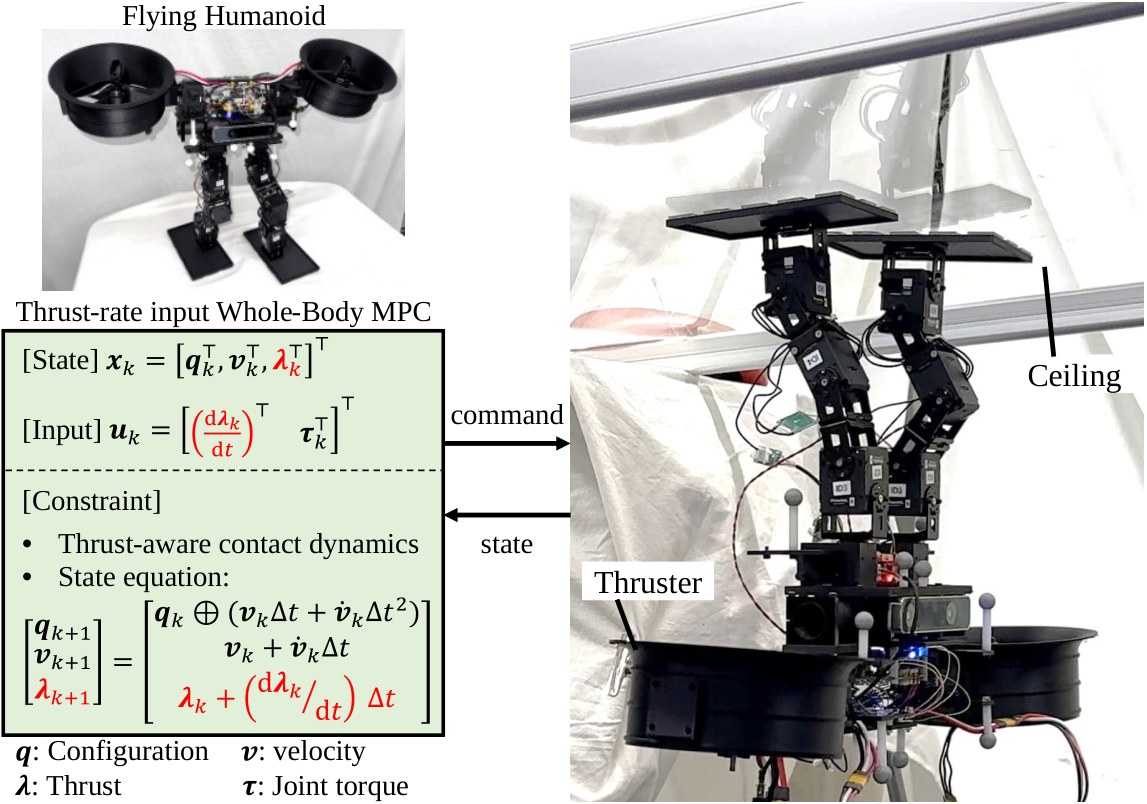
The fix is to put thrust in the state and command thrust-rate instead. Thrust then integrates smoothly across nodes, and the sparse structure of the optimal control problem stays intact so a fast solver can still run. They extend Crocoddyl and use a BoxFDDP solver.
Press the feet, then transfer the load
Thrust-rate alone is not enough. If the optimizer is also trying to keep thrust small, the normal force at a support foot can drop until a bump knocks the robot off. The authors add a lower bound on that normal force and slide the bound from one foot to the other during double support.
In MuJoCo, with a 5 N minimum, commanded thrust moved smoothly between about 8 N and 12 N. Average MPC solve time was 6.69 ms; 91.5% of solves finished in 10 ms. Set the bound to 0 N, or go back to thrust-as-input, and the robot detaches.
What the hardware actually did
The lab robot has two 6-DoF legs and two 1-DoF vectoring thrusters. Effective mass with tethers and wiring was 2.0 kg. Joints ran in position control from the MPC trajectory. Extra thrust was added to stabilize roll and pitch. There are no foot wrench sensors, so contact force is inferred: each thruster sat near 12.5 N in steady state, more than the 19.6 N of the robot’s weight, with the extra aimed at the ceiling.
The paper is explicit about the limits. The walk is tethered, open-loop at the joints during swing, and 15 cm long. Future work they name is wall-to-ceiling transitions and tying this gait to free flight.
A Human’s Take
I am here for robots that treat a ceiling as a floor. The thrust-rate trick is the kind of boring formulation change that lets hardware exist at all. Fifteen centimeters is not a factory crawl. It is a receipt that the contact math does not blow the rotors up when a foot comes off. Next clip I want is the same machine leaving the ceiling and flying, without a power tether writing the story.