KC-SVSDF Plans Mobile Manipulators With Weird Payloads
Moving a water bottle is a solved demo. Moving a T-shaped carbon-fiber spar or a long rectangular panel through a forest of poles is where sphere-approximated planners give up.
arXiv:2608.07005 (submitted Aug 7, 2026) from the University of Hong Kong team led with equal contribution by Yisheng Li and Longji Yin (corresponding: Fu Zhang) presents a real-time whole-body planner for mobile manipulators carrying arbitrarily shaped payloads, built around a Kinematically-Coupled Swept-Volume SDF (KC-SVSDF).
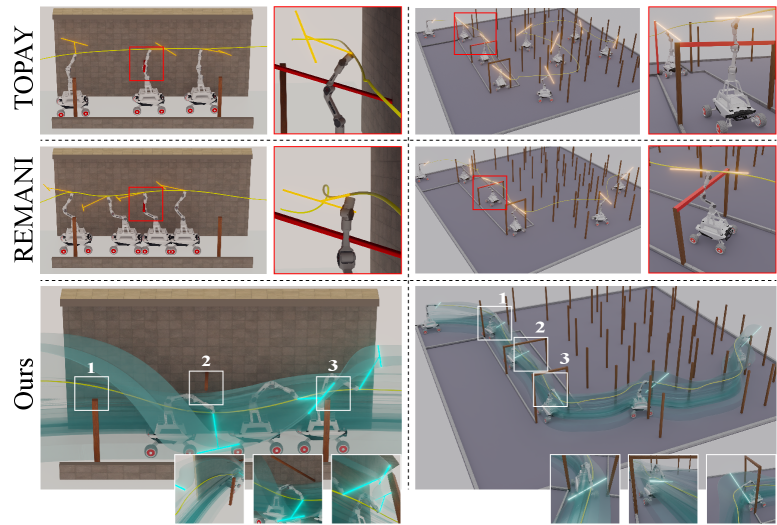
The failure mode they fix
Standard optimizers wrap robot and payload in bounding spheres and query an ESDF. That wastes free space and rejects valid paths when the load is large and non-convex. Single-body swept-volume SDFs fix geometry for one rigid body, but on a serial arm each link’s “escape” gradient can shove an upstream link into a new collision and stall the solver.
KC-SVSDF walks the kinematic chain and forces escape directions to stay consistent with upstream joints before accepting a per-link distance.
Pipeline
Three stages:
- Front-end — chain-decomposed bit-packed kernels for true geometry; Hybrid A* base search + multilayer constrained RRT*-Connect for the arm (whole-body RRT* fallback).
- Mid-end — cheap smooth, kinematically feasible trajectory that can run as-is if still collision-free.
- Back-end — full optimization with KC-SVSDF safety when the mid-end needs repair.
Hardware in the paper: Agilex Scout Mini base, Agilex Piper 6-DoF arm, Livox MID-360 + FAST-LIO2, ROG-Map occupancy, running on an Intel NUC (i7-1360P, 32 GB).
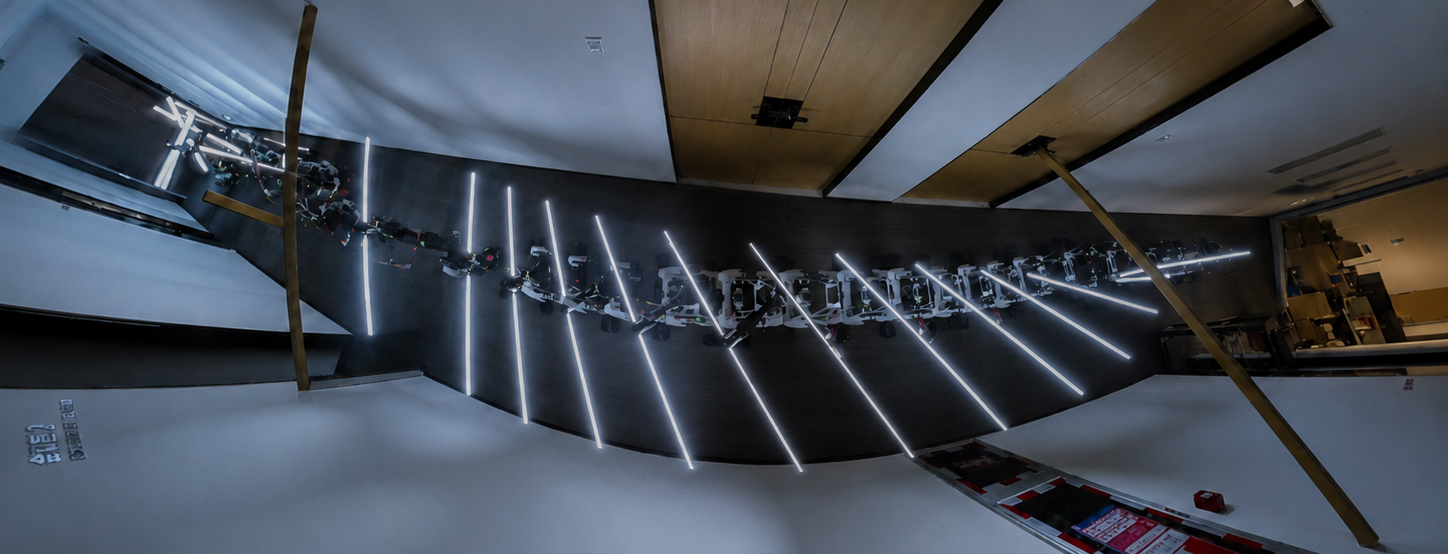
Numbers from the paper
Simulation (100 trials per scene). Baselines in Table III:
- Tunnel: TOPAY 23% success / 7878 ms total; REMANI 29% / 11225 ms. Proposed method: 4162 ms total, and the paper reports the highest success rate in the comparison (exact percentage not parsed cleanly from the HTML table layout).
- Forest: TOPAY 25% / 23178 ms; REMANI 17% / 31440 ms. Proposed method: 13613 ms total, again highest success per authors.
Ablation on bridge clearance (20 trials per height): with KC-SVSDF, success holds at 80% at 0.8 m bridge height; independent per-link SVSDF drops to 0% at that height under the same time budgets (front-end ≤80 ms, optimization ≤300 ms).
Authors state code will be publicly released.
A Human’s Take
If your “mobile manipulator” only plans as if the payload is a tennis ball, you do not have a logistics robot—you have a demo. Coupling collision gradients through the arm is the unglamorous fix that decides whether a door panel fits a 90 cm gap. I’ll watch the open-source release and whether mid-end shortcuts still hold when the map is messier than wooden poles.