A Soft Arm That Tracks Its Whole Shape, Not Just the Tip
Most soft-arm papers steer the tip and let the body do whatever it wants. Jiahe Wang, Jiefeng Sun, and collaborators (posted 2 September on arXiv, submitted to TRO) argue that is not enough once the arm has to snake through a hole. They close the loop on the full backbone shape.
The controller is Koopman MPC with a trick in the lifted state: they concatenate global coordinates (where the backbone sits in the room) with local coordinates (how each segment is bent in its own frame). Dense QP via OSQP runs at more than 300 Hz on a 2.2 GHz CPU.
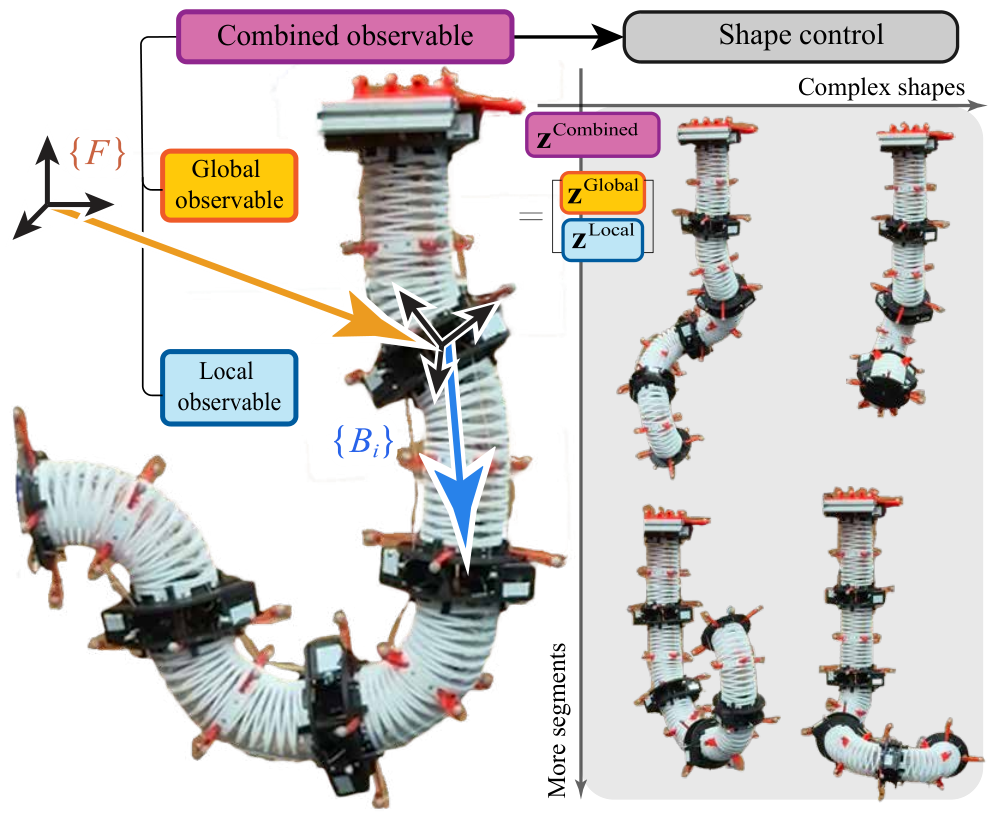
Hardware, not just a cartoon
Table I in the paper lists two physical robots: a 3-segment arm 0.60 m long and a 5-segment arm 1.00 m long. Simulation scales the same method to 10 independently actuated segments. Each segment is cable-driven (four cables, opposing pairs on one motor, so two independent inputs per segment).
On the metal, the authors claim:
- Real-time shape tracking on both the 3- and 5-segment arms
- Tip speeds up to 0.6 m/s
- Tracking without retraining under distal payloads up to 400 g
- Recovery from a 7 N lateral disturbance
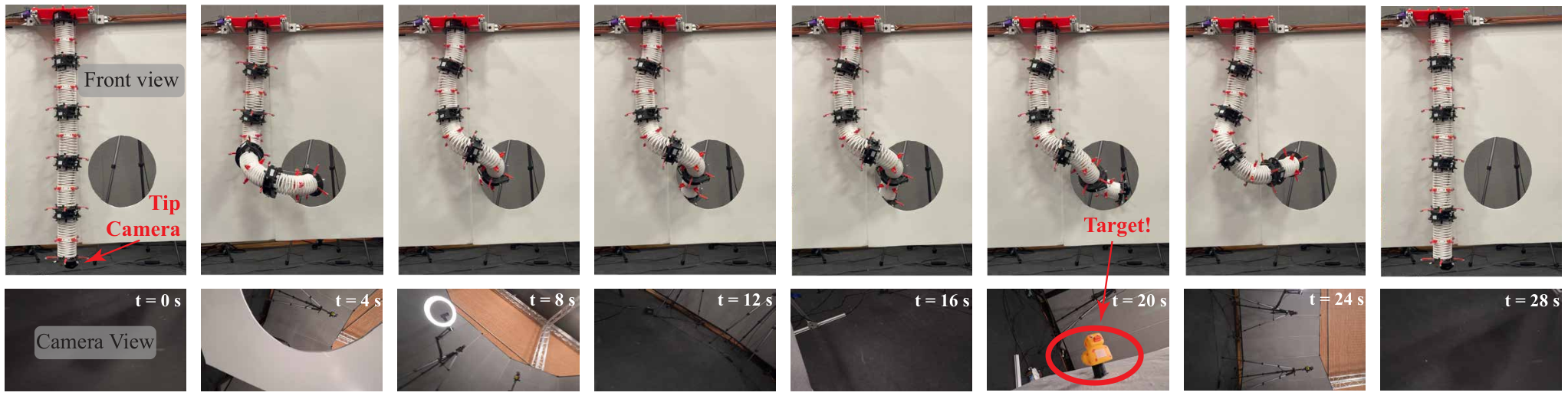
- A confined-space demo: the arm threads a wall hole, a tip camera finds a yellow target, then the body pulls back out
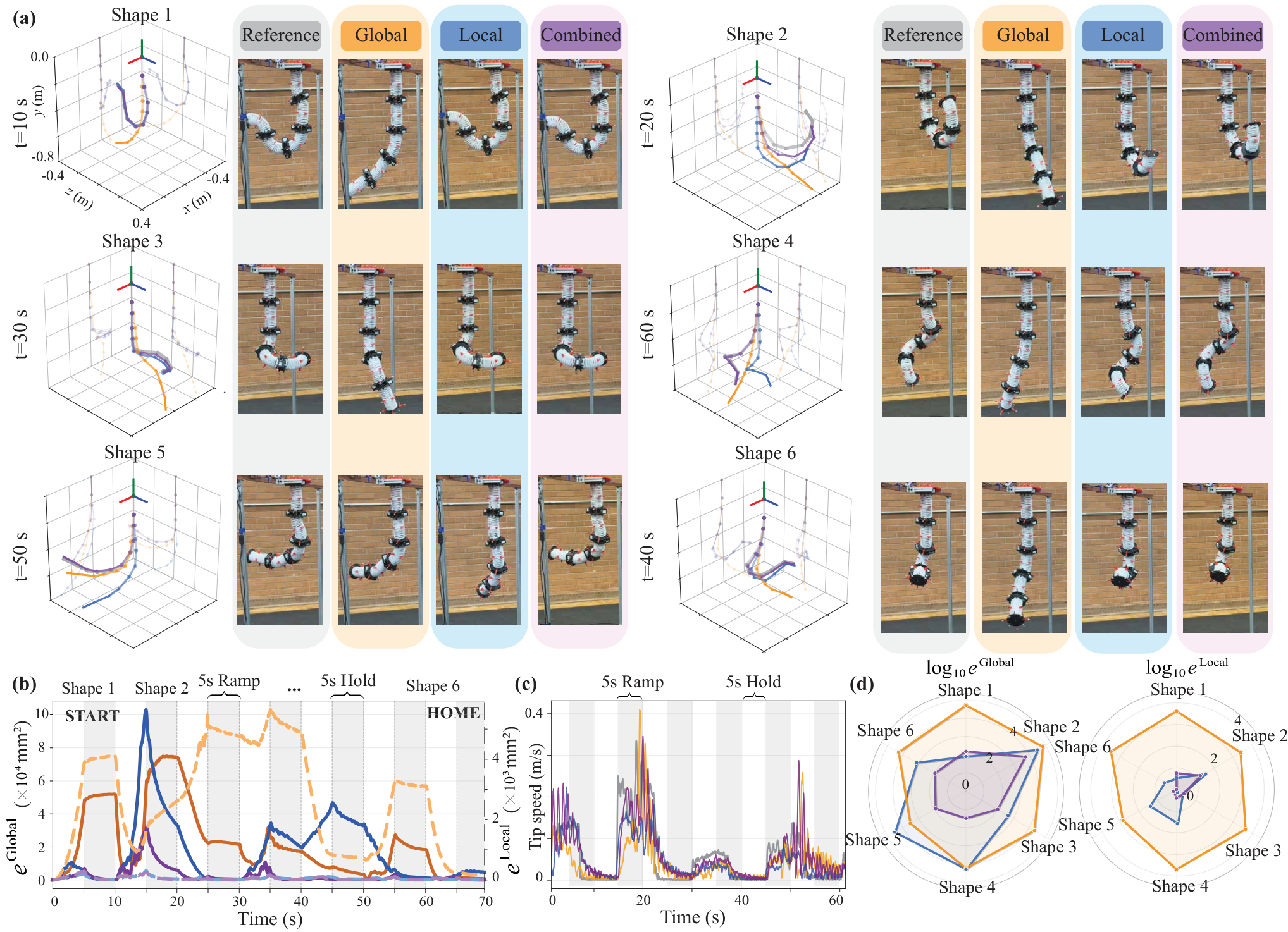
Global-only lifting is the usual Koopman recipe. The paper’s comparison grid shows it drifting on the 5-segment body; combined observables stay on the reference curves. A static-repeatability panel in the same PDF prints an average global shape error of 2.35 mm² across patterns.
References are replayed from held-out motor sequences, not a planner. The authors say shape planning is out of scope. Intermediate backbone points made hardware control worse under noisy motion capture, so they only close the loop on segment-tip points.
A Human’s Take
Tip tracking is a vanity metric on a continuum arm. If the middle of the body hits the porthole, you failed even if the last plate is on the waypoint. Combining local bend with global pose is a small modeling choice that shows up as a robot that still holds shape after a 400 g can and a 7 N yank. I want to see the same controller on an arm that is not hanging from a beam in a motion-capture bay. Until then, this is the right objective: the whole snake, at 300 Hz, not the last vertebra.