Lambda-Hold Learns a Human-Like Sprint From Velocity Alone
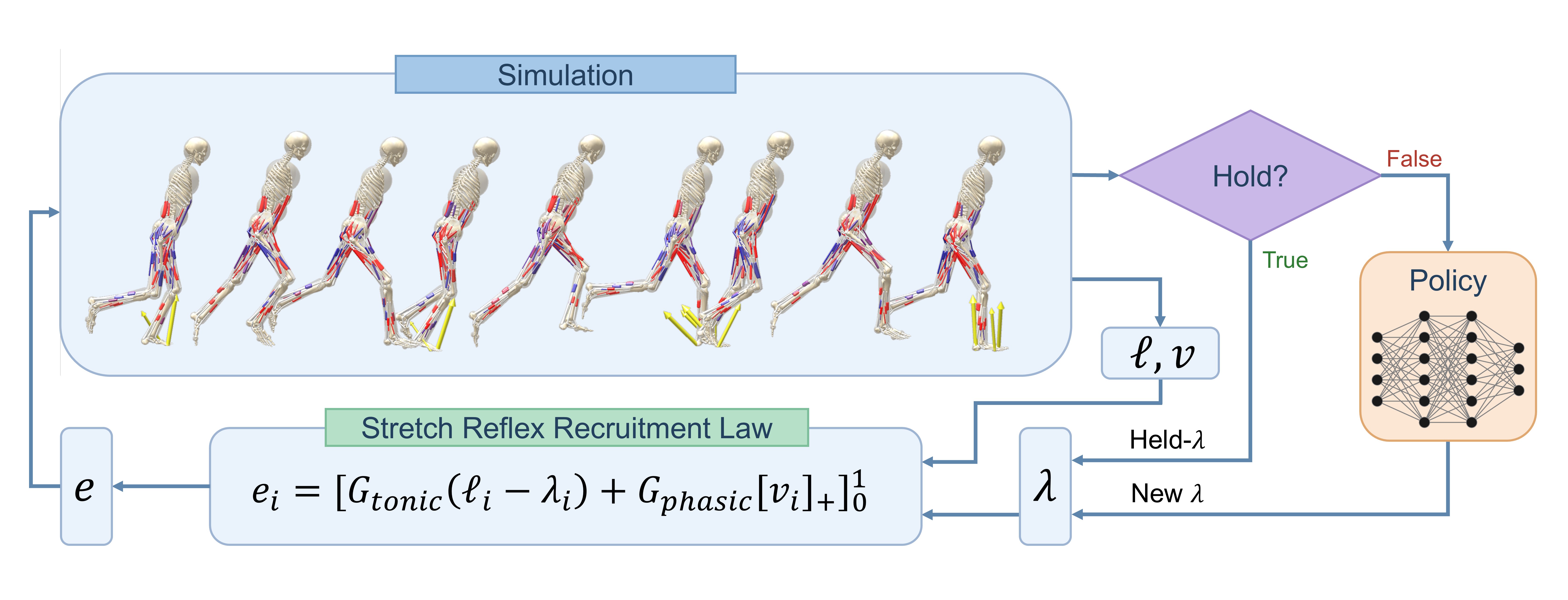
Muscle-level reinforcement learning is usually a mess. Ninety actuators, a many-to-one map to joints, and Gaussian noise that cancels itself. Jun Hyuk Lee, Chihyeong Lee, and Jooeun Ahn at Seoul National University change the command. The policy does not output excitations. It outputs a per-muscle equilibrium-point threshold λ, then a stretch-reflex law turns length and velocity into drive.
They hold each λ across a gait-phase interval so the policy is queried only at sparse ground-reaction events. On the H2190 model — 21 mechanical DoF, 90 muscle–tendon units, simulated in SCONE/Hyfydy — that is enough to learn a coordinated sprint from a forward-velocity reward plus a small lateral penalty. No motion-capture imitation, no metabolic-cost term, no symmetry reward.
An hour, not a week
The authors call this the first human-like sprint in a predictive musculoskeletal simulation under that minimal reward. On their workstation (RTX 5070, 24-thread Ultra 9), a sprint around 4.0 m/s shows up in about an hour of wall-clock training. Peak speed reaches about 4.7 m/s.
Decision points fire when vertical GRF on either foot crosses 0.05 body weight (strike or toe-off), plus one sub-point in between, with holds clamped to 0.05–0.15 s. Reflex gains are shared: tonic 50, phasic 0.1. λ is boxed to [0.6, 1.2].
Against Plain SAC, excitation-hold, DEP-RL, and a 30-D synergy baseline, λ-hold pulls away within the first 10 million simulation steps. Plain SAC and synergy stall after a step or two and a dive. DEP-RL later walks at about 2.6 m/s with a forward lean. Excitation-hold, which repeats raw excitations on the same schedule, sits an order of magnitude below λ-hold on return. The extra lift is the threshold variable, not just holding.
How human-like
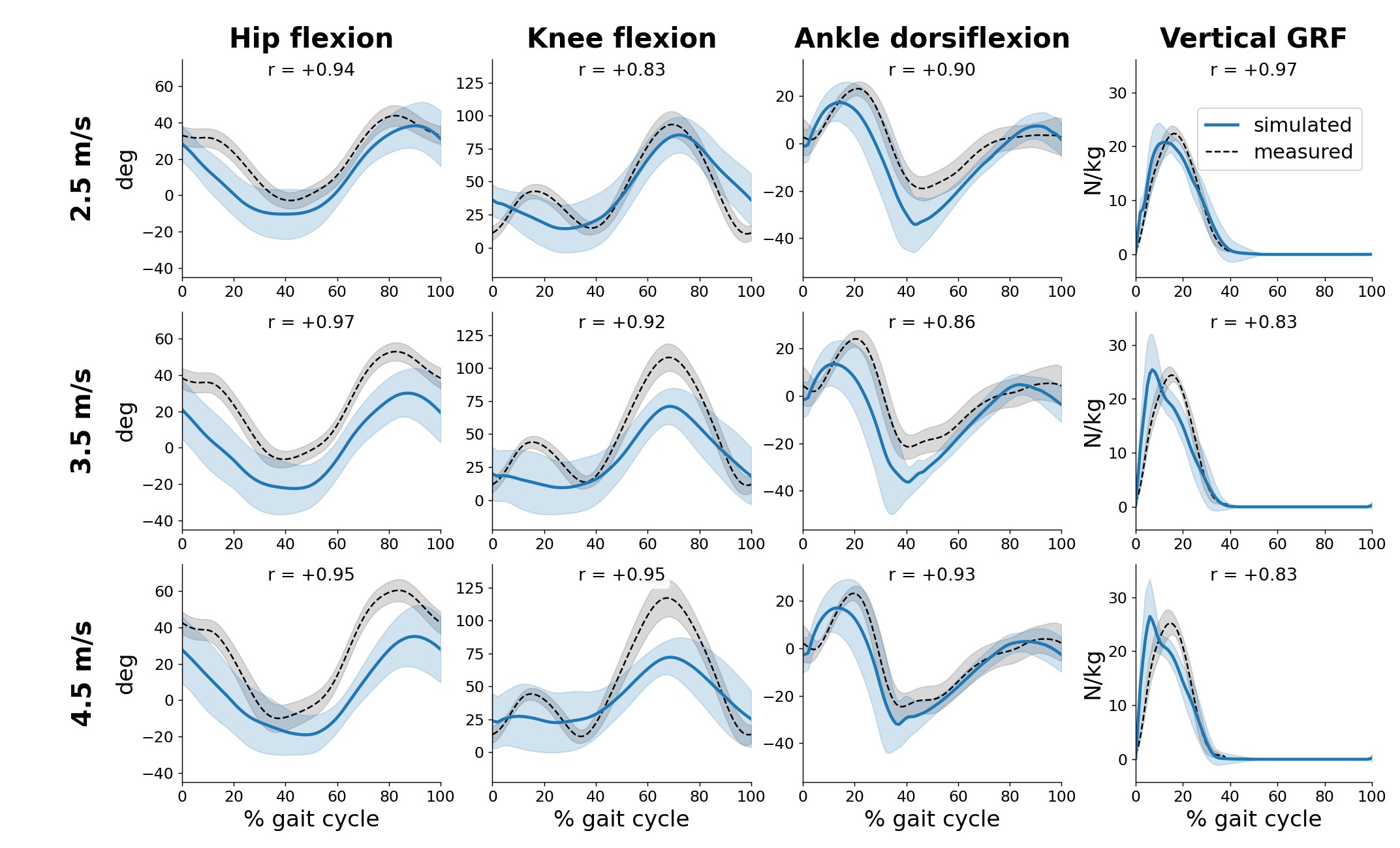
Sagittal angles and vertical GRF follow human treadmill shapes from Fukuchi et al. at 2.5, 3.5, and 4.5 m/s. Hip and knee swing flexion lag the human as speed rises. Muscle activations versus 5.0 m/s surface EMG average r = +0.42. Plantarflexors match well (soleus 0.80, gastroc med 0.87); tibialis anterior goes the wrong way in swing (−0.44).
Joint-velocity coverage finishes about 2.5× DEP-RL and about 7× Plain SAC. Code on the project page is still marked TBA; videos are up.
A Human’s Take
I like controllers that steal a spinal reflex instead of another reward term. If the skeleton couples the muscle lengths, you should not have to invent synergies by hand.
This is still a sim sprinter, not a robot. The useful transfer, if it comes, is to humanoids that are overactuated and slow to explore. An hour to a gait is the number I want other labs to try to beat.