LD4WAM Learns Robot Actions From 5,000 Hours of Human Video
World action models like to predict the next pixels, then hope an action head can read them. LD4WAM tries a middle language: motion-aligned latent dynamics, trained on semantic features and real end-effector deltas, then handed to the action expert through learnable queries.
The pretrain set is 274.66 million frames, 5,086 hours at 15 fps, 76.4% human and 23.6% robot, cleaned into LeRobot format. On RoboTwin the paper reports 93.4% average success. In the real world, across seven gripper and dexterous-hand tasks, the average is 70.5%, ahead of π0.5 (63.3%), Lingbot-VA (64.3%), and Fast-WAM (47.1%). Best on six of the seven tasks.
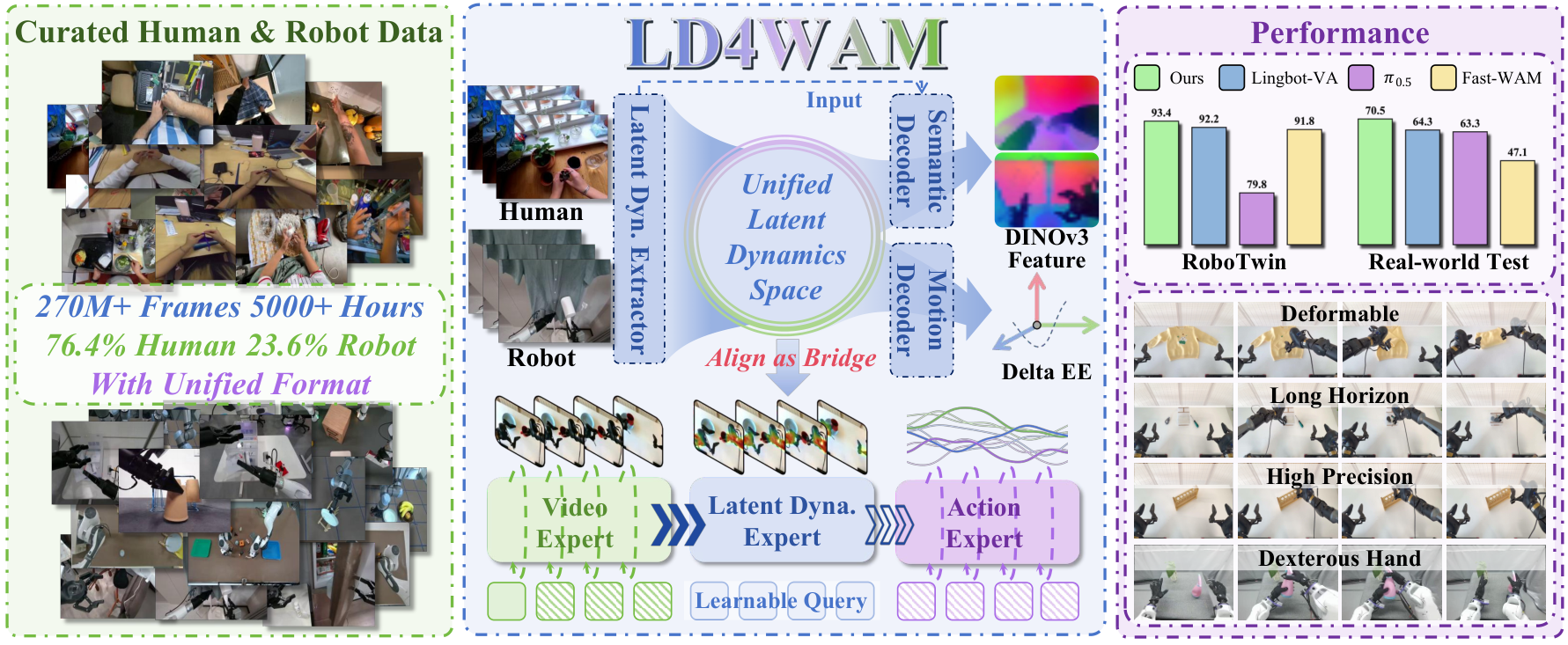
Do not reconstruct pixels. Reconstruct motion.
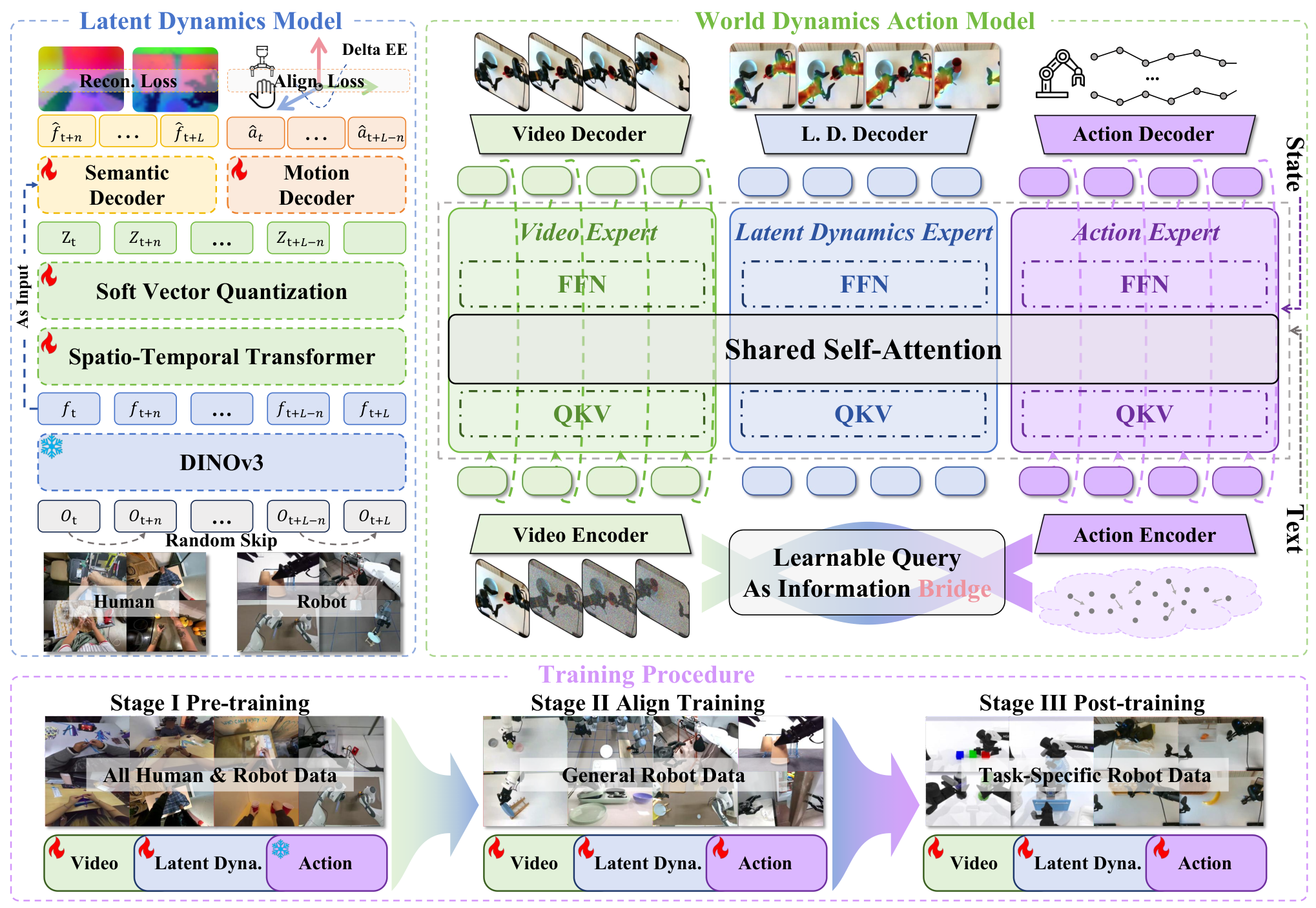
A frozen DINOv3 encodes frames. A transformer plus soft vector quantization writes a latent z for what changed. One head reconstructs future DINO features. Another predicts camera-frame end-effector delta, but only on clips that have action labels. Ablating motion alignment inflates a probe MSE 3.7–5.0×. Pixel reconstruction and hard VQ also hurt.
The World Dynamics Action Model is a mixture of transformers: a Wan2.2-initialized video expert, a latent-dynamics expert, an action expert. Attention is one-way: video → latents → action. Stage I trains video and latents on all data with the action expert frozen. Stage II aligns on robot data. Stage III post-trains per task.
Hands and shirts, not only sim
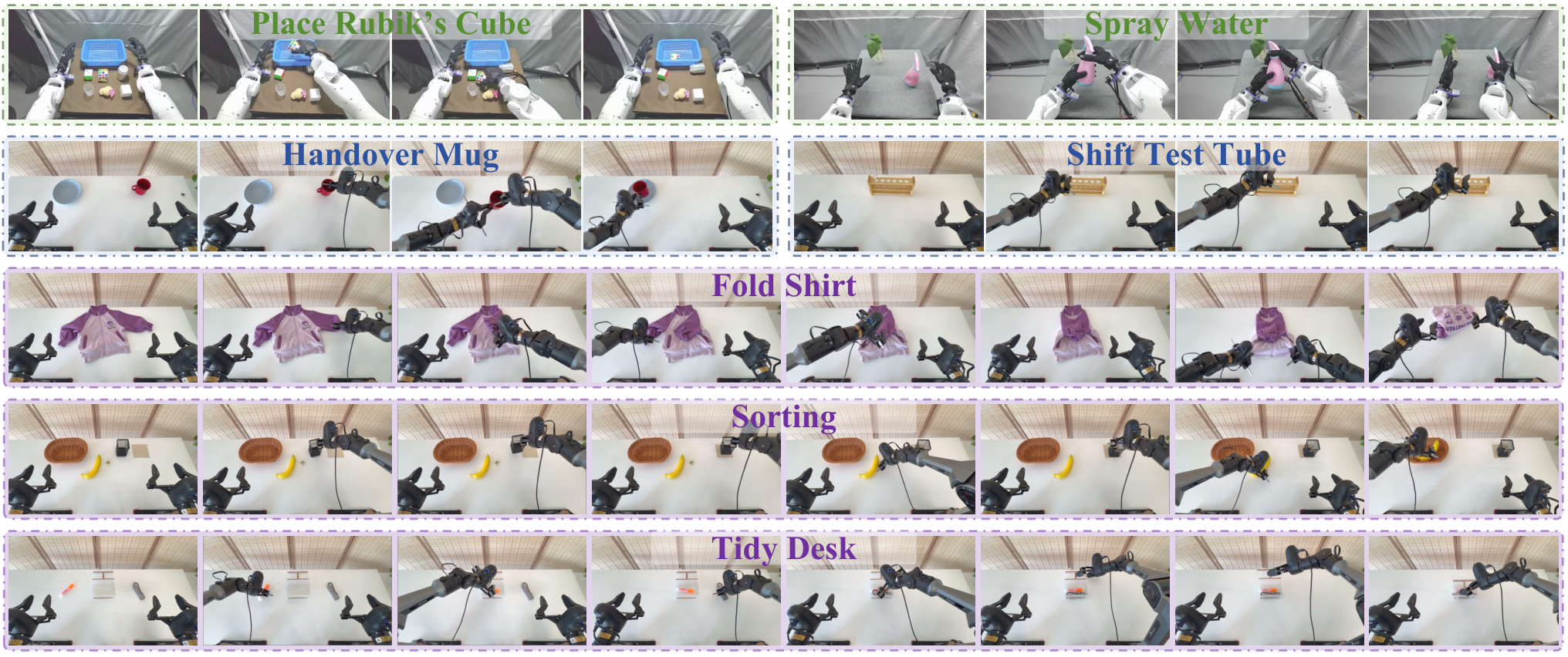
Real robots: dual-arm PIPER with parallel grippers, and a dual-arm Tianji with Wuji dexterous hands. Tasks: sort, insert a test tube, tidy a desk, fold a shirt, hand over a mug, place a Rubik’s cube, spray a bottle. Fifty demos per task, 30 rollouts per setting.
Unseen objects keep 88.6% of in-distribution performance, the best retention in their table. Unseen backgrounds are harsher: 44.4% versus π0.5 at 54.5%. The authors blame the world-action loop: the action head is conditioned on generated video, and new table texture is exactly what video models miss.
A retrieval figure in the paper shows human-hand clips and robot-arm clips landing as neighbors when the motion matches. That is the claim: the latent cares about the move, not the skin.
A Human’s Take
Five thousand hours is a serious pile of egocentric video. The number I trust more is the background drop. If your policy reads a dreamed future, a new tablecloth can still wreck the action. Motion alignment helps. It does not delete appearance. That is a fair paper, and a reminder that “just add human video” is not a complete recipe.