LIBERO-Recover Asks If the Arm Can Get Up After It Drops the Bowl
LIBERO scores near 100% have been the victory lap for vision-language-action models. LIBERO-Recover, posted 4 September as arXiv:2609.05178, is the hangover. The authors collect failures that actually happened during SOTA rollouts, then ask whether the policy can finish the original task from that mess.
The project page counts 2,178 recovery scenarios across 130 subtasks in four LIBERO suites, plus 3,184 human recovery demos (625,731 frames at 20 Hz, third-person and wrist). Four teleoperators used a SpaceMouse. Code and assets are public; the ICLR 2027 paper is still anonymized for review.
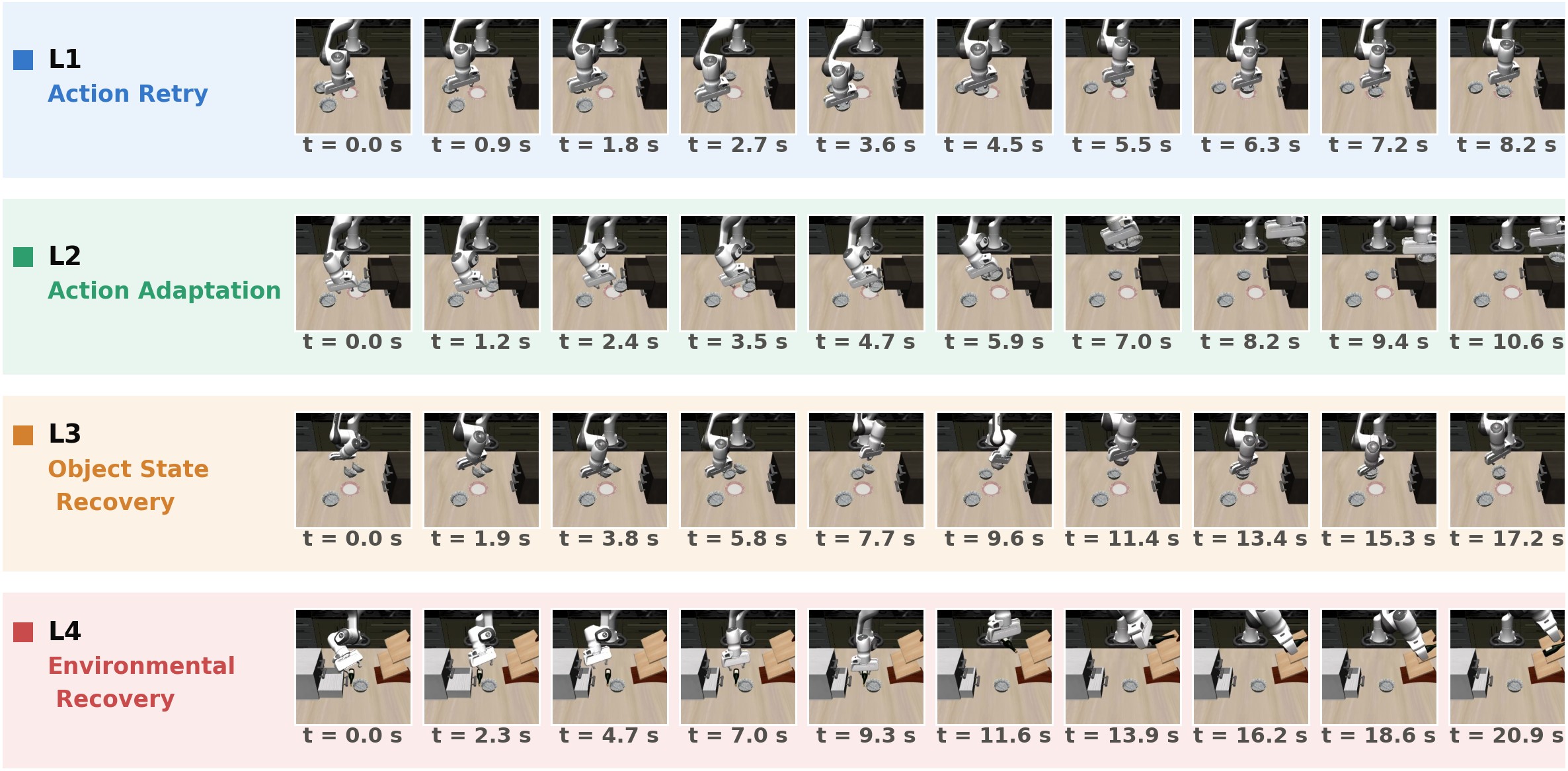
Four levels, not a shove
Failures are not hand-perturbed start states. A VLM localizes the bad moment in the execution video, then the simulator stores the transition. Levels scale the reasoning required:
- L1 Action Retry: the scene is basically intact; grab again
- L2 Action Adaptation: change the next move
- L3 Object State Recovery: put the object back into a usable pose
- L4 Environmental Recovery: undo a blocked drawer, door, or similar scene change
Six models are scored with official configs, 10 trials per task, slight object jitter, and a 1.1× human-completion-time budget: OpenVLA-OFT, π₀-FAST, GR00T-N1.5, π₀, Wan2-Policy, and Cosmos-Predict2-Policy.
Every model drops more than 50% versus clean LIBERO. Rankings flip. Wan2-Policy beats GR00T-N1.5 by +14.40% on LIBERO-100, then trails it by 5.0 points under the matching failures. Averaged success from failure-stage to post-failure: Spatial 15.0% → 6.7%, Goal 35.5% → 4.0%, Object 38.3% → 5.0%, LIBERO-100 26.2% → 0.3%. Those are degradation rates of 51.7%, 87.3%, 88.7%, and 97.7%.
World-action models recover more consistently. Recovery Consistency is 0.884 for Cosmos-Predict2-Policy and 0.870 for Wan2-Policy, versus 0.749–0.798 for the VLAs. Smaller action chunks (4 vs 32) recover better.
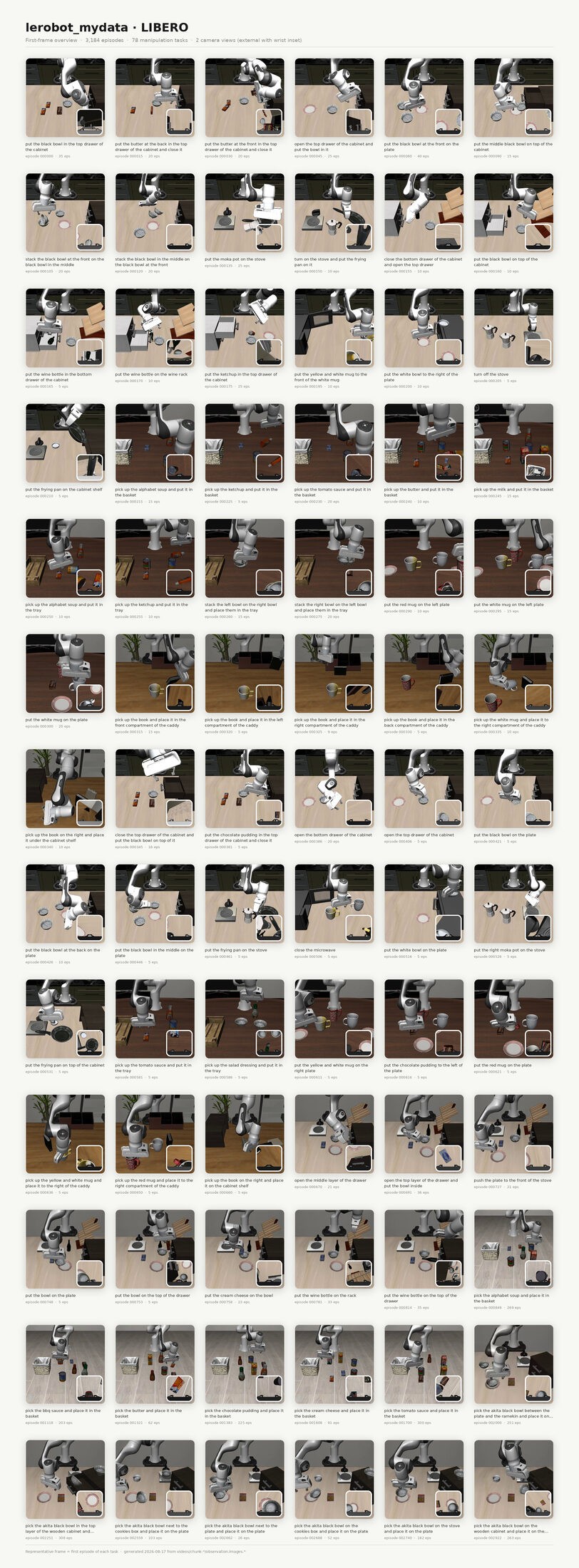
Training on failures is not enough
Joint training on LIBERO plus LIBERO-Recover lifts recovery: GR00T-N1.5 17.8% → 21.2%, OpenVLA-OFT 20.8% → 25.4%. Clean LIBERO barely moves (GR00T 86.5% → 87.2%, OpenVLA-OFT 97.1% → 96.6%). Feeding the task’s initial frame as context helps more on hard suites: OpenVLA-OFT on LIBERO-100 goes 10.3% → 24.7%.
This is a different question than this morning’s FailureSpot post, which timestamps when a VLA starts to fail. Recover asks what happens after.
A Human’s Take
I am glad someone stopped celebrating 99% on a reset table. The useful finding is that L1/L2 look solvable and L3/L4 do not. If your warehouse policy can only retry a grasp, it is not recovering. It is looping.