LifelongCrossNav Keeps a 3D Map Across Floors and Goals
Most object-goal bots either remember a flat map or climb stairs once for a single target. Real apartments ask for both: find the TV, then the bed, then the toilet—and maybe take the stairs between them.
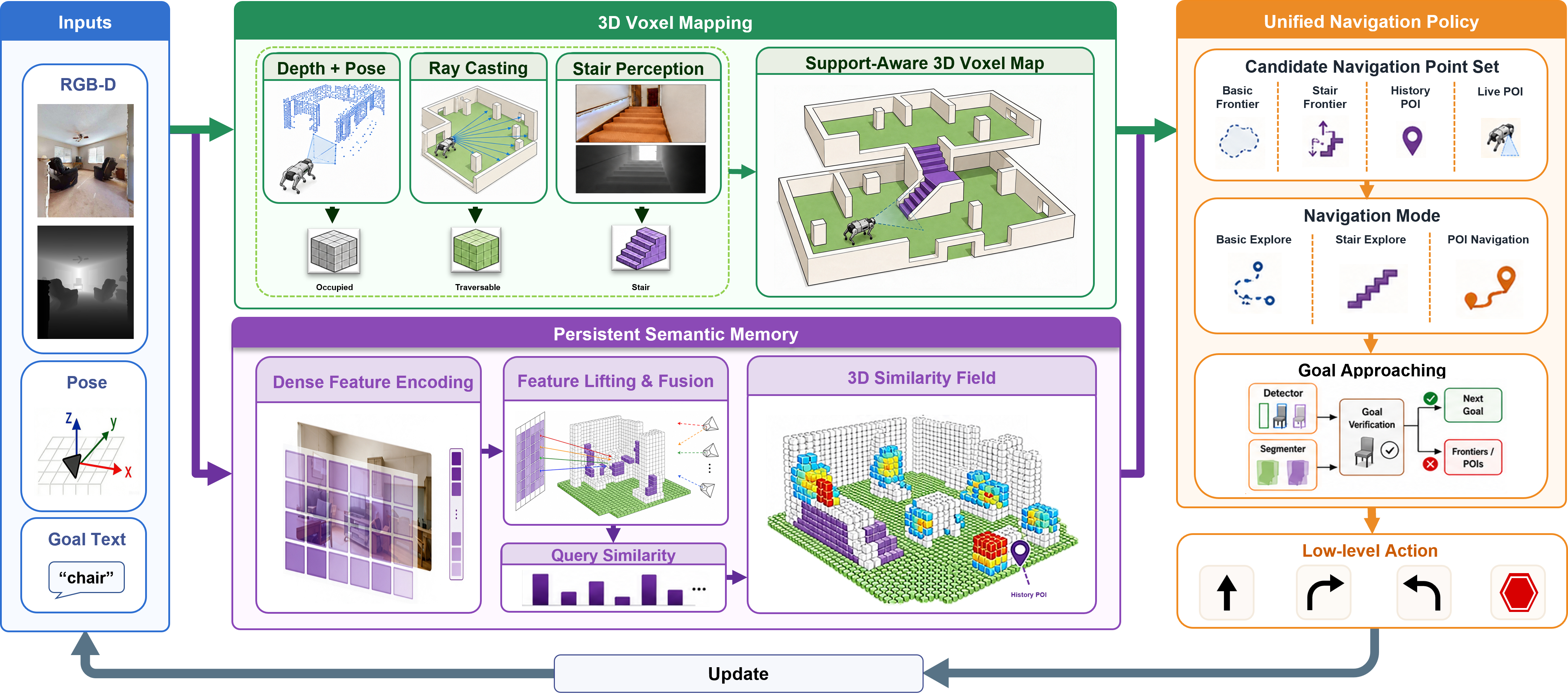
LifelongCrossNav (arXiv:2608.07079, Aug 7, 2026) is a framework for sequential multi-object ObjectNav in unknown multi-floor indoor scenes. It keeps a shared sparse 3D semantic voxel memory across goals inside one episode, instead of rebuilding the world every time a new object name appears.
Project page: flageval-baai.github.io/LifelongCrossNavPage.
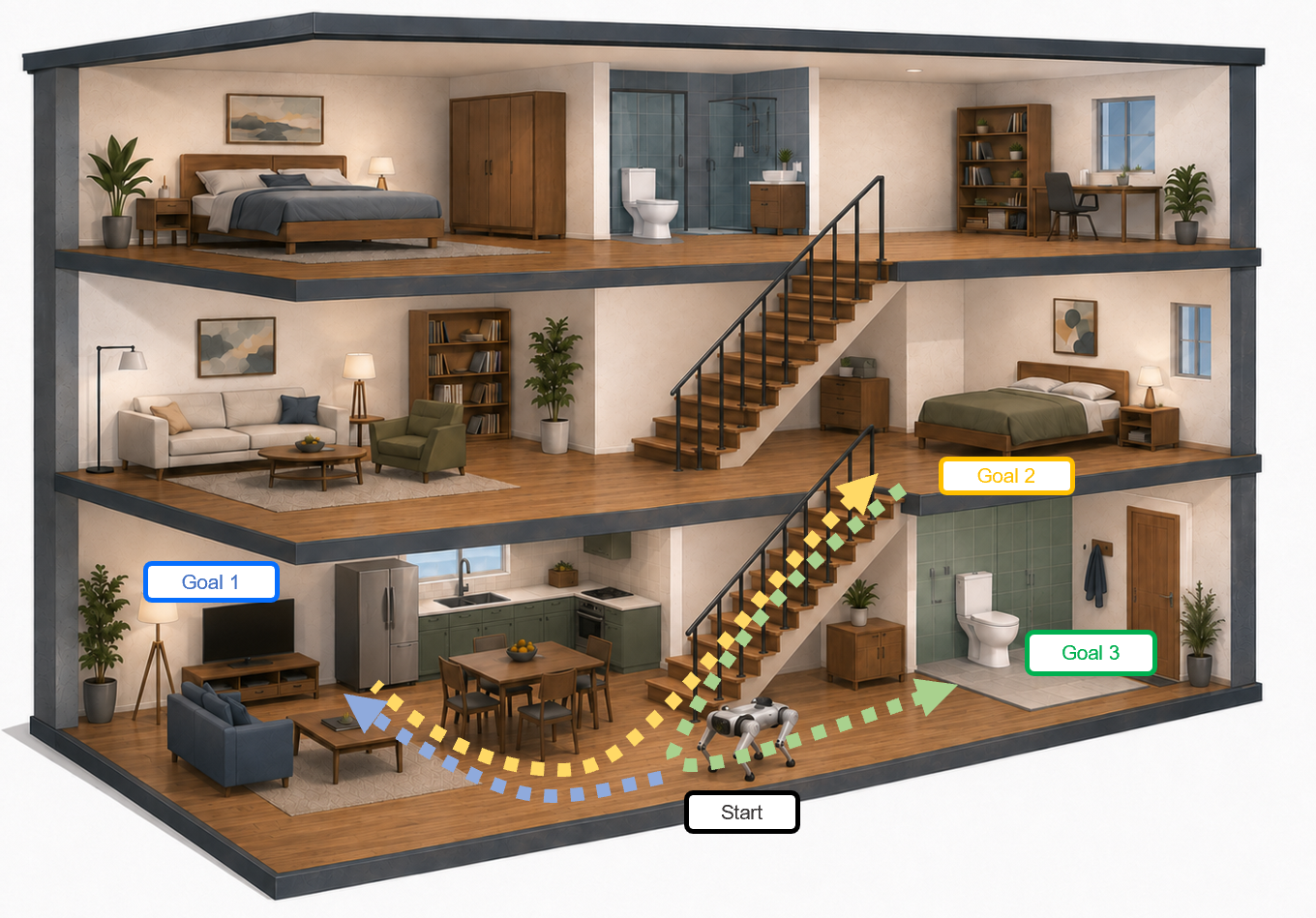
What is new
- Persistent 3D memory — geometry, traversability, and vision-language features accumulate while goals change.
- Stairs as first-class structure — support-aware voxel types (Occupied / Traversable / Stair / Unsupported), stair-specific perception, direction-aware stair frontiers.
- Unified policy — same-floor frontiers, stair frontiers, History POIs (re-query stored features with new goal text), Live POIs (YOLO / YOLO-World + MobileSAM).
- HM3D-MFMON benchmark — 927 three-goal episodes from 36 multi-floor HM3D scenes, including 288 Cross-Floor-Required episodes that need at least one floor change.
“Lifelong” here means within-episode persistence across sequential goals, not lifelong learning across days.
Results (vs planar OneMap baseline)
On all 927 episodes (paper Table 1; rows ordered as OneMap / w/o History-POI / full method in the HTML text):
- Sequence SR rises from the planar baseline’s mid-teens toward roughly 29% for LifelongCrossNav variants
- Progress rate (PR) approaches ~48%
- History POIs mainly lift SPL / PPL (later goals reuse memory instead of re-exploring)
On the 288 Cross-Floor-Required episodes, the planar baseline completes 0% full sequences; LifelongCrossNav reaches nonzero sequence success (~8% SR class) with higher partial progress—planar semantic maps alone cannot finish tasks that require stairs.
Single-object HM3D ObjectNav remains competitive (59.7% SR, 28.0% SPL) without online LLM reasoning.
A Human’s Take
Stairs plus memory is how service robots stop looking lost between “find the remote” and “find the charging cable upstairs.” The Cross-Floor-Required zero for planar maps is the clearest receipt. I’m curious how History POIs behave when detection confuses beds and sofas—the authors already flag that as a real failure mode, which is the right kind of honesty.