Light-Loco-Parkour: One Depth Policy for Walk, Climb, Vault, and Outdoor Stairs
Most humanoid controllers either track flashy whole-body clips on flat floors or do boring walking with perception. Light-Loco-Parkour (LLP) (arXiv:2608.02653) tries to close that gap with one deployable policy: conditioned only on onboard depth and a velocity command, it decides when to walk, climb, step down, or vault — no reference stream, skill label, or runtime motion graph.
Real2Sim2Real, not a motion library dump
The project page frames the hard problem clearly: a parkour motion without its obstacle is only half a demonstration. LLP’s pipeline:
- Recovers interaction intent from a short real seed (e.g. speed vault, reverse vault, climb).
- Grounds it in simulation with obstacle geometry and actuator limits, then expands obstacle height (example cited: a 45 cm seed grown through 75 cm — about 0.83× the 90 cm robot’s standing height).
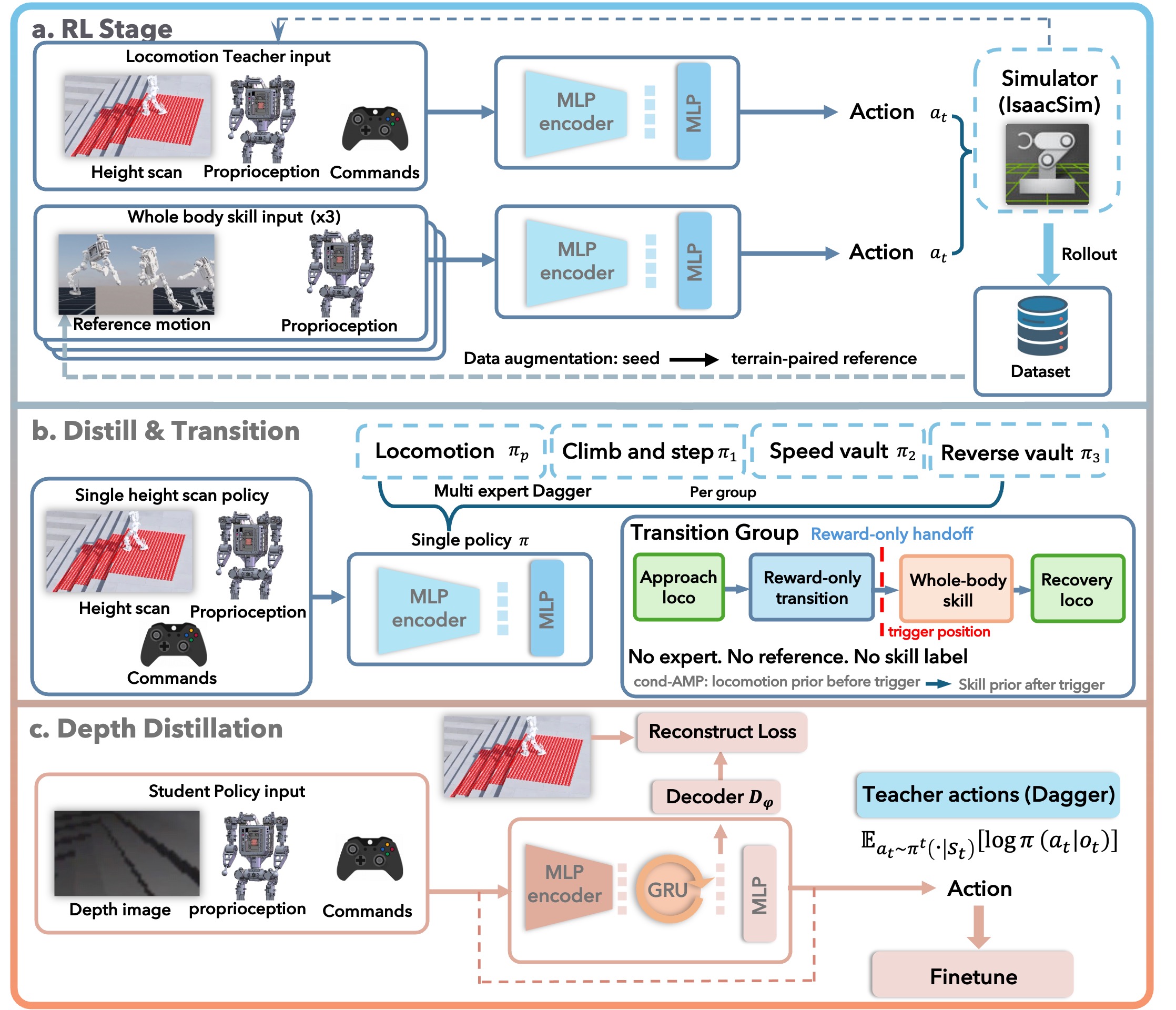
- Distills privileged teachers into one recurrent depth student running at 50 Hz.
Training uses multi-expert distillation plus reward-only transition learning so the policy times skill handoffs from depth and command alone.
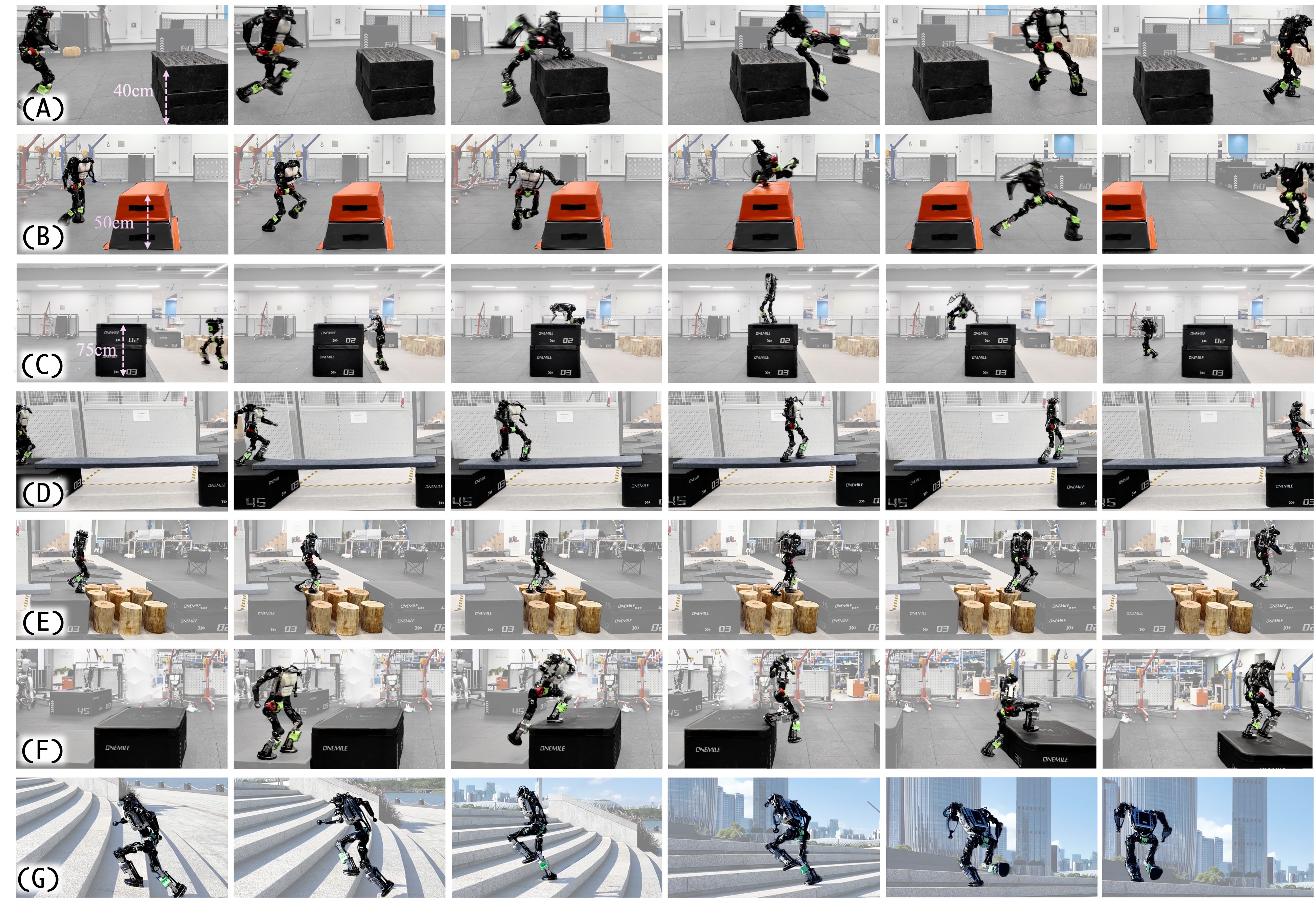
Hardware and results (as claimed)
Lightbot 0 is described as a custom 90 cm, 18.9 kg humanoid with 21 actuated joints. A single recurrent policy runs onboard from a chest depth camera, proprioception, and velocity command — zero-shot transfer in indoor and outdoor hardware clips, per the abstract and project site.
Simulation tables on the project page show high success on core skills for the full system, large drops when recurrent memory is removed, and a steep cliff at the 75 cm frontier for the deployable policy versus privileged teachers. Transition training lifts end-to-end handoff success from 33% (isolated skills) to 98% in their 100-trial setup.
A Human’s Take
Parkour is still a stress test, not a product roadmap — but “one policy, depth only, decides the handoff” is the right product shape if you want robots in human geometry. The height-curriculum idea is honest engineering: stop pretending one mocap clip is an operating envelope. I’d want field hours on wet outdoor stairs and true multi-obstacle courses before calling this deployment-ready.