A LimX Biped Reaches High and Low From One End-Effector Command
Most loco-manipulation stacks still want a base-velocity command and an arm target. A ZJU-UIUC Institute team with Hua Chen at LimX Dynamics posted a controller that takes only a 6-DoF end-effector pose. The legs decide whether to stay put, squat, or take a step.
The body is a LimX TRON 1 biped with an ARX L5 arm, a GENROBOT UMI gripper, a Livox Mid-360 LiDAR, and a Jetson Orin NX. Fourteen joints: eight in the legs, six in the arm. FAST-LIO2 handles localization. Policy rate is 50 Hz; PD tracking is 500 Hz.
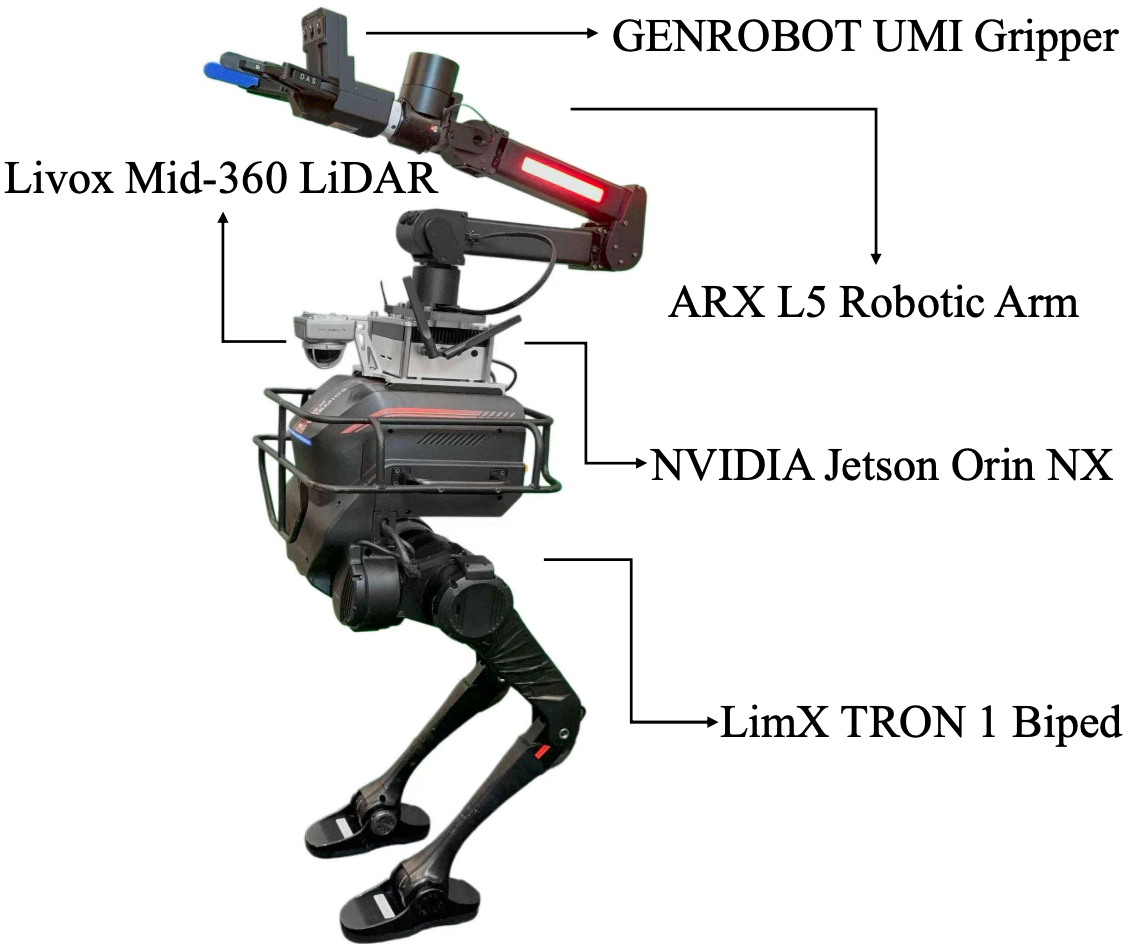
One target, whole body
The actor never sees a gait phase, footstep plan, or base-velocity command. It gets proprioception, the desired end-effector pose in the current base frame, and a latent from a Transformer–GRU estimator that looks at the last 10 observation steps. Training in Isaac Lab uses PPO with 8,192 parallel environments for 20,000 iterations, about 28 hours on an RTX 5090.
A reward-gating trick, building on Jiang et al.’s RFM for wheeled-quadruped manipulators, switches emphasis from “get closer” to “hold still and track” as a scheduled SE(3) distance decays. A best-so-far progress term only pays when position or orientation error beats the best so far on that command.
In simulation, gating lifts success from 82.73% (matched additive reward) to 88.30%, and mean position error from 3.23 cm to 2.85 cm. P95 position error drops from 14.35 cm to 5.38 cm. Success means staying under 5 cm and 7° for the last 11 seconds of a rollout. A privileged oracle that sees sim state hits 94.53%.
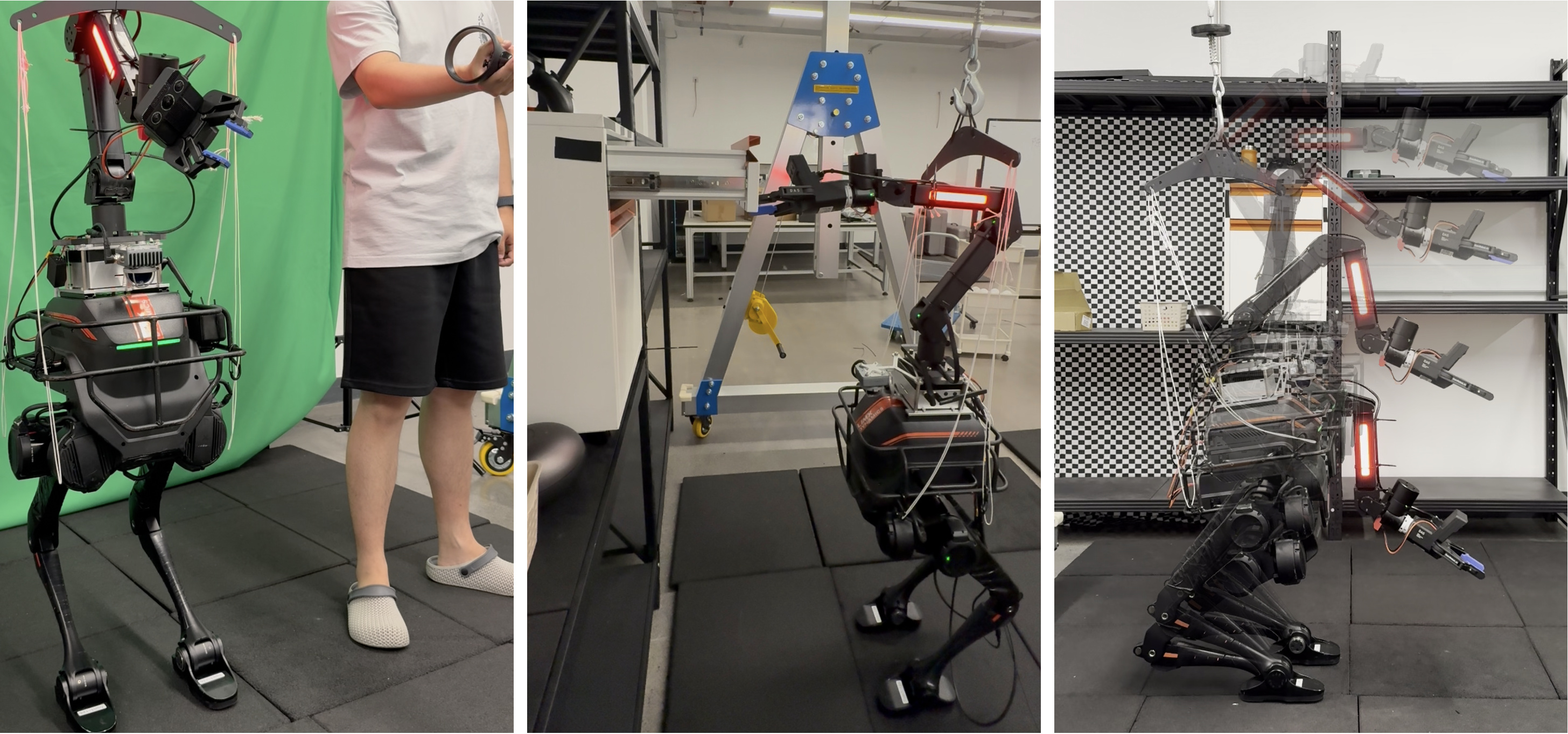
Hardware: pick off the floor, wipe a board, shut a cabinet
On the real robot the same policy eats Quest teleoperation, a diffusion policy trained from UMI-style demos, and scripted trajectories. Teleop picks a plush toy off the ground, steps, and puts it on a shelf. It also picks a whiteboard eraser and wipes a board. The diffusion policy closes a cabinet door from end-effector commands only.
A floating-base inverse-kinematics baseline reached about 38–163 cm vertically. The learned controller reached about 33–191 cm by squatting and stretching without an explicit base pose command. The paper says the IK baseline oscillates near workspace edges; theirs stays smoother.
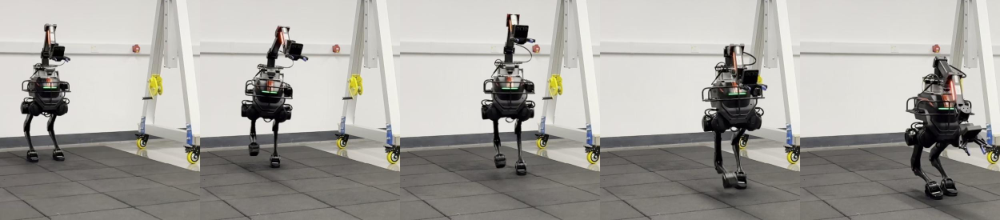
A Human’s Take
A 14-joint mutt that squats because the hand target is on the floor is my kind of controller. The vertical workspace numbers are the receipt. I still want a table of real-world tracking error, not only “it wiped the board.” Until then, the useful idea is the interface: high-level code speaks SE(3), the legs figure out the rest.