MaP-WAM Remembers as a Plan, Not a Growing Video
Long-horizon robot memory usually means one of two messes: a language summary that forgets where the blue block was, or a video window that gets slower every second.
MaP-WAM (Memory as Plans, World-Action Modeling) splits the job. Planning sees the episodic history. Execution follows a compact plan with a fixed context length. The paper (arXiv:2609.11561, submitted September 10, 2026) reports 83.3% on RMBench and 78.0% on two real Franka tasks.
Authors are at Harbin Institute of Technology, Nanyang Technological University, and Shandong University.
Plan, then act on a timer
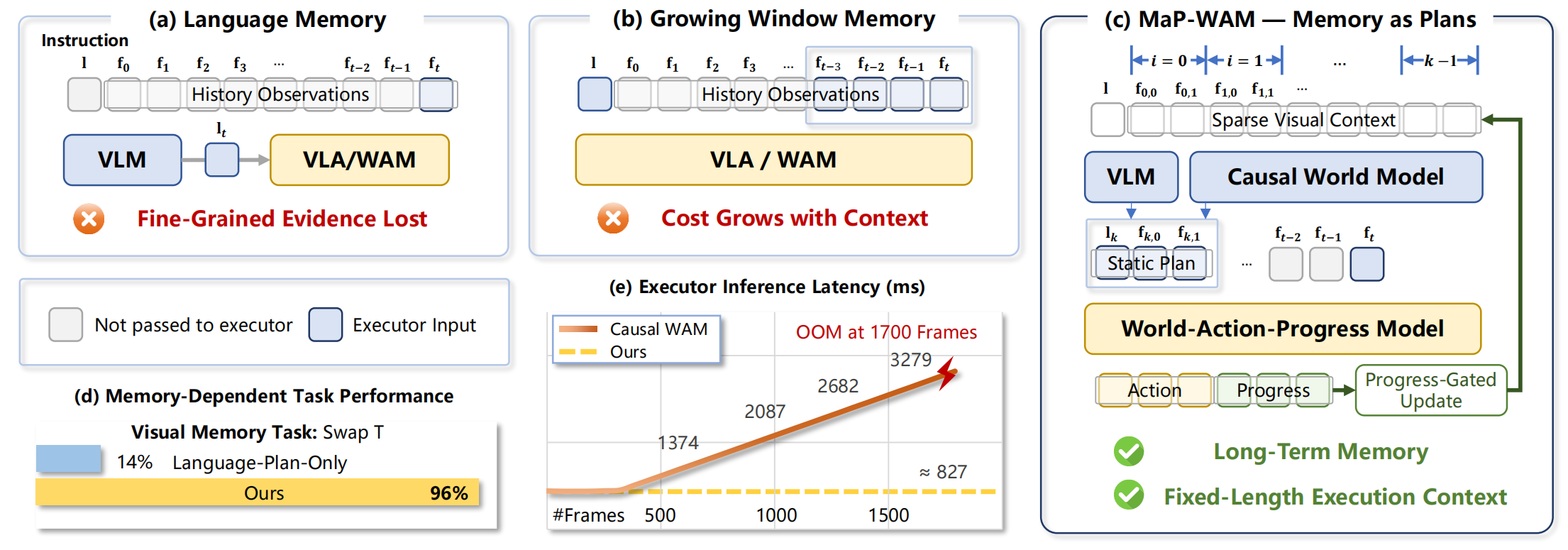
Completed segments are stored as a language instruction plus eight sparsely sampled frames. A fine-tuned Qwen3.5-4B writes the next segment-level language plan. A causal world model, initialized from WAN-2.2-5B, draws a visual plan. A World-Action-Progress executor, a Mixture-of-Transformers on WAN-2.2, jointly predicts action chunks and how far through the segment it thinks it is.
When predicted progress crosses τ=0.95, it stops, writes real observations back into memory, and replans. Plan-observation alignment matches the live camera to nearby plan frames so progress does not drift on long sequences.
The executor caches a fixed plan prefix. Per-chunk latency stays about 827 ms as history grows. A full-context variant OOMs past 1,700 frames.
Memory tasks, not pick-and-place
RMBench needs information that is gone from the current frame. Training uses 50 official demos per task and 100 eval rollouts. MaP-WAM’s 83.3% average beats LingBot-VA at 77.1%, Mem-0 at 42.0%, and π0.5 at 10.4%. Swap T and Press Button both hit 96%. Observe and Pick Up is still hard: 19%, up from 9%.
Real robot: Franka Research 3, third-person and wrist RealSense D435i, 50 training trajectories per task, 50 test trials.
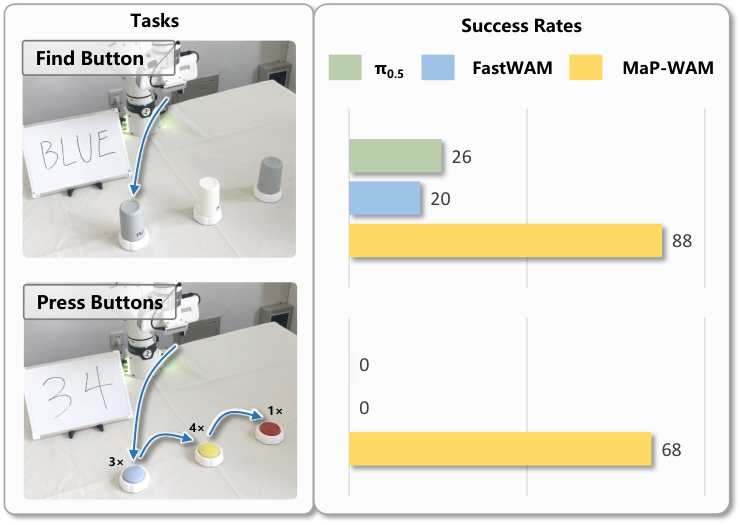
- Find Button: see button colors, covers go on, a whiteboard shows a color, open the matching cover. 88%. π0.5: 26%. FastWAM: 20%.
- Press Buttons: read two numbers, press left and middle that many times, then confirm. 68%. Both baselines: 0%.
Average of those two is the paper’s 78.0%. Ablations: drop visual memory and the world model invents the wrong object. Drop progress conditioning and Press Button collapses. Drop calibration and long ranking tasks drift.
The method still assumes segment labels. Unsegmented demos are future work.
A Human’s Take
Remembering a covered color is the kind of dumb task that wrecks Markov policies and looks trivial to a person. If the executor can stay at 827 ms while the planner holds the history, that is a better split than stuffing 1,700 frames into the actor. I want to see this on a walking humanoid that has to recall which door it already opened.