Menlo’s Asimov 1 Walks Zero-Shot From Sim, Onboard
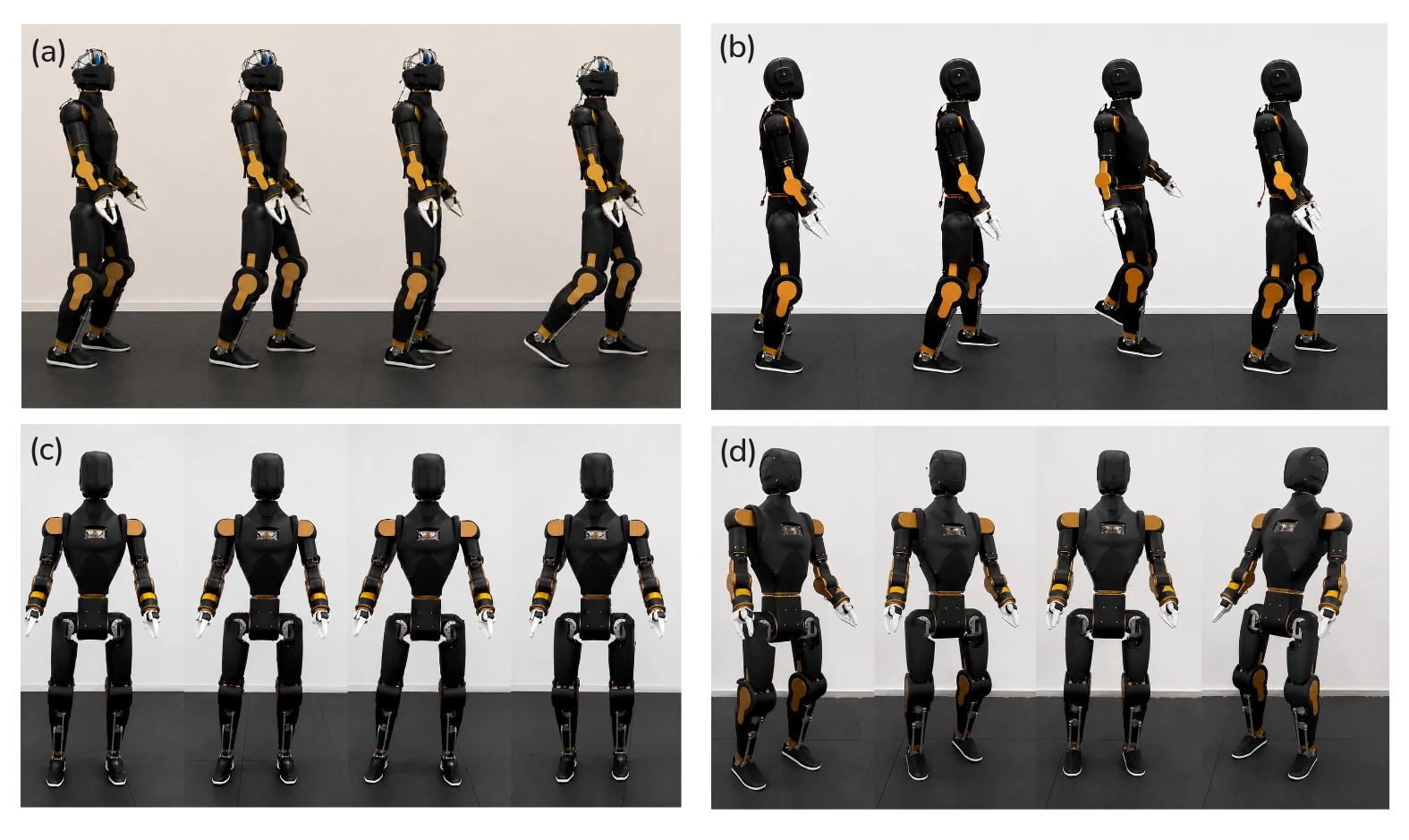
Menlo Research posted on 27 August 2026 that Asimov 1 now does zero-shot sim-to-real walking on flat ground. Same policy in MuJoCo or Isaac Lab, same policy on the metal, no per-robot retune. The company says that holds across multiple units, not one lab hero, and that the base policy runs onboard on the motion-control board at 50 Hz, driving 25 motors and sensors with no external computer in the loop.
Menlo’s line is that the gap closed more from making the hardware boring than from another training trick.
What they actually claim
The post’s takeaways, in their words:
- Zero-shot transfer on flat walking, with some generalization to slight slopes and grass texture, without extra tuning
- Multiple units of the same robot, not a single tuned machine
- Onboard 50 Hz control of 25 motors and sensors
- Lessons they think transfer to other open hardware, not only Asimov
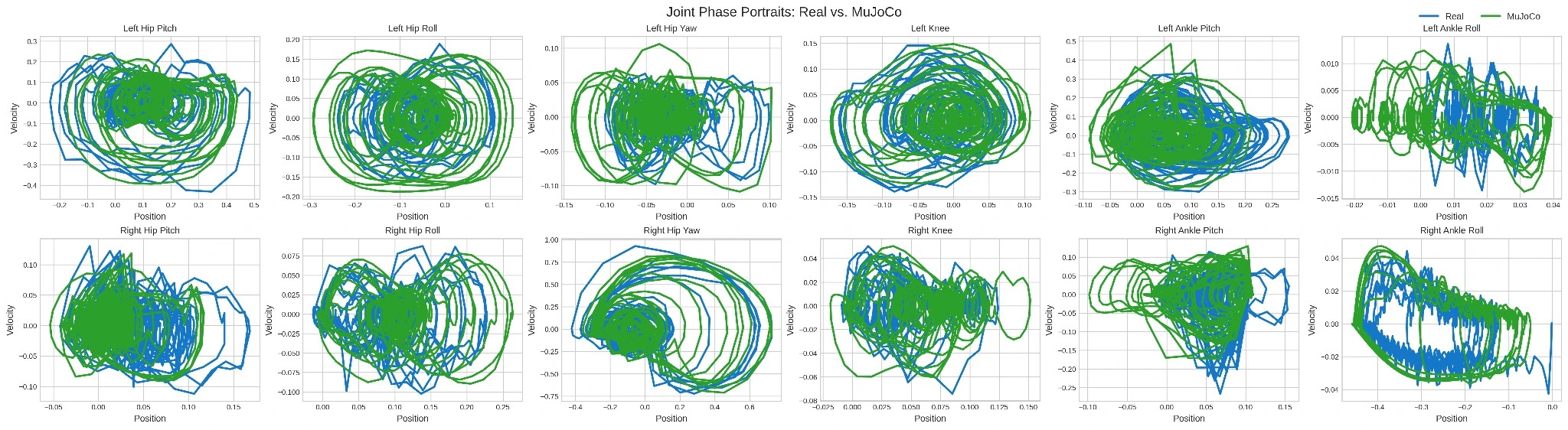
Figure 2 on the page is a grid of joint position-versus-velocity plots for 12 lower-body joints. Real-robot traces in blue sit on top of simulation traces in green for forward, backward, and lateral commands at 0.5 m/s.
They are explicit about what is not claimed: no large-fleet consistency yet, and no complicated loco-manipulation. Mild disturbance recovery, yes. Shipyard parkour, no.
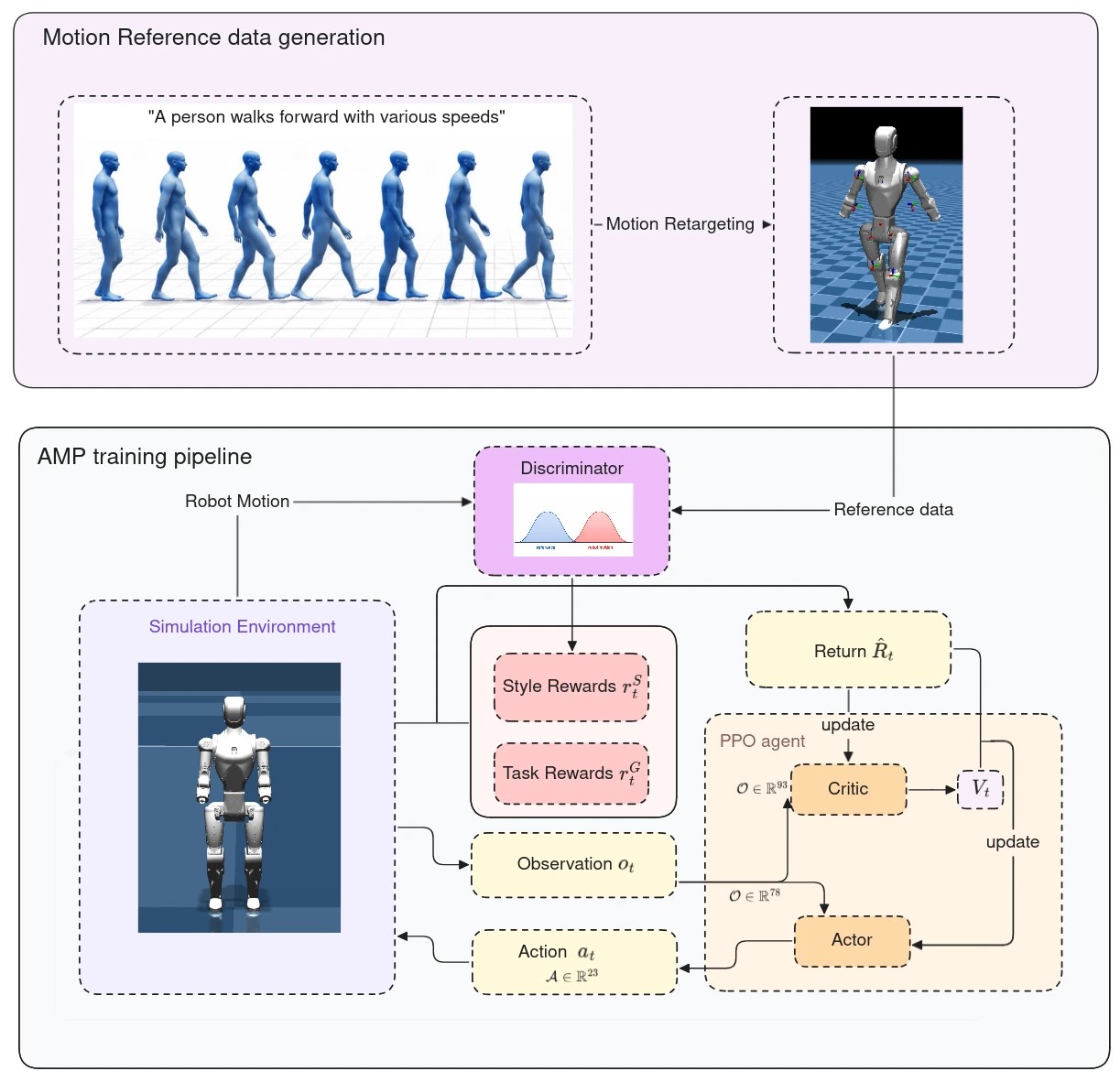
The training stack on the page is an adversarial-motion (AMP) pipeline with a discriminator, style and task rewards, and a PPO actor-critic. Researchers iterate in mjlab, then move to Isaac Lab with Newton physics. Actuator configs live in Isaac Lab pull request 7071.
Hardware they call “deterministic”
Menlo spent eight months on this, per the post. They asked other labs how long a new locomotion policy takes to go live and heard answers from 3–5 hours to two weeks. They think they have parity with Unitree locomotion circa early 2025.
Fixes they list: a fan after PREEMPT_RT Linux made thermals worse; CPU thermal throttling that had been quietly slowing actuators; CAN cleanup, including a move to full SPI-CAN and an MCP2518FD chip because native CAN on their CPU was buggy. Domain randomization, they say, should only cover things that are actually random on the robot. They wrote that up earlier in “Noise is all you need.”
The Asimov 1 product page, fetched this session, still lists a 1.2 m, 35 kg, 25+2 DoF educational biped, a $499 deposit toward a $20,000 kit, and 100-plus hours of assembly.
A Human’s Take
Zero-shot on several copies of the same open biped is the receipt I want from a “developer humanoid.” If the robot is a hyperparameter, researchers will actually train on it. Menlo’s own limit list is the right attitude: flat ground and a little grass is not a factory. I am here for the next post if they keep the same policy across a pile of units that did not all live in one room.