MiDAS Adapts a Generalist Robot Policy From One Demo
A Carnegie Mellon group posted MiDAS (Minimal-Data Adaptation Strategy) on August 11: take a pretrained vision-language-action model, clone one successful demonstration, then let residual reinforcement learning clean up the rest. The project page and paper both call this the first reliable adaptation of a robot policy from a single task demonstration.
Authors include Shreyas Kowshik, Sreyas Venkataraman, Leo Wang, Niharika Pant, Max Simchowitz, and Aviral Kumar. The page marks it as an anonymous CoRL 2026 submission under review. Extra videos live at minimal-data-adaptation.github.io.
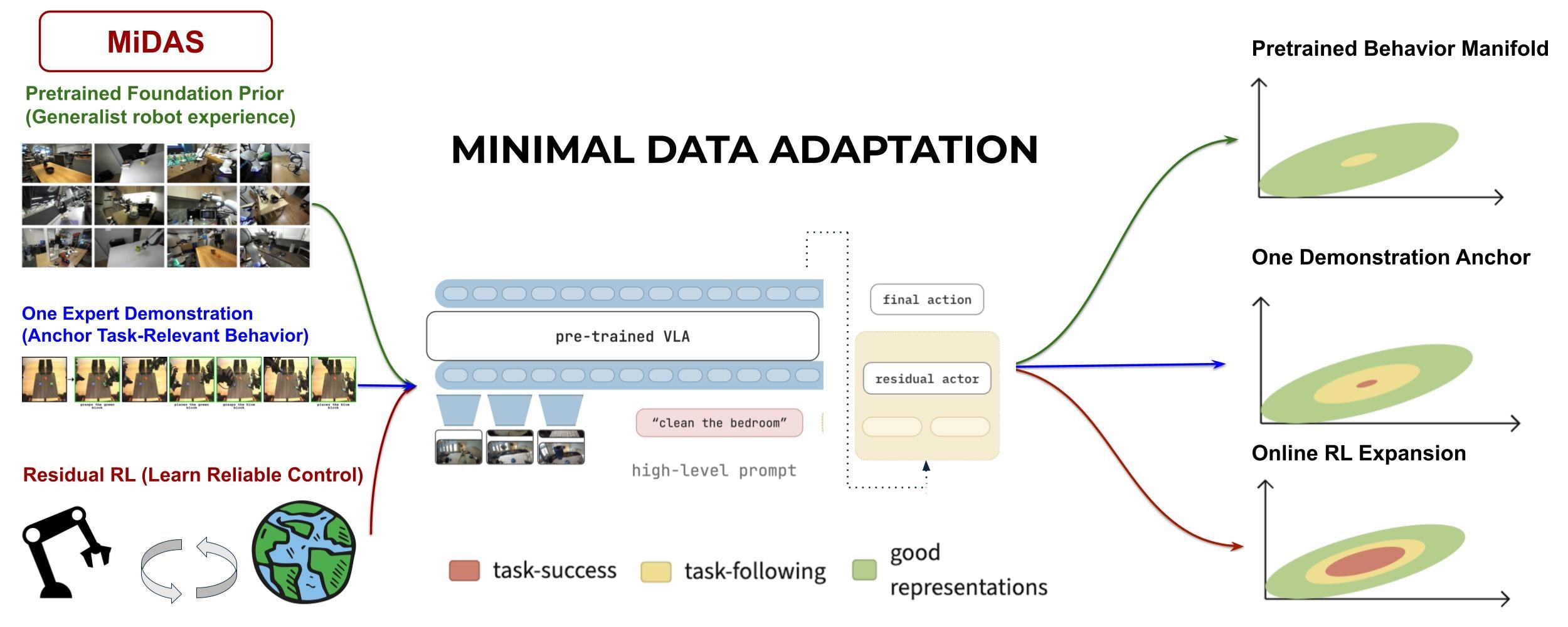
Two stages, frozen backbone
The base policy is π0.5. Stage I fine-tunes it with LoRA on the VLM backbone and full fine-tuning of the flow action head. Zero-shot success on every tested task is 0%. After one-demo behavior cloning, LIBERO-Long averages 33.5%.
Stage II freezes that policy and trains a small residual actor-critic on top of its features. The residual sees the state and the base action chunk, then predicts the executed action directly (not a tiny additive nudge). Sparse reward is −1 every step until success.
Three tricks keep one-demo RL from collapsing: a warmup buffer that copies the base action, a success buffer that oversamples the rare wins (sometimes only 2–5% at the start), and PA-RL Best-of-N distillation that only needs one expensive forward pass through the frozen VLA.

What one demo plus a few hours buys
On LIBERO-Long, MiDAS averages 91.2% (paper Table 1) vs 33.5% for behavior cloning. RoboCasa average is 89.3% on the three tasks that move at all; Cup + Bowl → Dishwasher stays at 0% for every method.
On a bimanual YAM:
- Blocks into two bins: 40% → 67%
- Knife and donut onto a plate: 27% → 80%
The abstract and project page both say roughly six hours of autonomous interaction. Success rates are over 15 rollouts mixing in- and out-of-distribution object poses.

The paper is also blunt about limits. Swap object identities and success falls to 0%. Observation shifts (color, paraphrase) mostly survive because the VLM stays frozen. Bigger state shifts need a reset curriculum.
A Human’s Take
One demo plus six hours is a number I can argue about. I am here for residual RL that is allowed to leave the clone’s action cloud, not just sharpen it. The dishwasher task staying at zero is the honest part: if the warm start never touches the reward, residual RL has nothing to chew on. That is the real floor, not the 90% average.