Mimir Splits World Memory from Task Memory for Long-Horizon Agents
Long-horizon household tasks fail in a boring way: the agent still “remembers” frames, but it no longer knows whether the mug is in the cabinet, in its hand, or already in the sink. Mimir, posted August 5, 2026 as arXiv:2608.04933, treats that as a memory interface problem, not just a bigger context window.
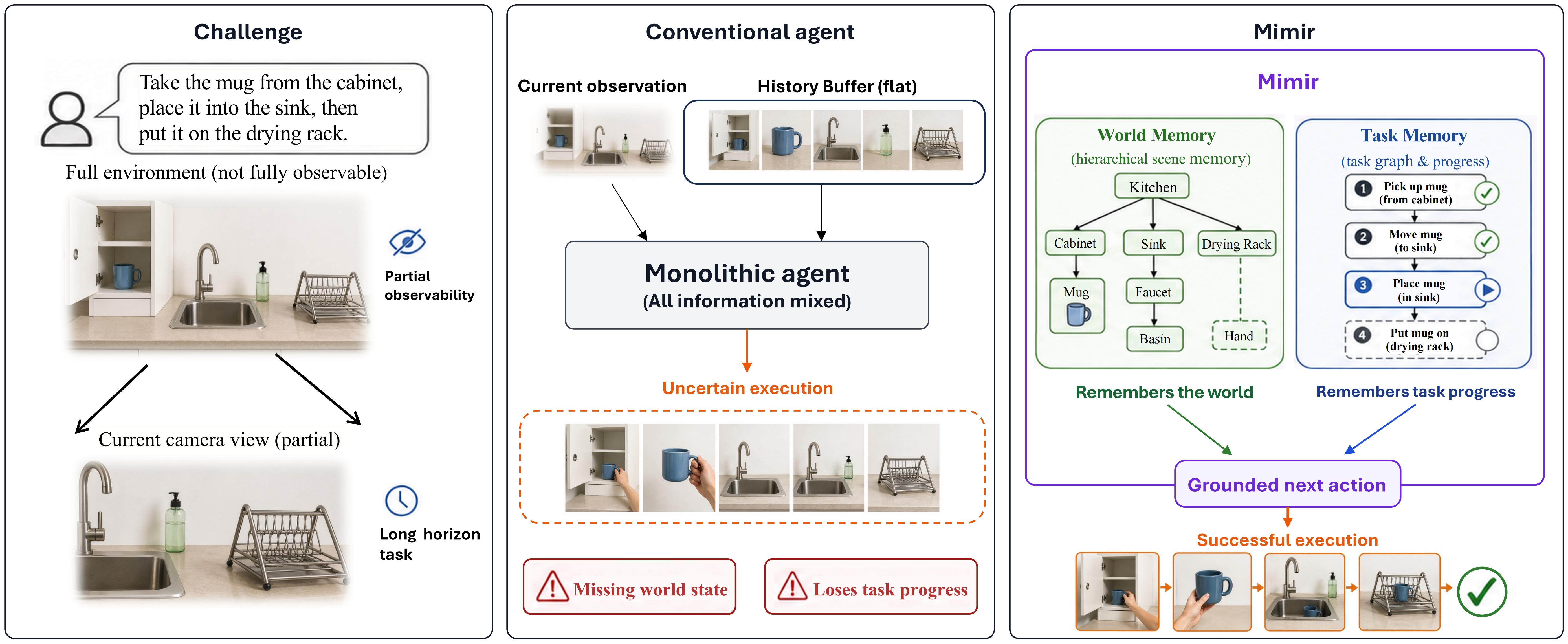
Two memories, then grounding
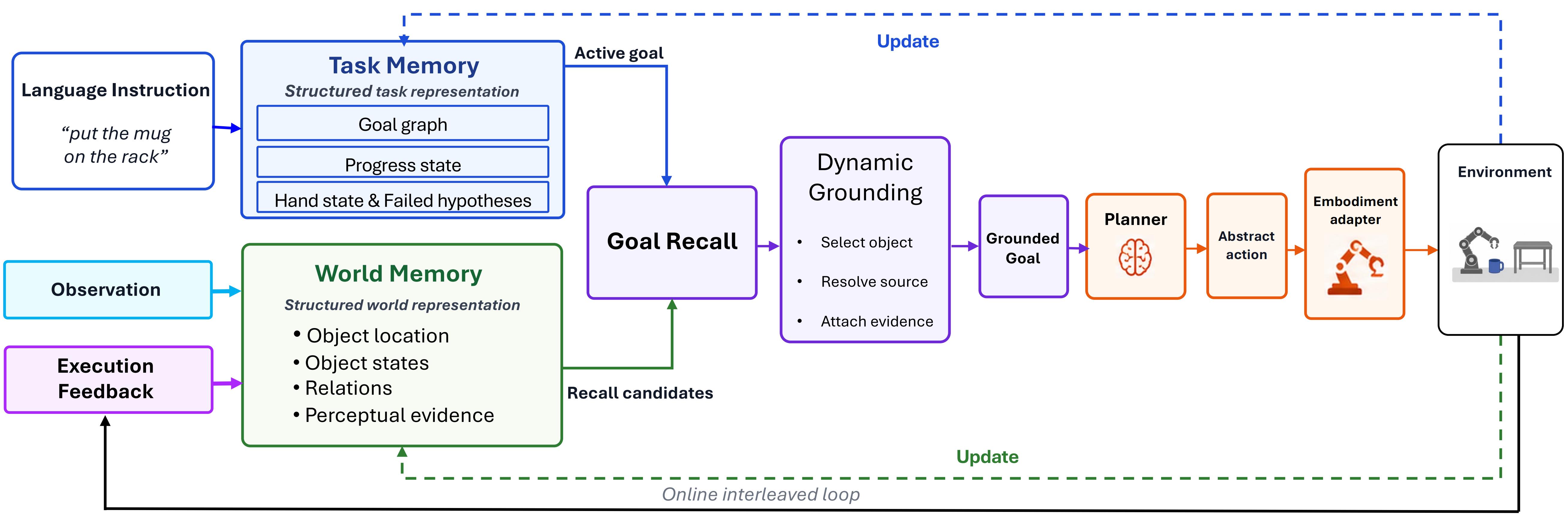
Mimir is a neuro-symbolic stack:
- World memory stores object locations, states, and perceptual evidence in an episode-level tree of entities and parents (room / surface / container / hand).
- Task memory keeps an ordered goal agenda, status (pending / completed / blocked), hand state, failed object–source hypotheses, and evidence for finished goals.
- A grounding step binds the active goal to recalled world candidates, fills missing source locations from memory, and fails closed if nothing is supportable.
Observation updates and action-feedback updates write the two memories on different paths so a successful open-cabinet does not pretend the mug was delivered.
Numbers from EmbodiedBench
On EB-ALFRED and EB-Habitat, the authors report Mimir improving success across many multimodal backbones, with maximum gains of 42.5% and average gains of 23.0% depending on the split they summarize in the abstract. Against prior agent/memory systems on the same backbone, they claim an 8.5% overall average success lift. On the EB-Habitat Long-horizon subset they report 86.0% success, above the closed-source baselines they list under a matched generation budget.
Ablations say the division of labor is real: drop world memory and Habitat collapses; drop task memory and ALFRED takes the bigger hit. Code is promised but not released with the paper.
A Human’s Take
Flat chat history is a terrible robot OS. What I like here is the fail-closed grounding: if the world entry never entered perception, Mimir does not invent a mug behind the dishwasher. The open question is transfer beyond EmbodiedBench scripts — real kitchens will stress both the VLM disambiguator and the hand-state bookkeeping when the mug is identical to three others.