Northwestern Maps Robot Fingertip Deformation Onto a 32-DoF Finger Pad
Teleoperators feel force. They almost never feel where on the fingertip the robot is touching. Rohan Kota, Gregory Reardon, and J. Edward Colgate at Northwestern argue that gap is why robot demos look twitchy compared with a bare hand. Their paper, on arXiv August 19, pipes a GelSight Mini on the robot finger into a 32-DoF electro-osmotic shape display from Fluid Reality on the operator’s pad.
Across two tasks, filling in that spatial map cut the deviation between teleoperated and natural trajectories by 29–79%.
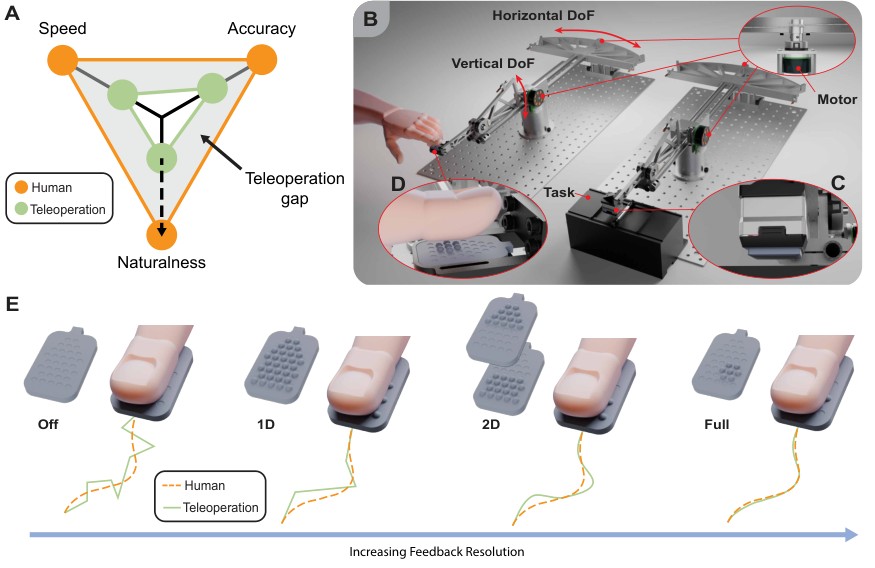
Four ways to feel the same contact
The hardware is a custom 2-DoF leader-follower with capstan-driven brushless motors and bilateral force feedback at 10 kHz. Everyone gets kinesthetic force. Cutaneous feedback is the variable:
- Off: no pad inflation
- 1D: whole pad inflates on any contact
- 2D: upper and lower halves independent
- Full: localized inflation matching the GelSight contact map
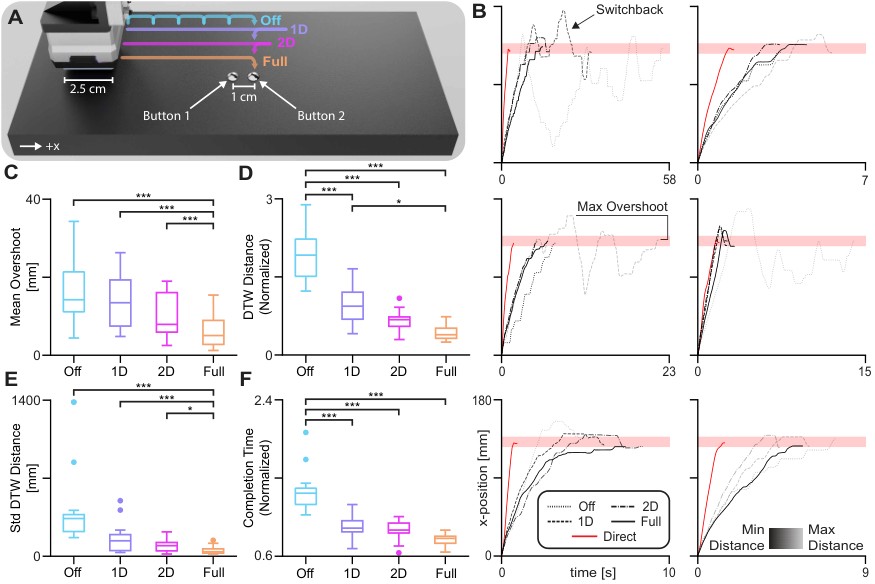
They ran two studies. A button task (12 people, two buttons 1 cm apart, no vision) and a peg-roll task (10 people, roll to a stop and back). Each person did 48 trials, 12 per condition, after a bare-finger baseline. IRB protocol STU00223620.
On buttons, full localization cut overshoot (p<0.001) and “switchbacks,” the reverse-and-retry moves you make when you cannot tell which button you hit. Dynamic time warping distance to the person’s own bare-finger path dropped as resolution rose; full beat 1D on naturalness (p=0.014). Completion time got faster with any cutaneous feedback, but full did not beat 1D on speed after correction. Consistency did: full had the tightest trial-to-trial spread.
Peg rolling, where force already tells you a lot
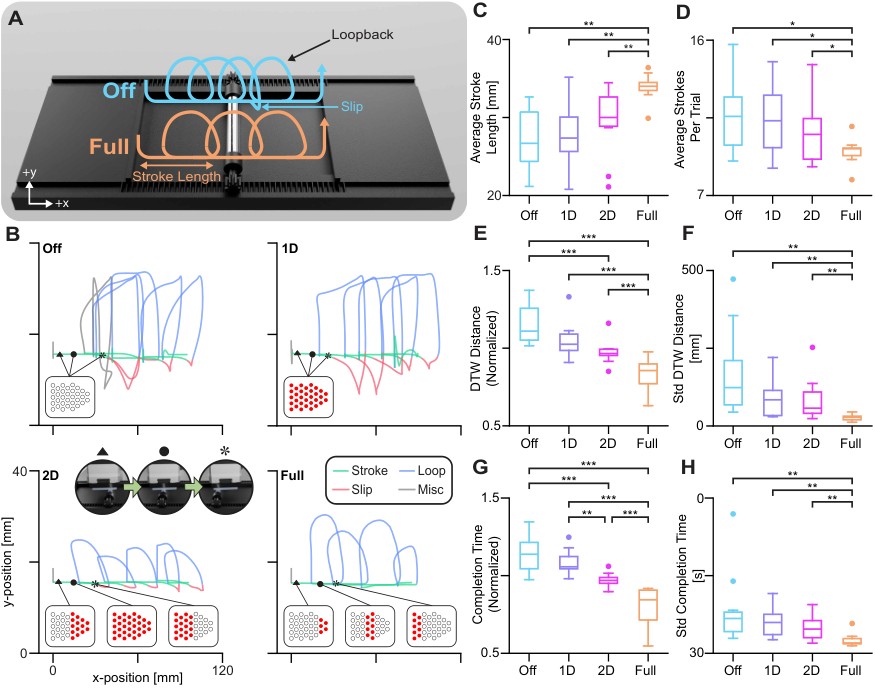
Peg rolling has kinesthetic cues. Uniform 1D inflation did not beat Off on DTW or time. Full still won: longer strokes, fewer strokes per trial, fewer roll-offs onto the table, faster times, and more natural paths than 2D (p=0.003). People told the authors they could feel how far the peg had traveled across the pad, which is the cue you use to plan the next loopback.
NASA-TLX-style ratings showed mental demand falling as resolution rose. The authors also pool every operator’s demos: higher resolution shrinks state-space occupancy and pairwise DTW distance across people, the kind of tighter dataset other work has tied to better imitation learning. They did not train a policy here. That is a claim about data shape, not a trained baseline.
A Human’s Take
Force feedback without a contact map is anesthesia with a motor. I like that they measured naturalness, not just stopwatch time, and that 1D was a dud on the peg because it duplicated what the arm already told the hand. The next receipt is a multi-finger leader, not another 2-DoF peg. If full-resolution skin actually cleans up the demos we train on, that is a data-quality story, not a haptic gadget story.