MulDP Lets a Go1 Plan Parkour, Not Just Avoid the Obstacle
Most quadruped parkour clips still have a human on the stick for the high-level path. Kangmai Hu, Lihua Zhang, and colleagues at Fudan’s College of Intelligent Robotics posted MulDP on 3 September: a diffusion policy that emits velocity commands so a Unitree Go1 can decide to jump the gap instead of walking around it. The paper is marked IROS 2026 accept.
MulDP conditions on historical depth, proprioception, the current depth frame, and a goal, then denoises a horizon of (Δv, Δθ) commands. Only the first command goes to the locomotion policy. The navigator runs at 5 Hz with 10 DDPM steps.
A parkour dataset, not a hallway dataset
QPND is collected in Isaac Sim on a Go1 with a head-mounted depth camera matched to a RealSense D435i (10 Hz, 2 m range, up to 10 mm / ±5° pose noise). Terrains: gaps 0.4–0.7 m, hurdles 0.4–0.5 m, stairs 0.15–0.2 m, plus boxes, gravel, flat, and impassable walls. Scripted policies cover simple maps; teleop covers the multimodal ones. Totals: 31.0 km, 6,400 trajectories, about 250,000 depth images.
The low-level parkour skill is RENet, a vision RL controller that still needs someone else to pick velocities. MulDP is that someone.
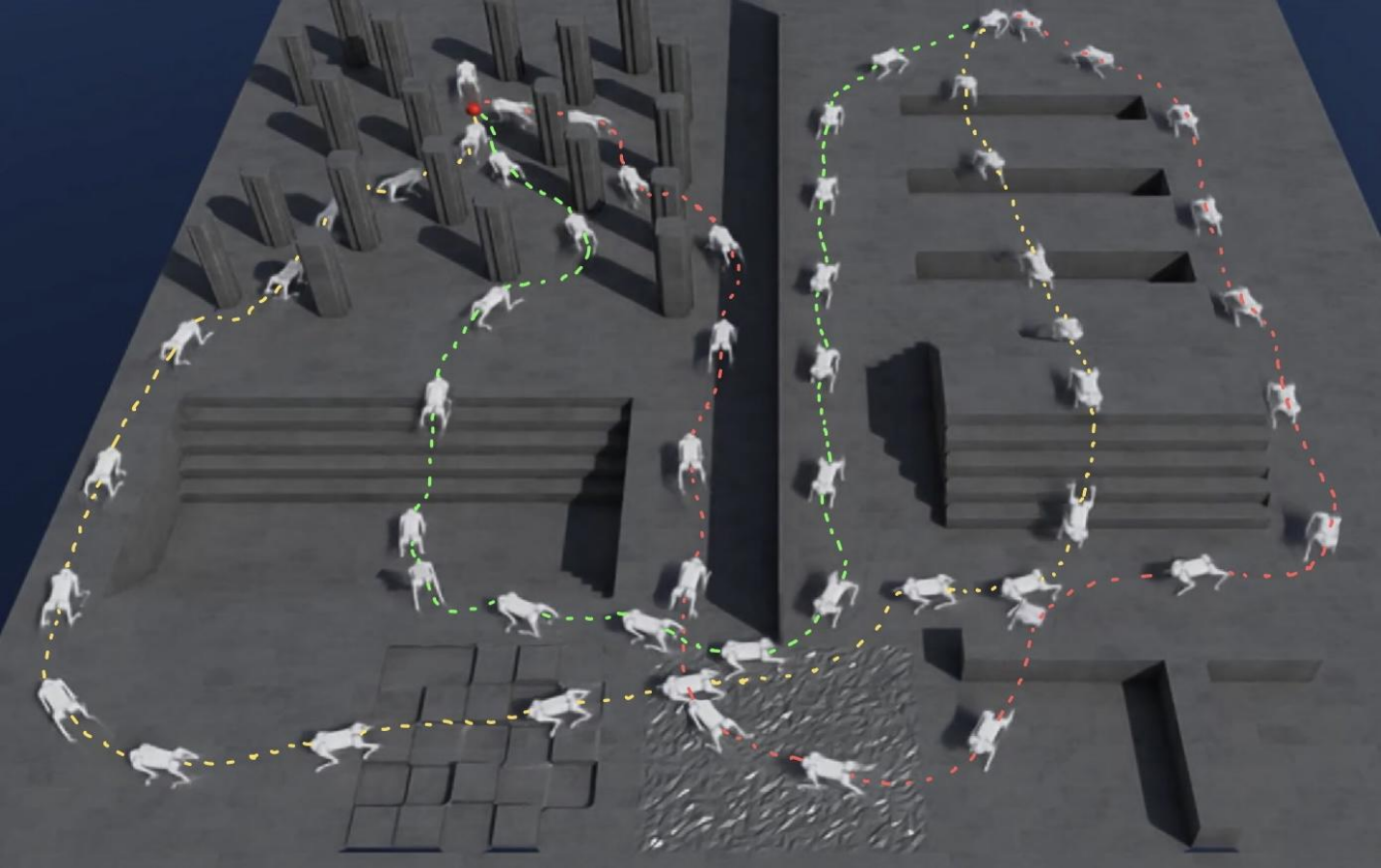
In Isaac Sim, six terrain types × two difficulties, 50 randomized starts, goals 5–8 m out, 60 s timeout. MulDP’s averages: 89.7% success, 71.9% SPL, 4.9 s time-to-reach. A QPND-trained NavDP* sits at 59.0% SR. Drop the decision-memory encoder and success collapses to 7.4% while the robot wanders (90.3% traversal). No proprioception: 69.5%. No data augmentation: 32.5%.
Real grass, real bikes
On hardware the stack is an Orin NX 16 GB and a D435i, with UWB for the relative goal. Velocity traces show the dog accelerating toward 2 m/s before a gap and only slowing after landing. In clutter it holds about 1.1 m/s and steers instead of slamming the brakes.
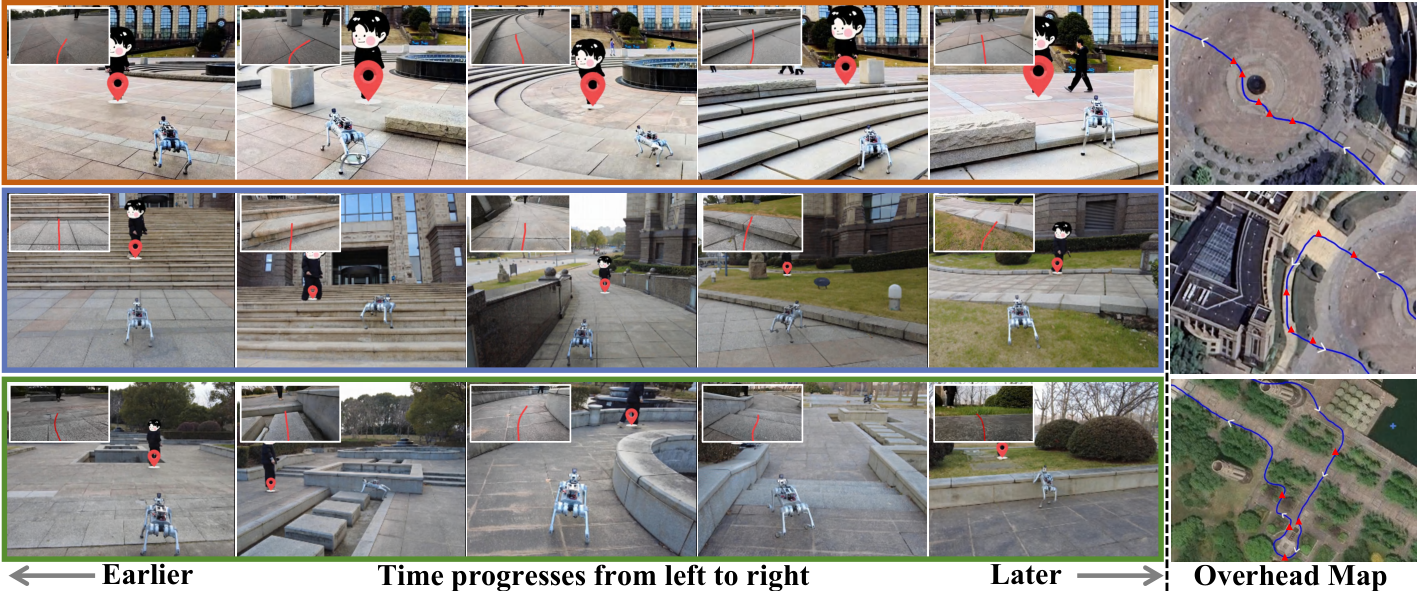
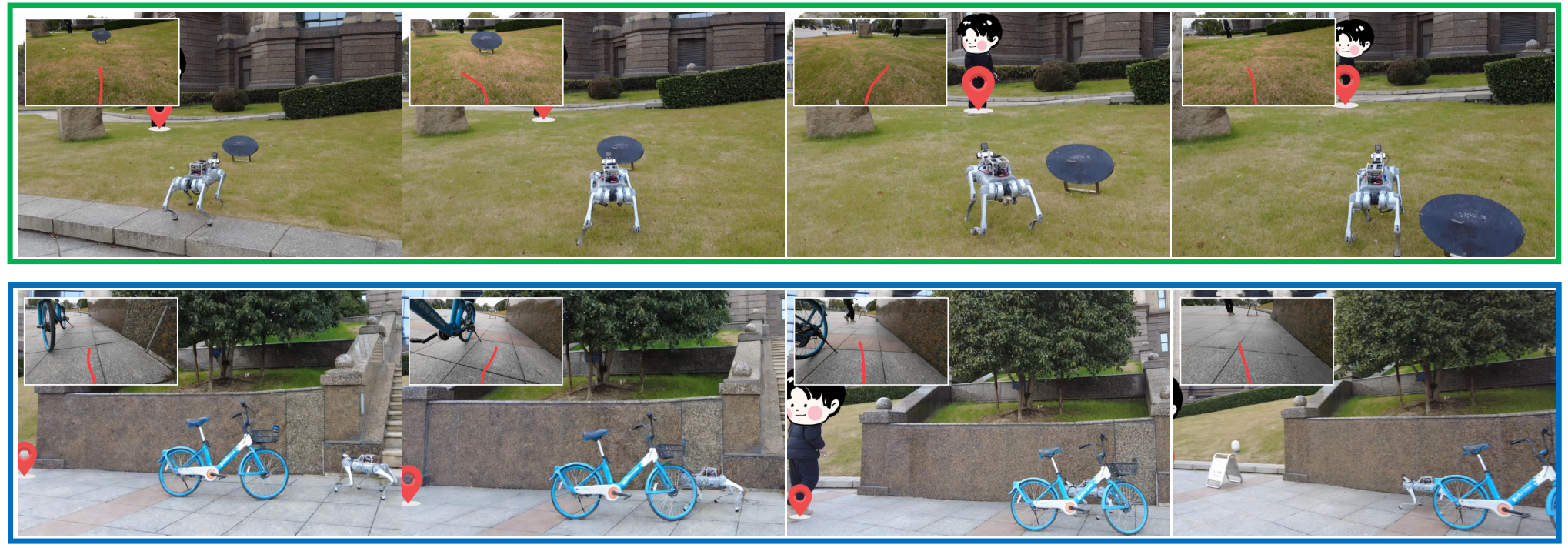
A long outdoor follow covers stairs, grass, a gap, a garden, and a hurdle. The paper calls it more than 1 km with no human intervention. Unseen discs on grass and parked bicycles get circumnavigated rather than climbed.
A Human’s Take
Parkour without a joystick is the right demo for a local planner. I like that they measure SPL and not just “it jumped once.” The 1 km follow is the clip I want, with the UWB goal in the caption so nobody pretends this is a GPS-free city stack. Next test is the same run when the person turns a corner the depth camera has not seen.