Two Vine Robots Share a Working Channel and Steer About 90 Degrees
A vine robot is a thin tube folded inside itself. Pressurize it and the tip everts, growing forward with almost no sliding friction — useful in a colon, useless if the only way to deliver a tool is a skinny channel trapped in the wall. Reza Kashef, Cem Suulker, Mohammad Sheikh Sofla, and Kaspar Althoefer at Queen Mary University of London posted a Hamlyn Symposium 2026 abstract on 3 September: two vines, one external working channel, steering by growing them at different rates.
The architecture couples two eversion bodies to a shared lumen through soft mounting tips. Independent pressure lets the pair yaw while the channel rides along outside the vine walls, so the tool diameter is not capped by the vine fabric.
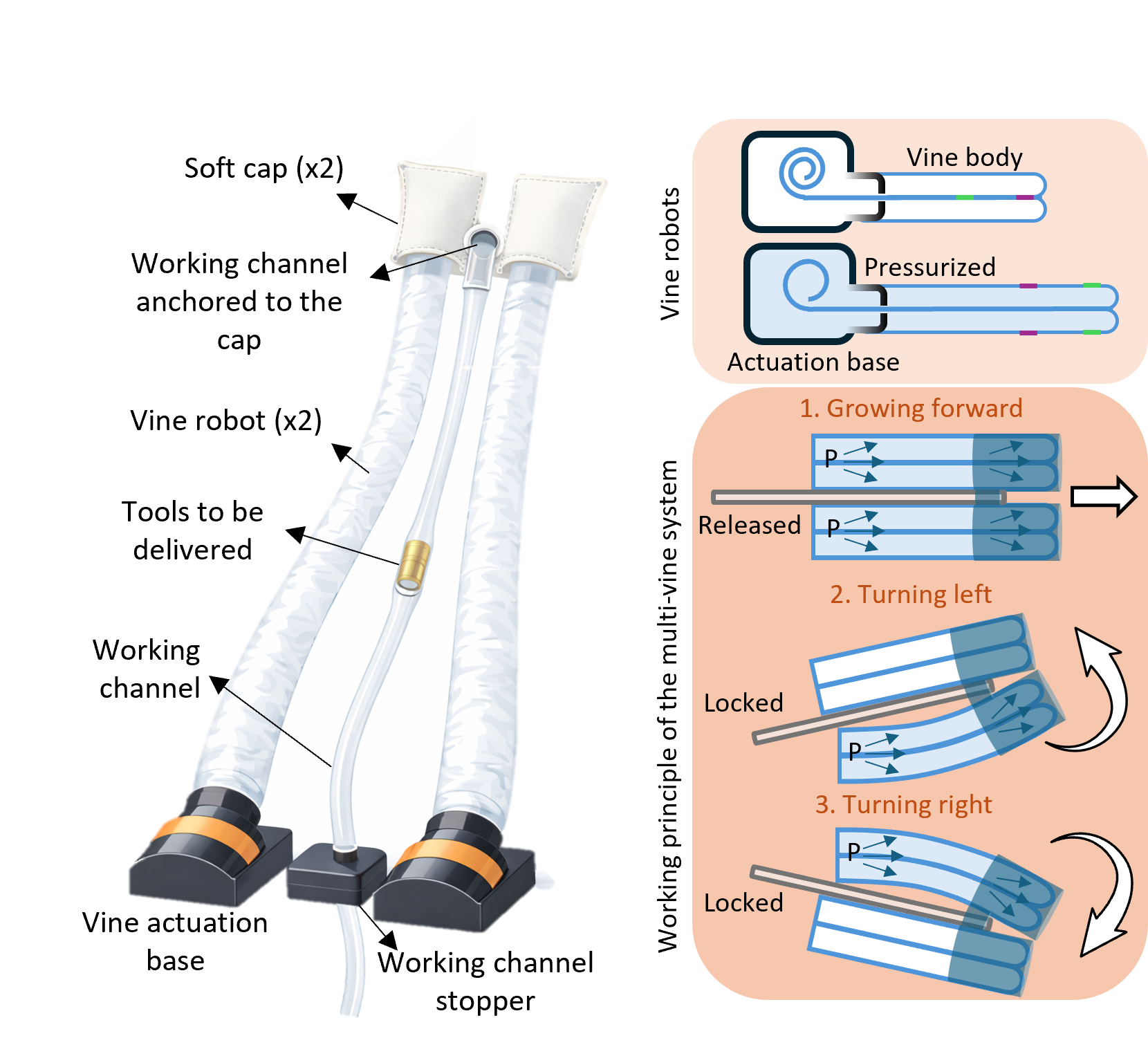
Grow, lock, turn
The paper’s steering cartoon is three steps: both vines grow; lock the right and pressurize the left to turn left; lock the left to turn right. Experiments, they write, show sharp steering of nearly 90 degrees during growth.
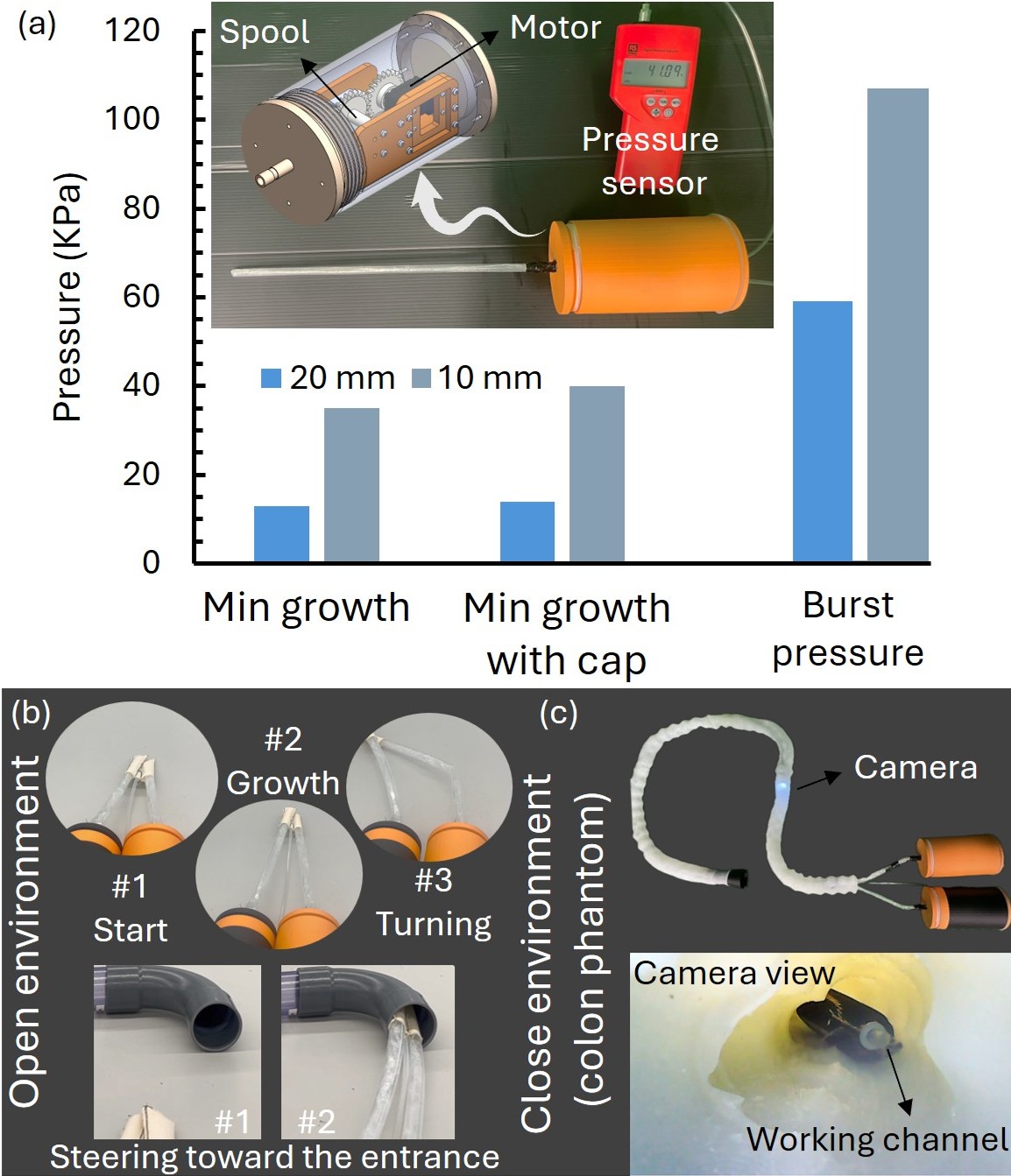
A second figure reports pressure for 20 mm and 10 mm vines: minimum growth, minimum growth with a cap, and burst. The 10 mm body wants more pressure in every bar. A motorized spool, a red handheld pressure readout, and an orange canister sit in the same panel.
Open-environment stills: start, growth, turning, then a gray elbow pipe the pair aims into. Closed environment: a colon phantom, a camera on the grown body, and an endoscopic view of the working channel in tissue-colored lumen.
The work sits inside the ERC Synergy project EndoTheranostics, which wants vine robots that can carry microsurgical tools while they grow. Prior channel-in-the-wall designs, the authors say, squeeze tool size, add friction, and only open to the world at the tip.
This is a short Hamlyn abstract, not a full T-RO paper. Burst numbers, force at the tip, and in-vivo data are not in the text I fetched.
A Human’s Take
Steering a garden hose by growing a second hose is a delightful mechanism. Nearly 90 degrees in a phantom is enough to make me watch the video. I will not call it a surgical platform until someone puts a real tool through that channel around a sigmoid bend and measures what the tissue feels. Until then it is a clever two-body trick, and that is already worth a post.