Tokyo’s Musashi-W Gets a Joint Skin That Estimates Elbow Angle
Musculoskeletal humanoids usually guess joint angle from muscle length and tension. A University of Tokyo group led by Akihiro Miki argues the covering around the joint should help. Their IROS 2026 paper, posted to arXiv on August 24, wraps the elbow of Musashi-W in a three-layer silicone skin with strain gauges and stretchy conductive mesh inside.
Skin alone estimates elbow angle with an average error of about 3 degrees. Muscle length is still better (1.70° RMSE). Fuse muscle and skin with an encoder and the mean RMSE drops to 1.62°.
What they actually built
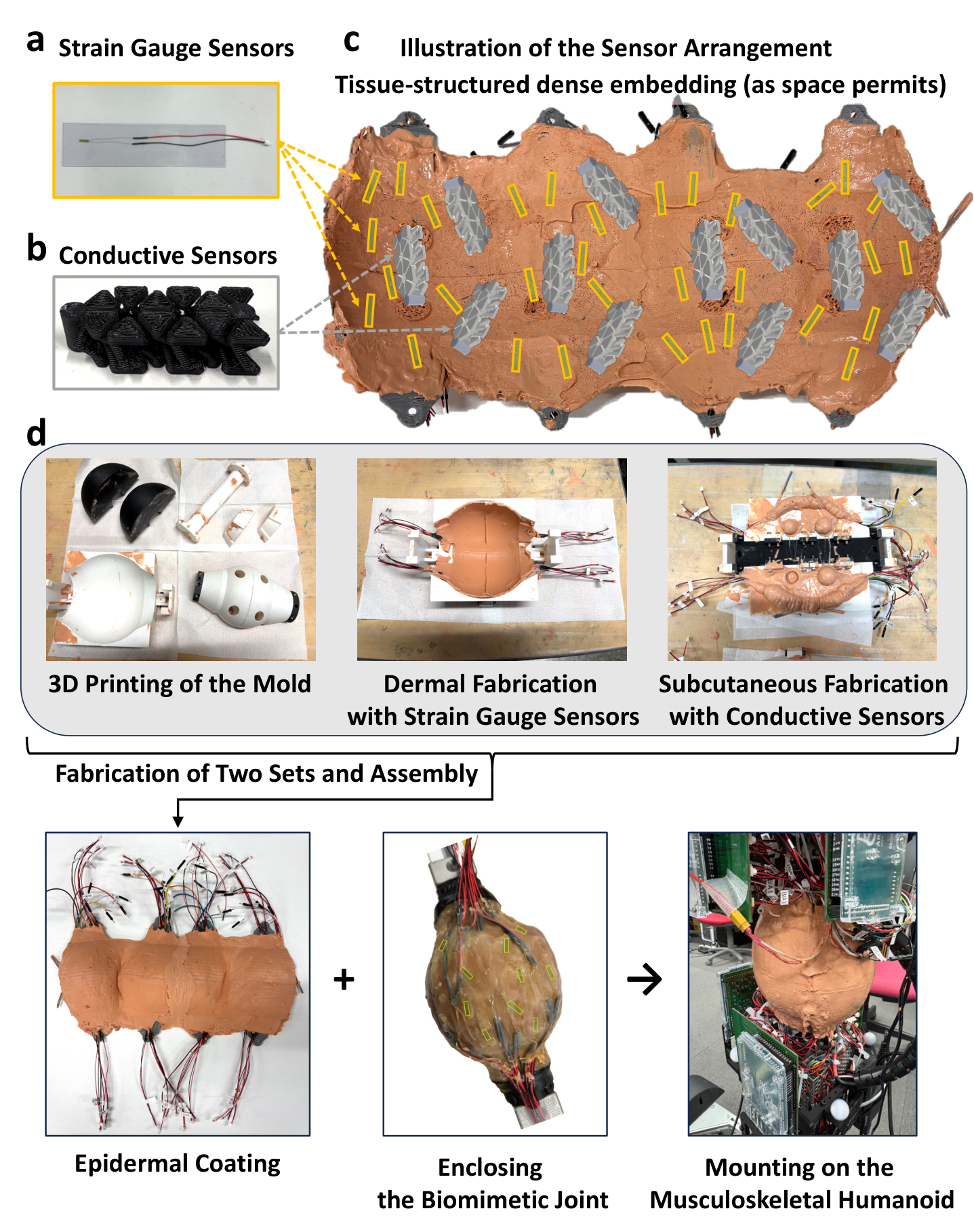
The skin copies epidermis / dermis / subcutaneous layering, not as a costume but as a place to hide sensors:
- Epidermis: Dragon Skin 30, about 0.2 mm
- Dermis: Ecoflex Gel 2, about 2 mm, with 32 Kyowa foil strain gauges (Merkel-like)
- Subcutaneous: Soma Foama 15 sponge, about 10 mm, with 12 Recreus conductive Filaflex chainmail patches (Ruffini-like)
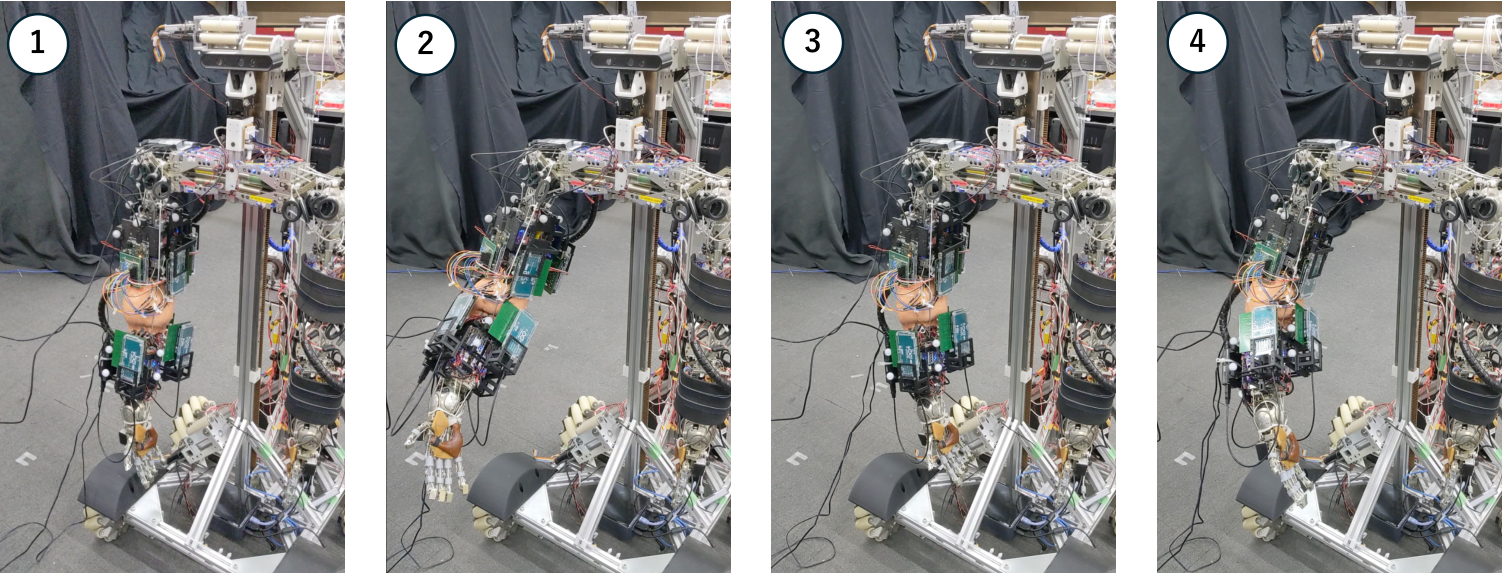
They mold the pair, wrap an open biomimetic elbow, and mount it on Musashi-W. The original joint pots come out. Motion-capture markers on the upper arm and forearm become ground truth. One hour of posing produced 615 samples over about 50° on pitch, yaw, and roll.

The numbers they will quote
Single-modality elbow RMSE, 20 random seeds:
- Muscle length: 1.70°
- Ruffini-like skin: 2.56°
- Merkel-like skin: 2.69°
- Muscle tension: 4.84°
Encoder fusion of muscle plus skin is the only mix that beats muscle length. Poke the elbow with a stick or a hand and the skin estimates blow up (~41–54° RMSE). Muscle length degrades to 4.18° but stays usable. The authors’ point is not that skin is a better encoder. It is that a big disagreement between skin and muscle is a contact flag you cannot get from tendons alone.
Limits are in the paper: sensors are huge compared with real receptors, the set is quasi-static, silicone will drift, and they have not run fast motion.
A Human’s Take
I am glad someone is putting skin on the joint instead of another palm taxel array. Three degrees from a floppy elbow sleeve is not factory spec, but the disturbance split is the trick I would steal: if the cover screams and the tendons do not, something hit the joint. That is a useful bit for a robot that works next to people.