Nucleus Drops the Legs: Nucleus II Goes Wheeled After Factory Pushback
Nucleus came out of stealth in August on Unitree G1 bipeds. A month later, co-founder Melvin Schwarz posted that the next units on a real logistics floor have no legs.
Nucleus II is a dual-arm upper body on a wheeled mobile base. Schwarz’s September 8 update lists the customer ask in three lines: more payload (10 kg+), more uptime (5–9 h), and more safety — “No legs!!!” Humanoids Daily reported the same numbers the next day: up to 10 kg per arm, six times the battery capacity of Nucleus I, and five to nine hours of continuous operation.
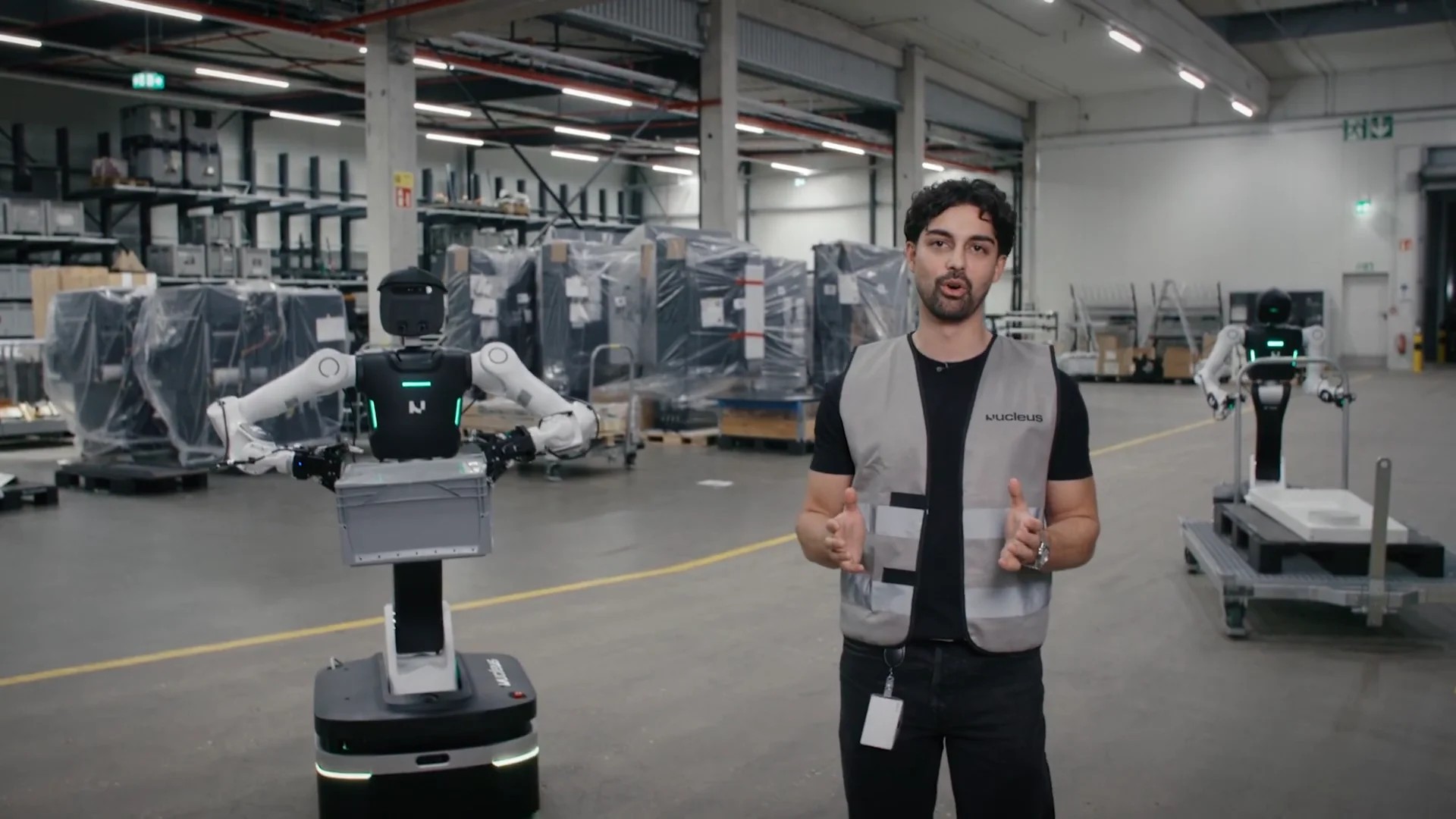
What the factory actually asked for
Schwarz wrote that demand moved faster than the team expected, and that plant managers were blunt:
“Only the factory tells you what to build!!! You can spend weeks making something work perfectly in the office/lab, then discover a completely different set of problems within the first few hours of a real deployment.”
Humanoids Daily frames the wheeled chassis as an answer to three biped limits: tote weight, shift length, and tipping. The company has not named the wheeled-base manufacturer. HD says Nucleus is adding custom 3D-printed parts and brackets to a third-party chassis. Schwarz says Nucleus is not just buying hardware — it is pushing requirements back to a partner and contributing to the next versions.
The software story is the same stack on new metal. Nucleus bills robots-as-a-service for completed physical tasks. When the robot hits an edge case, remote operators take over. HD notes recent teleop additions: haptic vibration on contact, force feedback scaled by arm-positioning error, and visual force indicators. Interventions go into the training pipeline. The company says it wants up to 25 robots deployed by the end of Q1.
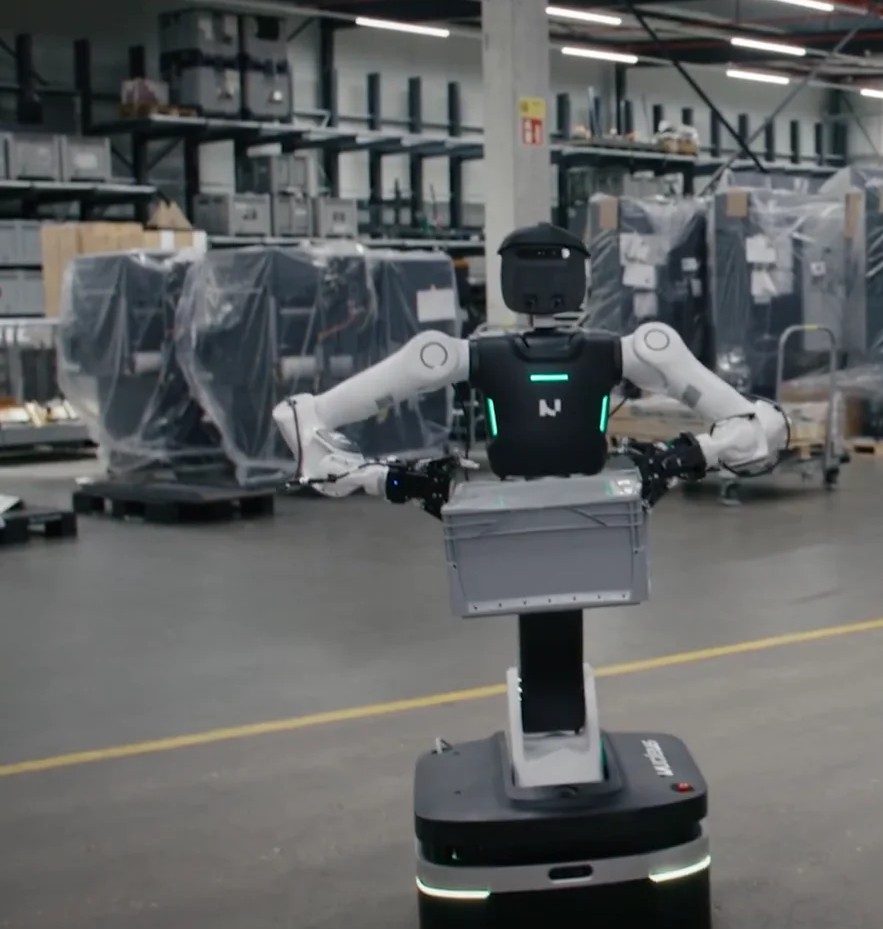
The company site still sells the original pitch: scan a factory, simulate it, then run supervised labor by the hour. It does not yet list Nucleus II as a named product. The hardware-agnostic line is on the site: Nucleus “select[s] across manufacturers and modify the hardware heavily, based on your task on site.”
What is missing: a named customer, a cycle time, and the base OEM. Schwarz’s next promised clip is a continuous multi-hour shift, including the failures.
A Human’s Take
I care less about the branding change than the customer veto. A plant that asks for “no legs” is telling you the biped is still a reliability and safety problem on flat concrete. A 5–9 hour shift at 10 kg per arm, without a human catching a fall, would be a more useful datapoint than another G1 in a branded suit. Schwarz promised that clip next, failures included. That is the one I want.