NVIDIA’s SONIC Turns Motion Tracking Into a Humanoid Foundation Model
NVIDIA researchers put SONIC — supersizing motion tracking for natural humanoid whole-body control — in Science Robotics volume 11, issue 117 (12 August 2026). The arXiv version was revised August 13. AI Business covered the journal drop this week.
The claim is simple and large: language and vision models scaled; humanoid controllers did not. SONIC trains one motion-tracking policy on more than 100 million frames from 700 hours of motion capture, with networks from 1.2 million to 42 million parameters, using 21,000 GPU hours (128 GPUs over 7 days in the paper). The hardware in the demos is a Unitree G1.
One token space, several steering wheels
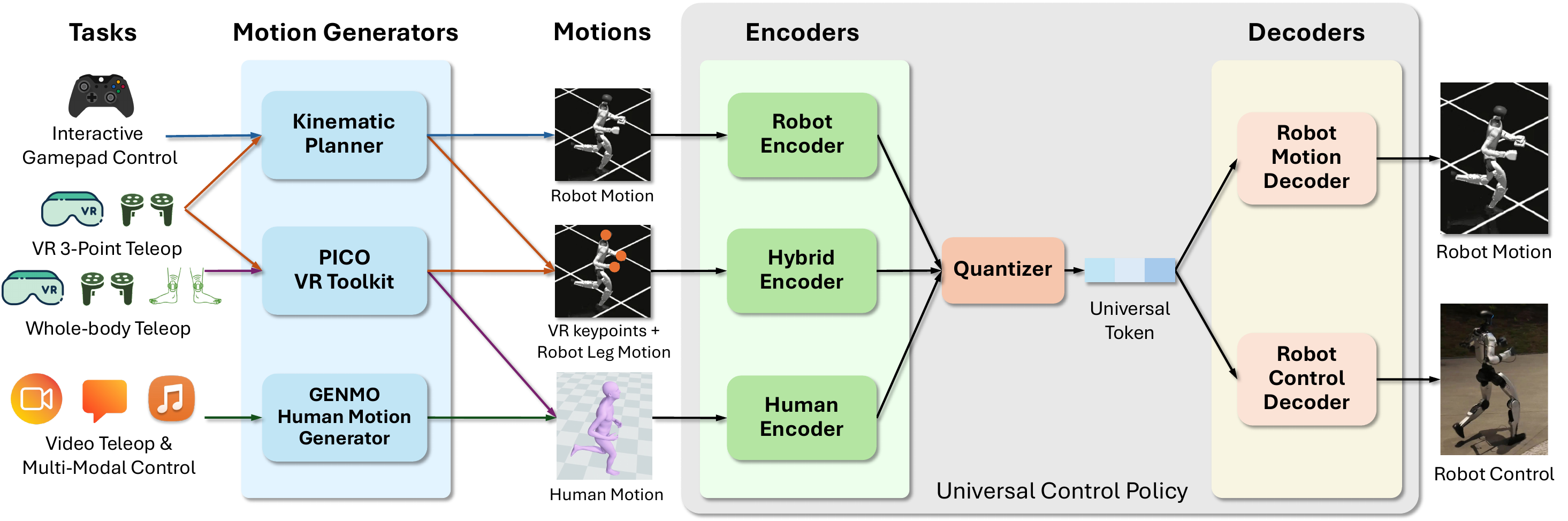
The project page and paper describe a universal control policy. Specialized encoders pack robot motion, human motion, and hybrids into a shared token. Downstream that token can be driven by:
- a real-time kinematic planner (gamepad-style walking, running, stealth, injured, squat, kneel, crawl, boxing)
- VR with three trackers (head + hands) or full-body tracking
- video teleop via GEM pose estimation (kung fu, crawling)
- text and music through GEM-generated choreography
- a VLA (GR00T N1.5 in the project write-up) for autonomous loco-manipulation
Yuke Zhu, a NVIDIA director and distinguished research scientist, told AI Business the same policy can be driven by VR, video, or VLA models and still generalize past motions seen in training.
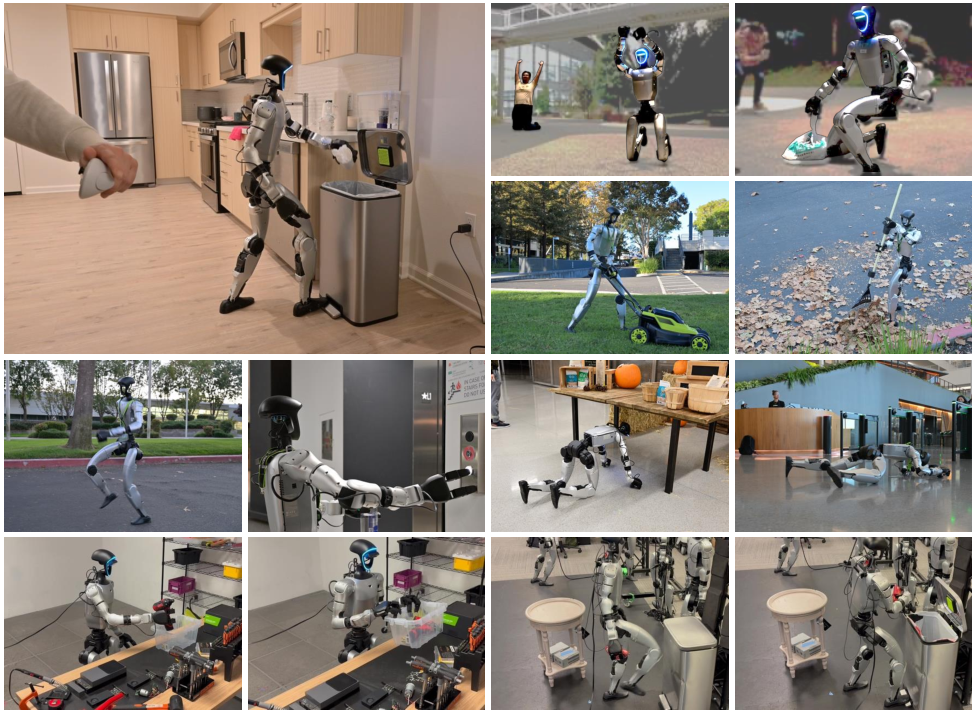
The VLA clips on the project page are the ones that look like work: pick-and-place a drill, drop a soda in a can, handle a carrot, sponge, and apple. Those need coordinated hand and foot placement, not just a walk cycle.
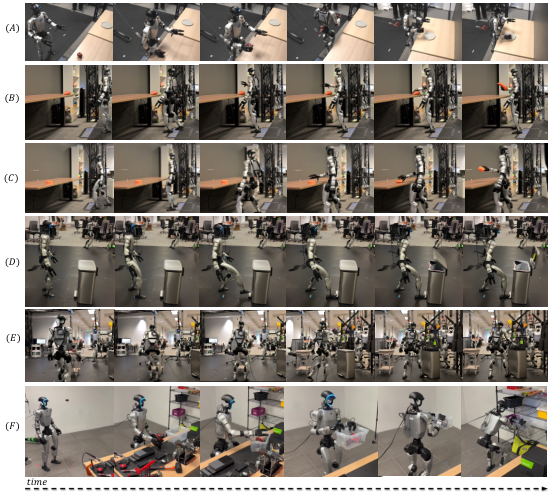
Sim-to-real numbers in the paper: on N = 124 motions, simulation succeeded 124/124 and the real G1 123/124. Against the OpenHomie specialist, survival was 197/200 runs versus 86/200.
NVIDIA released a checkpoint in July on Hugging Face as GEAR-SONIC, plus code under GR00T Whole-Body Control. Zhu told AI Business the remaining pain is contact-rich and highly constrained motion, plus the usual sim-to-real gap. Next test: long-term robustness and production-grade safety.
A Human’s Take
Scaling motion tracking is the least glamorous way to get a humanoid to crawl, and that is why I like it. Dense mocap supervision beats another hand-tuned reward for “look alive.” 123 out of 124 on the real G1 is a serious transfer number. The catch is still the one Zhu named: contacts and tight spaces. A policy that can mow a lawn in the parking lot still has to prove it can hold a drill for a shift.