OccPlanner Turns a Pixel Tap Into a 3D Path on a Go2
OccPlanner is a diffusion local planner that takes a pixel in the camera as the goal, then builds a continuous path through a learned 3D occupancy volume. The technical report is on arXiv as 2608.14160.
A pixel has no depth and no “you can walk here” label. Most pixel-goal stacks either stay in image space or back-project a waypoint and hope. OccPlanner’s bet is to keep asking the occupancy grid where the floor actually is.
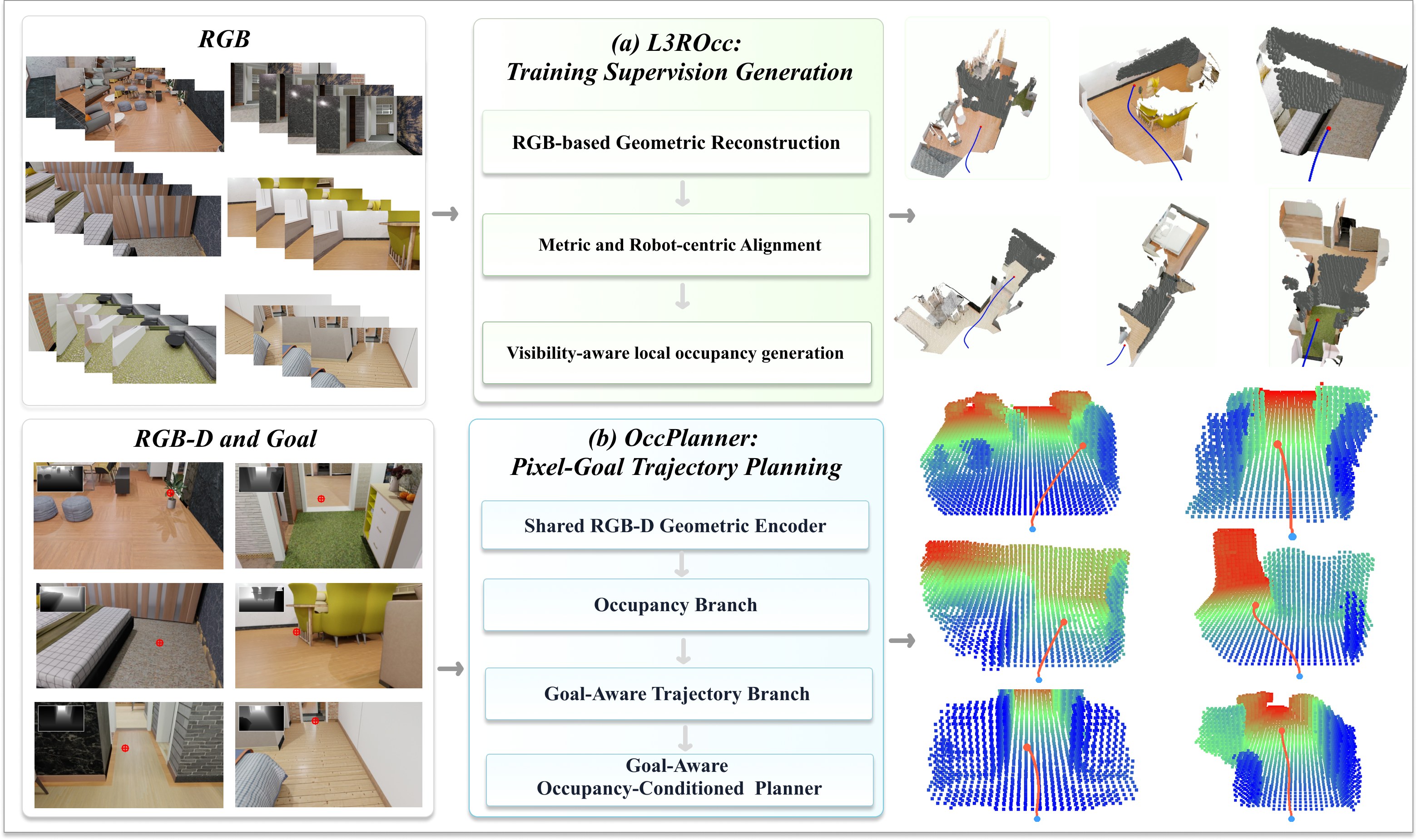
L3ROcc, then a two-stage goal
L3ROcc (Local 3D Reconstruction with Occupancy) turns monocular navigation video into robot-centric occupancy. It reconstructs geometry with π³, voxelizes it, then ray-marches so voxels are occupied, observed free, or unknown.
OccPlanner shares an RGB-D encoder, predicts a local occupancy volume, and compresses the near-ground slice into tokens. The pixel goal becomes a Fourier feature. Two cross-attention stages then mix that goal with visual history and occupancy before a 10-step diffusion head emits 24 waypoints.
Training used InternData-N1: more than 200,000 simulated indoor trajectories, 30 epochs on four H100s, about 48 hours. Input is eight 224×224 RGB-D frames.
The number that jumped
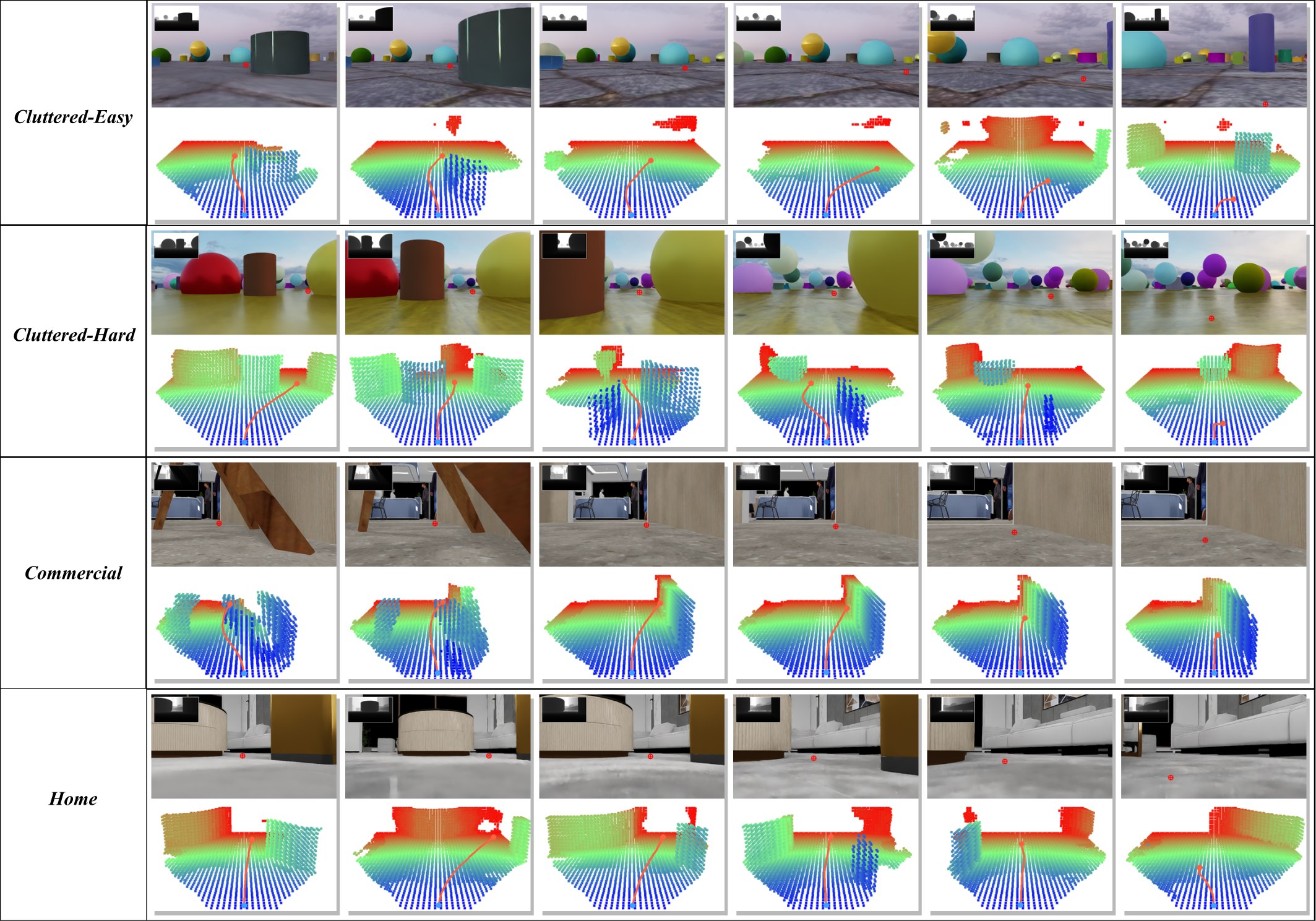
Closed-loop eval is 6,000 episodes in 60 unseen InternScenes rooms: home, commercial, cluttered-easy, cluttered-hard, at 3–5 m and 5–8 m.
In the 5–8 m band, average success over four categories rises from NavDP’s 20.81% to 71.55%. Cluttered-easy hits 86.20%. Cluttered-hard hits 84.92%. The paper also lists home going from 24.98% to 69.90% and commercial from 19.07% to 45.17%. Success is a stop within 0.5 m.
Ablations say ego-goal supervision is the big single-stage gain, and two-stage conditioning then lifts cluttered-hard from 75.55% to 84.92%.
A Go2 in an office, open-loop
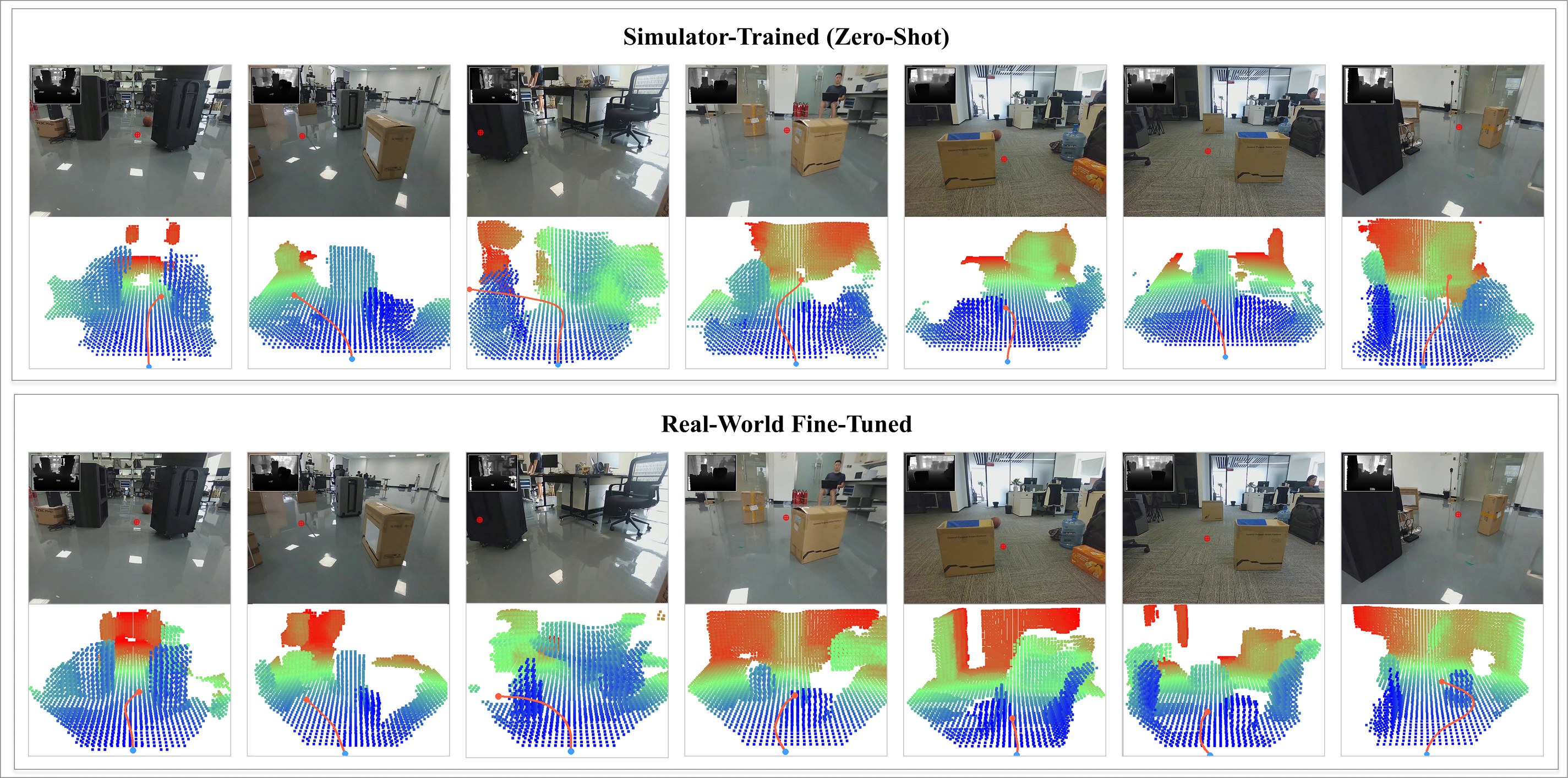
They recorded RGB-D on a Unitree Go2 in a cluttered office. Zero-shot, the sim-trained model already draws coarse obstacles and a goal-directed curve. Fine-tuning on 829 L3ROcc-labeled real clips makes the occupancy denser around furniture. That test is open-loop and qualitative. No closed-loop physical success rate is in the paper.
A Human’s Take
Tapping a pixel on the floor is how I already drive a robot when I do not have a map. The 70-point clutter jump is the part I will remember. The Go2 reel is still a look-but-don’t-walk test. Close the loop on that office and then we can talk about whether occupancy tokens earn their keep outside InternScenes.