OpenDexGrasp Picks Up a Pitcher by the Handle, Not the Body
Most grasp papers ask whether a hand can hold an object. OpenDexGrasp asks whether it holds it the way the task needs: kettle by the handle, knife away from the blade, spray bottle with the trigger free.
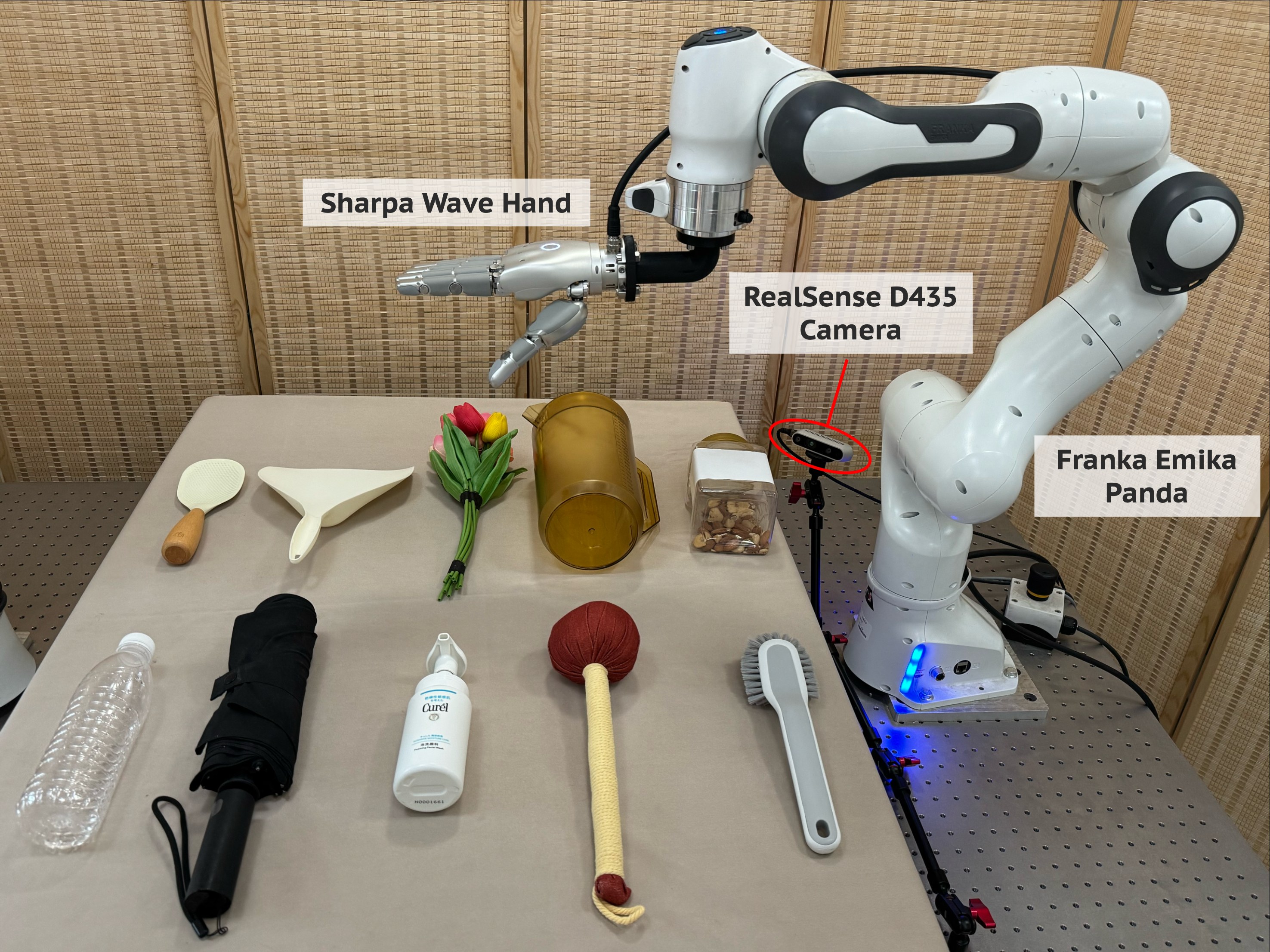
The Peking University team posted the CoRL 2026 paper as arXiv 2609.18117 (v2 on 17 September 2026) and a project page with real-robot clips. Hardware is a Sharpa Wave hand on a Franka Emika Panda, with an Intel RealSense D435 for pose.
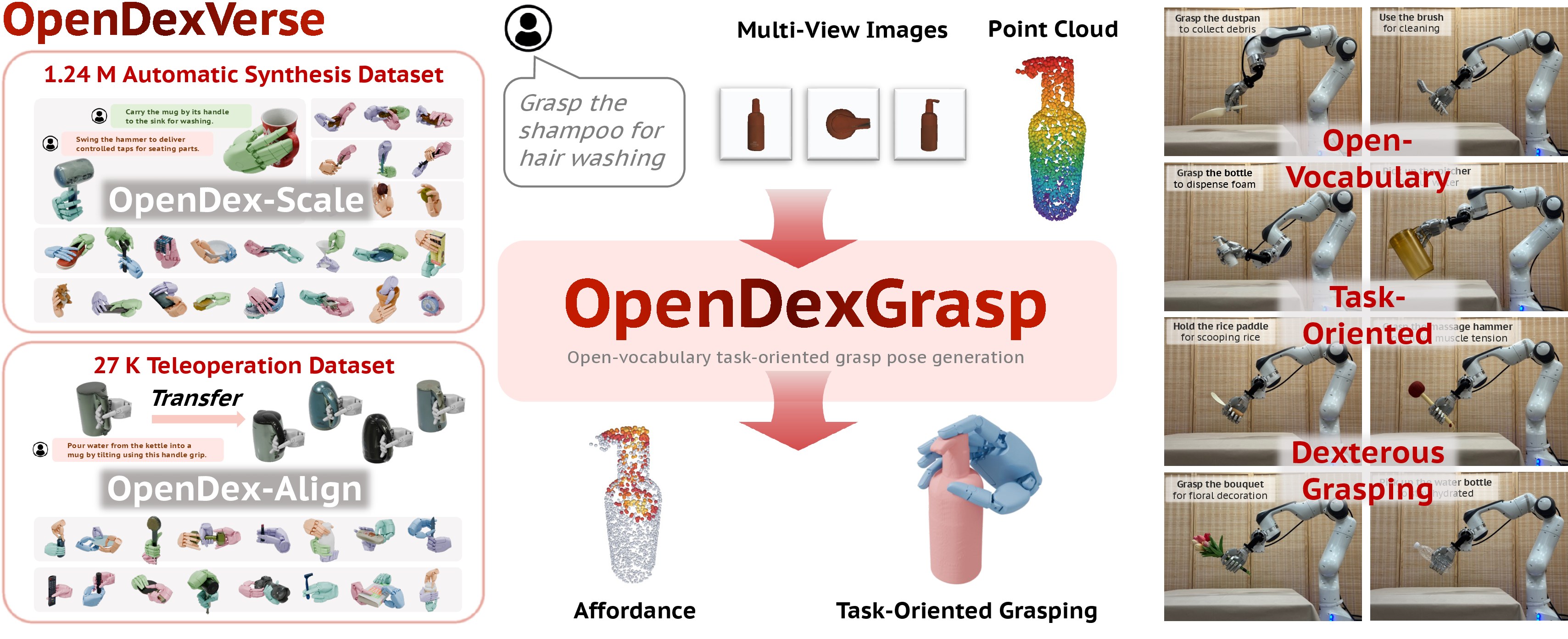
Coverage, then alignment
The data recipe is C2A (Coverage-to-Alignment). OpenDex-Scale is the wide net: 105 categories, 1.11k instances, 1.24 million automatic grasps, 557.18k functional poses tagged by a VLM (44.93% functional). OpenDex-Align is the clean set: 95 categories, 2.77k instances, 27.42k teleop and transferred grasps, 68.02% functional.
The model fuses multi-view RGB and language through a pretrained VLM (Qwen3-VL-4B in the appendix), a PointNet++ cloud, and a flow-matching action expert. Affordance is an auxiliary head on the same latent, not a separate map-then-search step at test time. Grasp pose is 31-D: 3 translation, 6-D rotation, 22 joints.
Numbers that matter
In simulation, functional success is 68.07% on seen objects and 62.96% on unseen, versus 50.88% and 43.22% for a DexGraspNet 2.0 baseline the authors retrained with CLIP on the same splits. Unseen penetration depth drops from 1.62 cm to 0.48 cm.
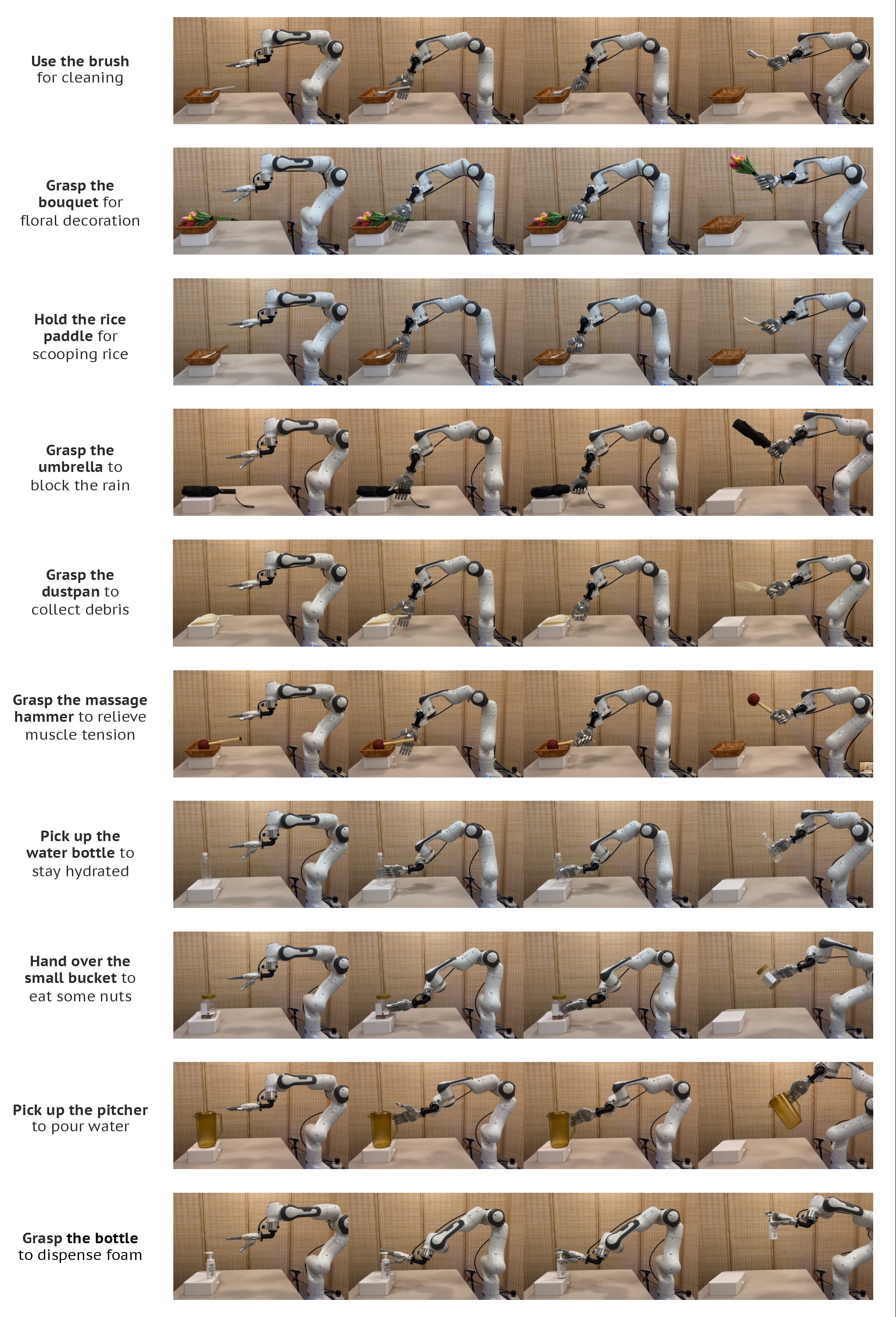
On the real hand, average success is 72.0% versus 59.0%. Per-object rates from the paper’s Table 4 include pitcher 80% (baseline 50%), water bottle 100% (70%), umbrella 90% (80%), and bouquet 50% (40%). The authors flag open-loop execution, no tactile loop, and a still-small Align set.
A Human’s Take
“Grasp the pitcher to pour” is the right test. I like that they published the misses (bouquet at 50%) next to the pitcher win. The next receipt I want is closed-loop contact, not another million synthetic poses.