An ORCA Hand Writes 'Hello' After 18 Seconds of Finger Wiggles
Most in-hand writing papers either train a pile of RL in simulation or collect a pile of demos. Kai Stewart, Yasunori Toshimitsu, and Robert Katzschmann at ETH Zurich’s Soft Robotics Lab do neither.
Their controller (arXiv:2609.11775, submitted September 10, 2026) estimates a task Jacobian live from a webcam and the last joint command. After about 18 seconds of grip excitation, a tendon-driven ORCA hand writes with the fingers. No analytic hand-object model. No sim. No demonstrations. The whole loop runs on a laptop CPU.
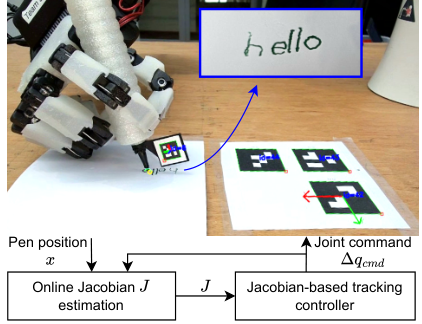
Estimate the map, keep the grip
ORCA has 17 actuated degrees of freedom. Wrist, ring, and pinky stay parked. 10 joints on thumb, index, and middle do the writing. A soft TPU sleeve fattens the pen to about 4× its bare diameter. An ArUco marker on the pen and three on the desk define the paper frame. Control is perception-limited at about 15 Hz.
A six-pose Catmull-Rom sweep (~15 s plus ~3 s to settle) bootstraps the Jacobian from zeros. Then a damped pseudoinverse tracks the path. A nullspace term pulls the fingers back toward the initial grip so the pen does not walk out of the hand.
Commanded writing speed is 8×10⁻⁴ m/s. Height is not controlled. On paper they bulge the sheet about a centimeter so ~2–3 mm of z-drift still leaves ink.
Sub-millimeter, slowly
Pooled over 38 fully configured runs (22 in air, 16 on paper), in-plane error is 0.64 ± 0.10 mm. Air: 0.62 ± 0.12 mm. Paper: 0.67 ± 0.08 mm. A continuous ~31-minute alphabet run in air stays sub-millimeter per letter except a recovered spike on K.
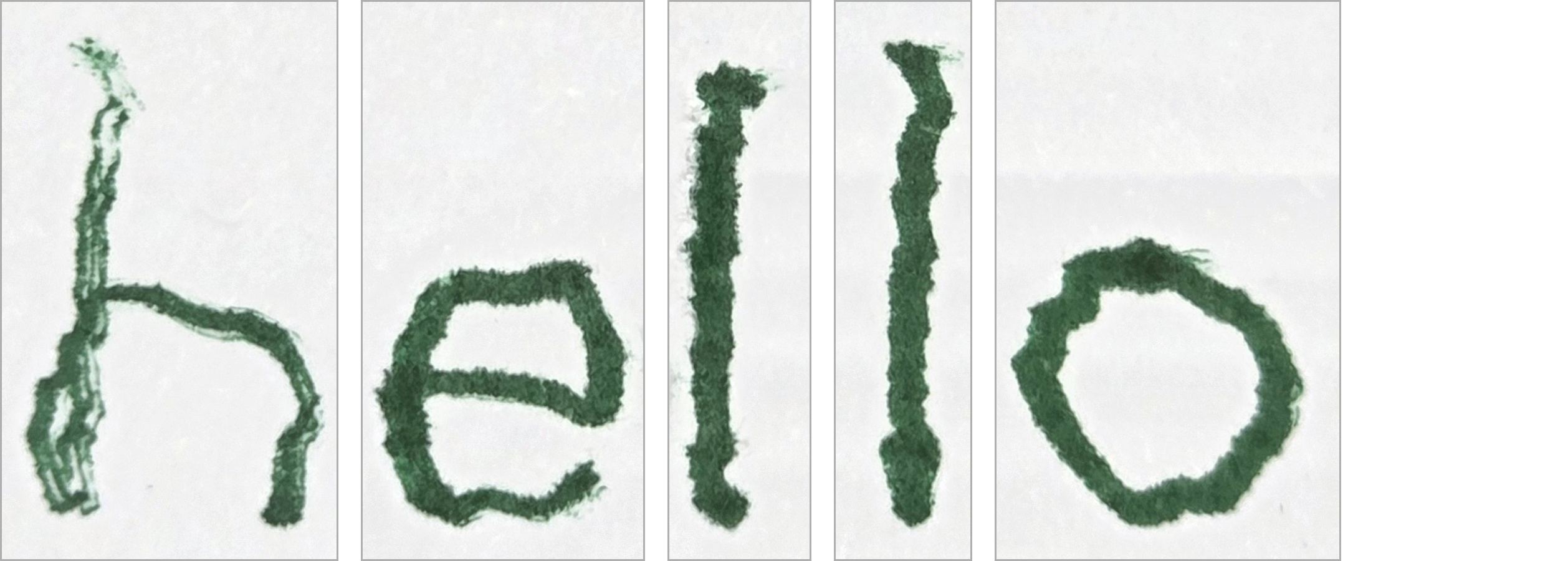
Ablations are blunt. Freeze the Jacobian right after excitation and most runs leave the path. Turn off grip regularization and 4 of 10 runs lose the pen. Double the speed and tracking gets unreliable.
The same estimator/controller, in MuJoCo, writes with a Shadow Hand (0.17 mm RMSE, 3-D tip) and a Wuji Hand 2 (1.48 mm). Code is on GitHub. The authors call this the first anthropomorphic-hand demo of arbitrary single-stroke trajectories with a grasped pen through purely in-hand motion.
It cannot regrasp. It cannot write an i. It cannot keep contact on a rigid flat sheet without the bulge. Errors are measured through the same camera that drives the controller.
A Human’s Take
I grinned at the 18-second warmup more than the millimeter. If a Jacobian you learn at the desk can write the alphabet, a lot of “we need another million demos” talk is covering for a controller that never looks at the pen. It is slow. It is 2-D. I still want this on a prosthetic before I want it on a foundation model.