PAC-MAN: Caltech Teaches a Unitree G1 to Dodge Balls Safely
Caltech’s AMBER Lab released PAC-MAN—Perception-Aware CBF-RL for whole-body safety in humanoid dodgeball—on arXiv (submitted 30 Jul 2026). The punchline: a Unitree G1 dodges thrown balls using only onboard sensing, with a 95% hardware success rate (19 of 20 hand throws) and zero falls.
Why dodgeball is a serious benchmark
The robot must clear every body link from a ball’s path and stay upright. At deployment, the policy never gets privileged ball state. It sees only segmentation-masked depth from a head-mounted RGB-D camera—the same sparse ball-only representation used in training.
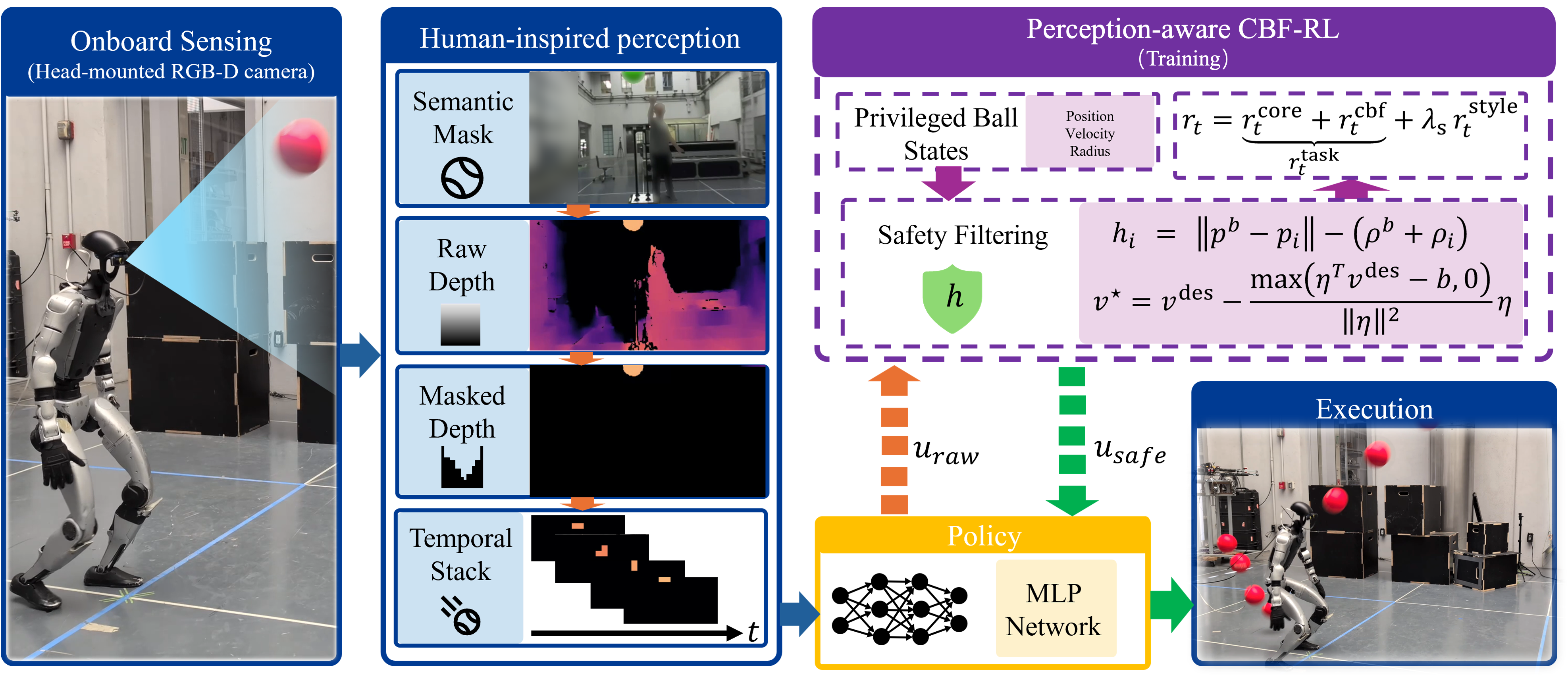
Authors Lizhi Yang, Junheng Li, and Aaron D. Ames couple:
- Link-CBF training rewards that enforce clearance barriers on each link (deployed policy).
- Joint-CBF guidance / privileged filtering for sim ceilings when ball state is known.
- An adversarial motion prior so evasive reflexes look human-like (ducks, sidesteps, leaps).
Results that transfer
On a controlled any-link contact benchmark (seeded throws; single throws and a walk-back deployment loop), the fixed-camera policy sits within a few points of a privileged oracle. Joint-CBF wins when ball state is accurate, degrades under fixed-camera partial observability, and recovers with a tracking gimbal or privileged filter.
On hardware, a lightweight Link-CBF policy transfers zero-shot to the G1. An EfficientTAM segmenter masks ZED depth to the training observation. Semantic segmentation makes the threat ball-agnostic—the robot dodges ball types it never saw in training.
Code is public on GitHub; the project site includes an in-browser throw-a-ball demo.
A Human’s Take
Whole-body safety that works when the camera loses the ball for a frame is the product. Lab oracles that assume full state are easy; 95% on imperfect onboard perception is the receipt. Next question is whether the same barrier-shaped RL survives multi-agent clutter, outdoor light, and industrial payloads—not just gym dodgeball.