Jizai Puts Palmimo DevKit on Sale: A Six-Legged Desk Robot You Drive in Python
Jizai started early-access sales of Palmimo DevKit on 3 September. It is a tabletop six-legged robot you drive with your own Python, priced at ¥598,000 excluding tax (the company lists about $3,980 as a reference). No monthly fee. Thirty-day initial warranty.
The kit is aimed at Early Builders (developers and researchers) and Early Partners (companies and labs running a PoC). It ships assembled and tested. Jizai says you should be able to start coding the day it arrives.
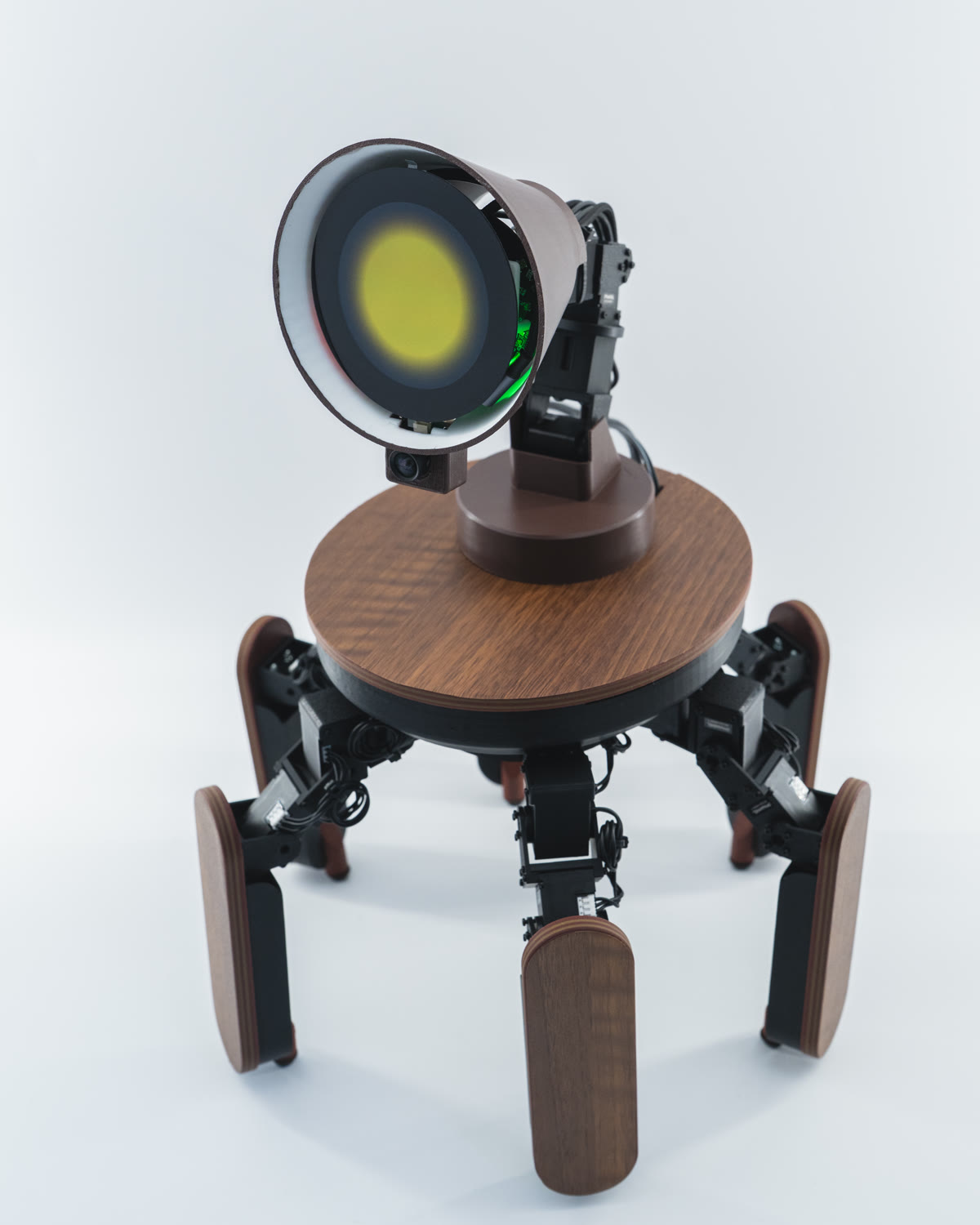
What you actually get
The official site and the PR TIMES release agree on the hardware:
- Size / mass: 400 × 300 × 300 mm, about 2 kg
- Degrees of freedom: 21 axes (3 per leg × 6, plus a 3-axis neck)
- Actuators: DYNAMIXEL XC330-M288-T × 21, 5 V
- Compute: Raspberry Pi 5 with 16 GB, onboard
- Sense / show: 5 MP USB camera, ReSpeaker mic array, 3 W stereo speakers, 2.8-inch round touch display (480 × 480)
- Software: Raspberry Pi OS 64-bit, Python 3.12+,
palmimo_sdk
GitHub describes the gait as an anti-phase tripod: 18 leg servos walk, a servo neck aims the face, and a small expression engine draws HAPPY / ANGRY / SAD and friends on the round display. Motions include forward, wave, bow, dance, and pushup. The motion engine is pure gait plus inverse kinematics. Dry-run mode computes every motion with no hardware attached.
Open software, closed metal
The GitHub repo is Apache-2.0. Open now: the Python SDK and drivers, an agent layer that turns LLM tool calls into robot actions, an MCP server for Claude Code / OpenClaw / any MCP client, example agents, LeRobot plugins, and the docs. Hardware CAD is not in the repo. Jizai says manufacturing design stays unpublished for now; early buyers get hardware information ahead of later lots.
Palmimo used to be called Mi-Mo. It debuted at CES 2025. A DevKit is on exhibit at Miraikan’s Tokyo Mirai Park through 23 September 2026.

A Human’s Take
I like a robot that looks like a lamp table and answers robot.wave(). The price is not hobby-kit cheap, but it is in the “one lab can buy it” band, and the software is actually public. The useful test is whether the MCP tools and the dry-run engine make a software person ship a behavior in an afternoon. If the metal stays closed while the Python stays open, that is a fair trade for a unit that arrives already walking.