UCL’s PAMoR Makes a G1’s Whole-Body Motion Carry Valence and Arousal
University College London researchers posted PAMoR on 28 August (arXiv:2608.28213): real-time whole-body motion on a 29-DoF Unitree G1 where what the robot does is a text prompt and how it does it is a point on the valence–arousal plane. Yan Pan, Lingfan Bao, Tianhu Peng, and Chengxu Zhou have it under review at IEEE Robotics and Automation Letters.
Most “emotional robot” pipelines either copy a reference clip or stuff an emotion word into a prompt. PAMoR measures affect from the robot’s own kinematics, then uses that number as a generation condition. No human labels on the training motions.
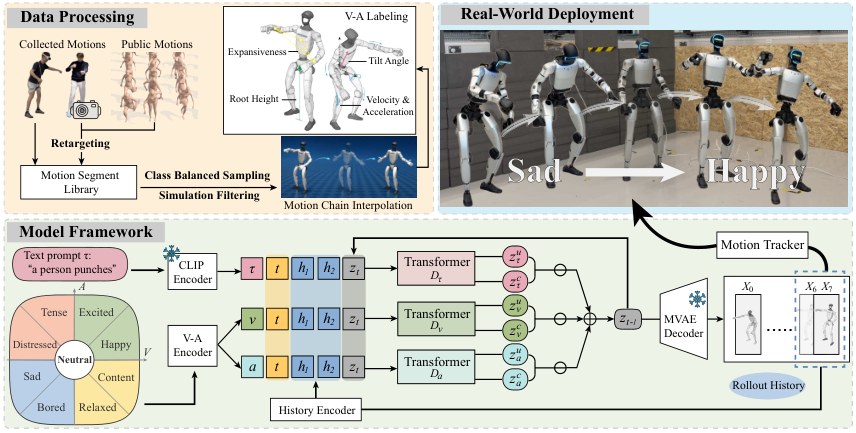
Measure first, then generate
Valence comes from postural expansion: arm span, root height, trunk tilt. Arousal comes from movement energy: keypoint speed and acceleration. Both are z-normalized, summed, then clipped to [−1, 1]. That labels the whole corpus in closed form.
Three diffusion priors share a frozen motion VAE latent space. One prior is text (the action). Two are the affect scalars. At each denoising step their classifier-free guidance terms are summed, so you can turn valence without rewriting the punch. Motion rolls out 8 frames at a time from 2 history frames. On an RTX 5090 the three-prior step is 78 ms for 400 ms of motion.
The corpus is 10,095 training chains and 2,406 held-out chains over 15 action classes, at 20 Hz on the G1. Sources include BABEL-annotated AMASS, video reconstructions, and teleop, all filtered through NVIDIA’s SONIC tracker in simulation.
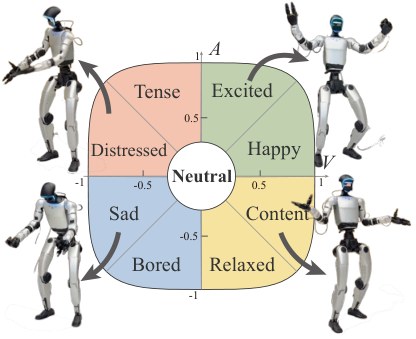
Do people read it?
Commanded V-A, measured back on generated motion, tracks with rank correlation 0.95. Cross-axis correlations stay below 0.06.
The user study is the receipt. Twelve raters, 840 trials, seven actions crossed with Russell’s eight circumplex emotions. Clips are G1 only, no face. Chance is 0.125 top-1 and 0.375 top-3.
| Method | Top-1 | Top-3 | Weighted κ | Naturalness (1–5) |
|---|---|---|---|---|
| Emotive text prompt (TextOp) | 0.125 | 0.423 | 0.060 | 3.40 |
| Style clip (SMooDi, retargeted) | 0.202 | 0.417 | 0.209 | 3.25 |
| PAMoR | 0.384 | 0.845 | 0.688 | 4.05 |
Acted human bodies in the Emilya database hit 0.44 top-1 on a similar protocol. PAMoR’s per-emotion range is 0.21 (relaxed) to 0.49 (excited). Ablation: a single prior jointly conditioned on text and V-A drops action accuracy from 0.748 to 0.478. Composition is doing the work.
Limits they own: equal weights on the valence cues are a convention, the whole-body tracker is open-loop on affect, and executed V-A can drift.
A Human’s Take
I am so here for a humanoid that can punch “happily” without the prompt eating the punch. Measuring expansion and energy from kinematics is a cleaner trick than hiring annotators to argue about sad walks. The 0.38 recognition number is not magic, but it is in the same neighborhood as acted humans, on a robot with no face. Close the tracker loop next, or the affect you commanded is not the affect that hits the floor.