PanoVLA Puts 360° Context Into Mobile Bimanual Manipulation
Mobile arms keep failing for a boring reason: the thing they need is outside the wrist camera, and the base has already rolled past the only good view.
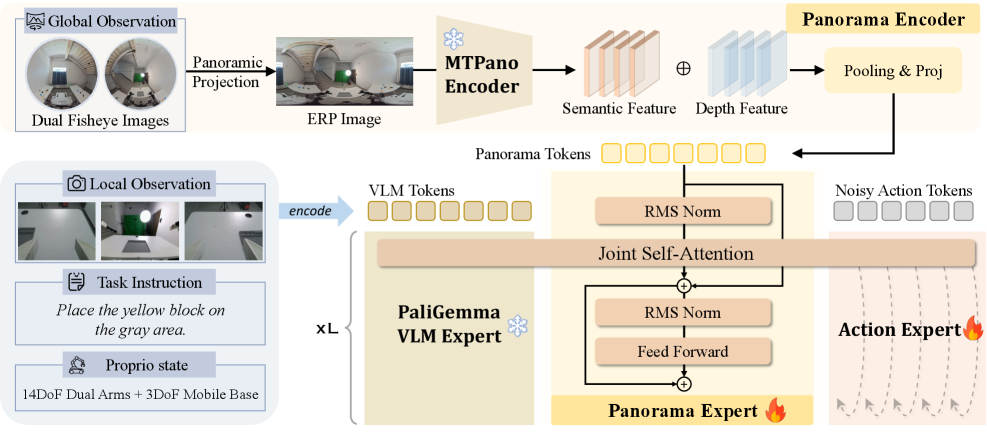
PanoVLA, described in arXiv:2608.02257 (submitted Aug 3, 2026), is a panorama-aware vision-language-action policy for wheeled bimanual robots. The authors pair a VR whole-body teleop stack with a Mixture-of-Transformers model that treats a top-mounted 360° camera as first-class context, not an afterthought image stream.
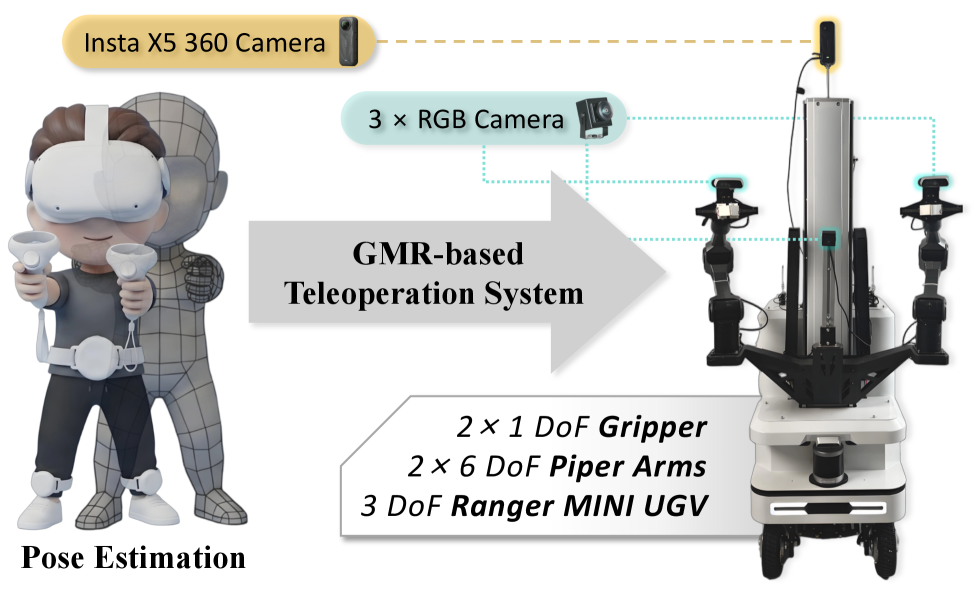
What they built
Hardware is a RANGER MINI 3 base, two Agilex PIPER 6-DoF arms with parallel grippers, three local RGB cameras (front + two wrists), and a top-mounted 360° camera stored as equirectangular images. Operators wear a VR headset, two hand controllers, and three body trackers; sparse motion is reconstructed into SMPL and retargeted through General Motion Retargeting (GMR) so base and arms move from one body stream instead of a separate joystick for the chassis.
Dataset facts from the paper:
- 800 successful teleoperated trajectories (200 per task)
- About 5.5 hours of multimodal demos
- Roughly 500K synchronized frames at 25 Hz
- Whole-body action is 17-D (14 arm/gripper + 3 base velocities)
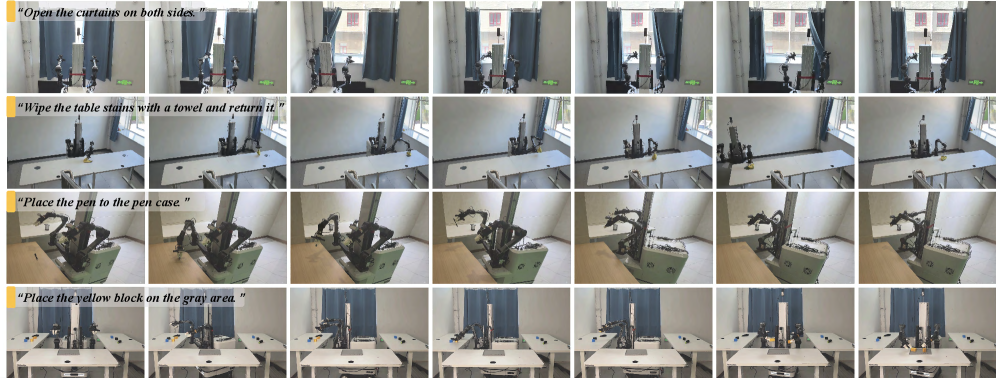
Tasks: Move Pen, Move Block, Open Curtain, Wipe Table — layouts that deliberately put targets off-axis relative to local cameras.
Results that matter
Closed-loop real-robot evaluation (15 trials per task) reports average stage completion rate 91.3% and end-to-end success 73.4% for PanoVLA. A local-view π0.5 baseline lands at 58.6% SCR and 30.0% SR. Naively stuffing the equirectangular panorama into SigLIP helps some tasks but collapses on long multi-stage work such as Wipe Table; the dedicated MTPano encoder plus 100M panorama expert is what holds global state across stages.
A Human’s Take
I’m so here for the boring sensor upgrade: one more camera, wired into the policy the hard way. Mobile manipulation fails less because of “not enough foundation model” and more because the robot keeps forgetting where the cloth is when the base turns. If panoramic fusion stays this useful outside one lab layout, every wheeled dual-arm cell is going to want a ceiling eye — and a training stack that doesn’t treat that eye like a decorative logo cam.