Perceptron Opens Isaac 0.5, a 36B Robot Model
Perceptron AI released Isaac 0.5, a 36-billion-parameter sparse model that reads images, video, language, robot state, and previous actions, then answers questions, points at objects, estimates task progress, or outputs robot actions. The company blog is dated 26 August. Weights, a technical report, and LeRobot-side training and inference code are public.
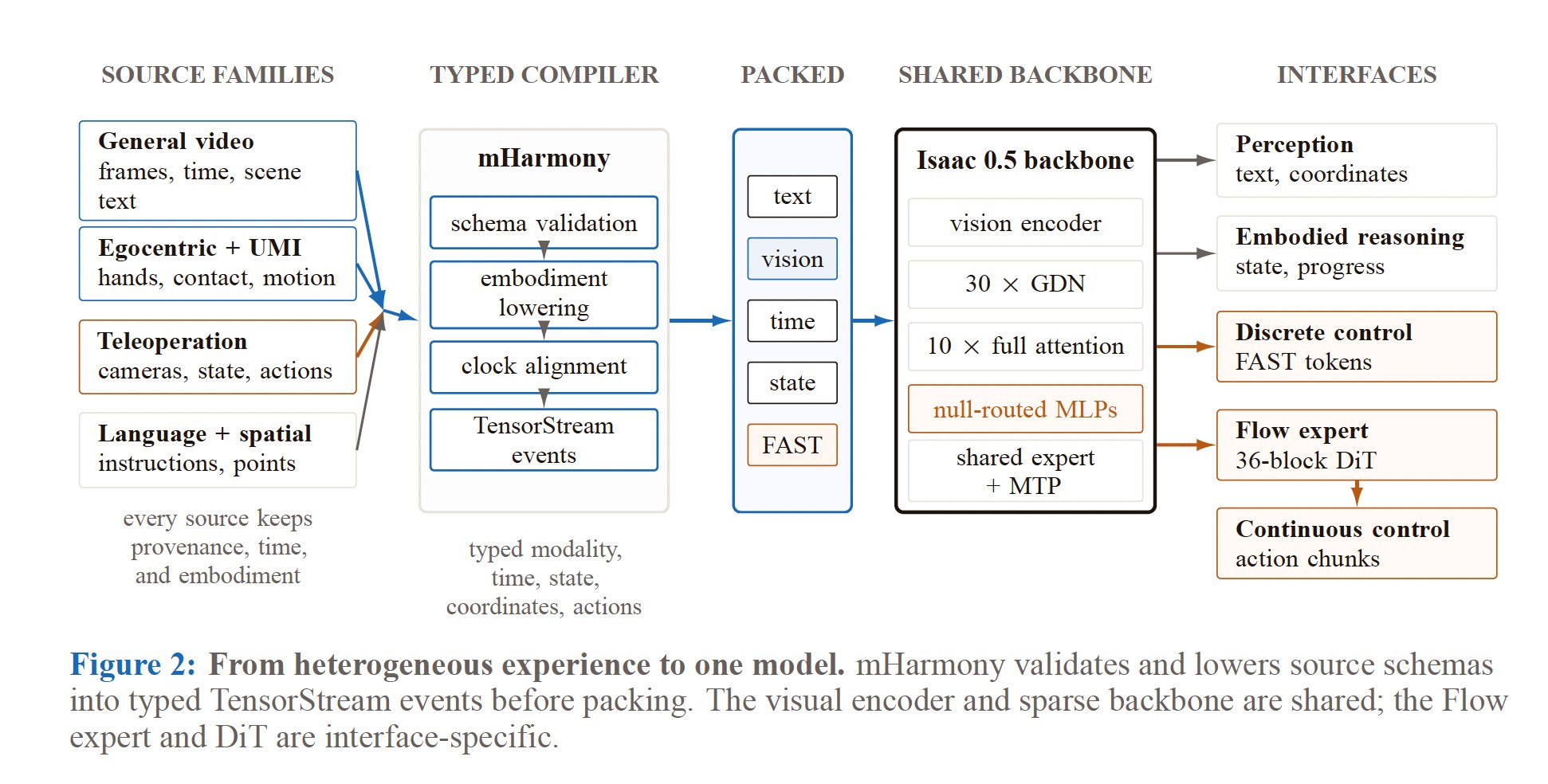
The training mix, from the blog and Hugging Face model card: more than 35 robot systems, 100,000 hours of robot experience, 1 million hours of general video, and 3 trillion multimodal tokens. Video understanding, spatial grounding, task progress, future-percept prediction, and control were co-trained on one backbone.
The scaling law they want you to use
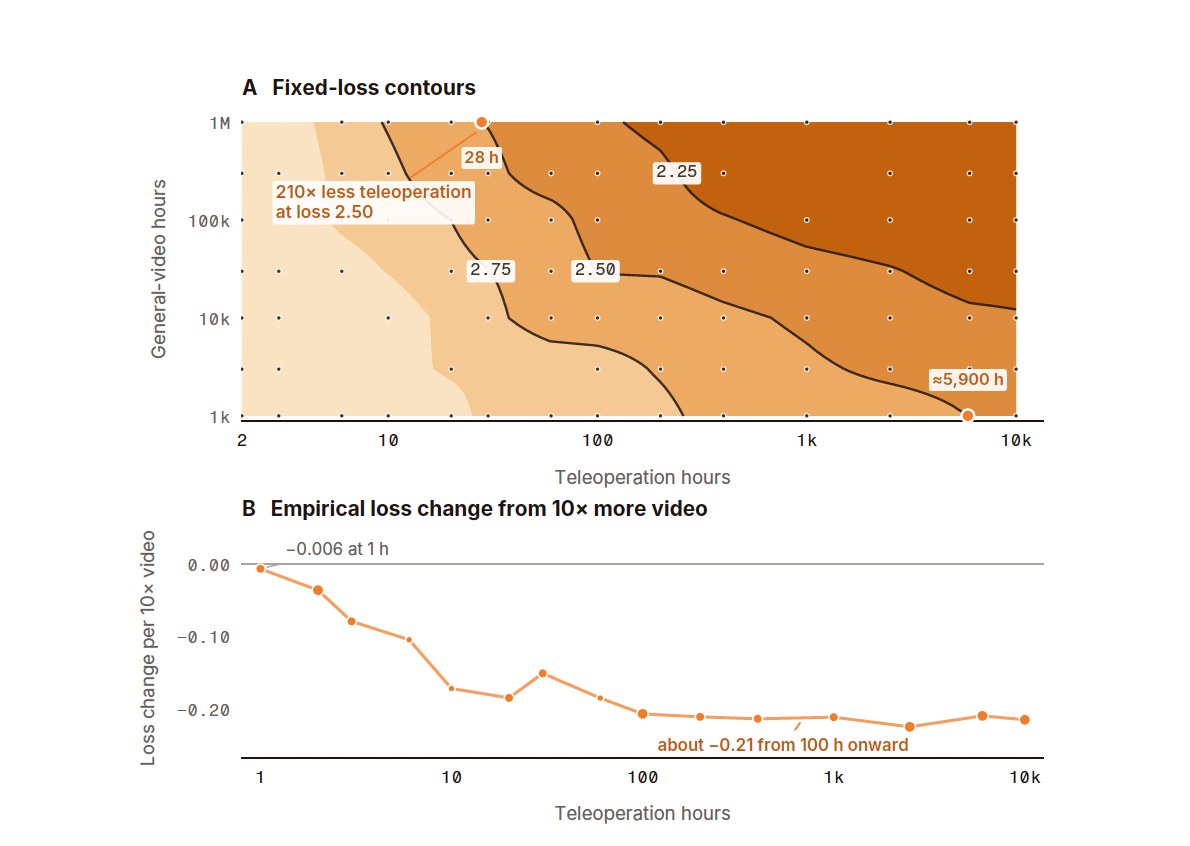
Holding an 80:30:30 mix of general video, egocentric video, and UMI data, Perceptron scaled pre-training and measured held-out action-prediction loss. To hit a calibrated loss of 2.50:
- 1,000 hours of general video needed about 5,900 hours of teleoperation
- 1 million hours of video needed about 28 hours of teleop
That is the 210× figure in the announcement. Cheap video, in this plot, buys down expensive robot time.
The model card also lists two action interfaces off the same backbone: FAST tokens (2,048-token discrete vocabulary) and a Flow expert with a 36-block diffusion transformer for continuous chunks. Mixture-of-experts layers give each token access to 256 learned experts plus a null route.
What other outlets added
TechCrunch’s 26 August piece names the founders: Armen Aghajanyan and Akshat Shrivastava, formerly of Meta FAIR. The company started in November 2024. PitchBook, via TechCrunch, puts a prior round at $21 million from Bessemer, Foundation Capital, and S32, with another round in process.
The AI Insider, citing Perceptron’s Business Wire announcement, reports a 97.2% average on LIBERO, against 97.0% for NVIDIA GR00T N1.7 and 96.9% for π0.5 in Perceptron’s comparison table. After one epoch on a single expert chess-manipulation episode, Isaac’s loss dropped 7.0× to 10.5×; π0.5 was 2.3× to 3.1×. Those LIBERO numbers are the company’s table, not an independent bake-off I re-ran.
Aghajanyan, in that announcement:
“Companies need a model that performs at the frontier, learns a new task quickly and adapts to their hardware. Isaac gives them a strong, open starting point, and our team is working alongside our customers to bring it into real operations.”
A Human’s Take
Open weights plus a data-mix plot is more useful than another closed VLA teaser. The 210× teleop claim is the one to stress-test: if a million hours of random video really collapses robot-hours that hard, labs with a camera budget just got a recipe. If LIBERO is saturating at 97% for everyone in the table, the interesting number is the one-demo chess drop, not the leaderboard. I’ll believe the industrial pitch when someone fine-tunes this on a warehouse arm that is not in the 35-system list.