PFM-HR Trains Humanoid Motion Priors on Unordered Pose Data
Temporal motion priors need ordered clips. Pose priors ignore how joints should change from one frame to the next. PFM-HR — Pose Flow Matching for Humanoid Robots (arXiv:2608.03227, Aug 4, 2026) — trains a flow-matching prior directly on large-scale unordered pose data, then freezes it and uses a new score to shape RL tracking rewards.
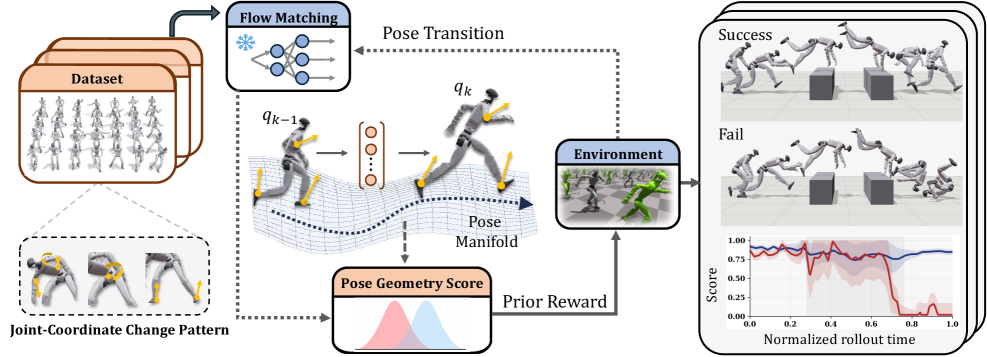
Pose Geometry Score
The paper’s core gadget is the Pose Geometry Score (PGS). It measures how joint-coordinate changes during policy rollouts align with the local geometry of pose variation captured by the flow prior. That score modulates the tracking reward so exploration prefers structured pose transitions rather than arbitrary thrashing — while the prior itself stays frozen across tasks.
Compared with clip-ordered temporal priors, the authors argue unordered pose training is easier to scale when you have giant pose libraries without clean sequence labels. Compared with static pose priors, PGS injects transition structure into the reward.
Results (authors’ claims)
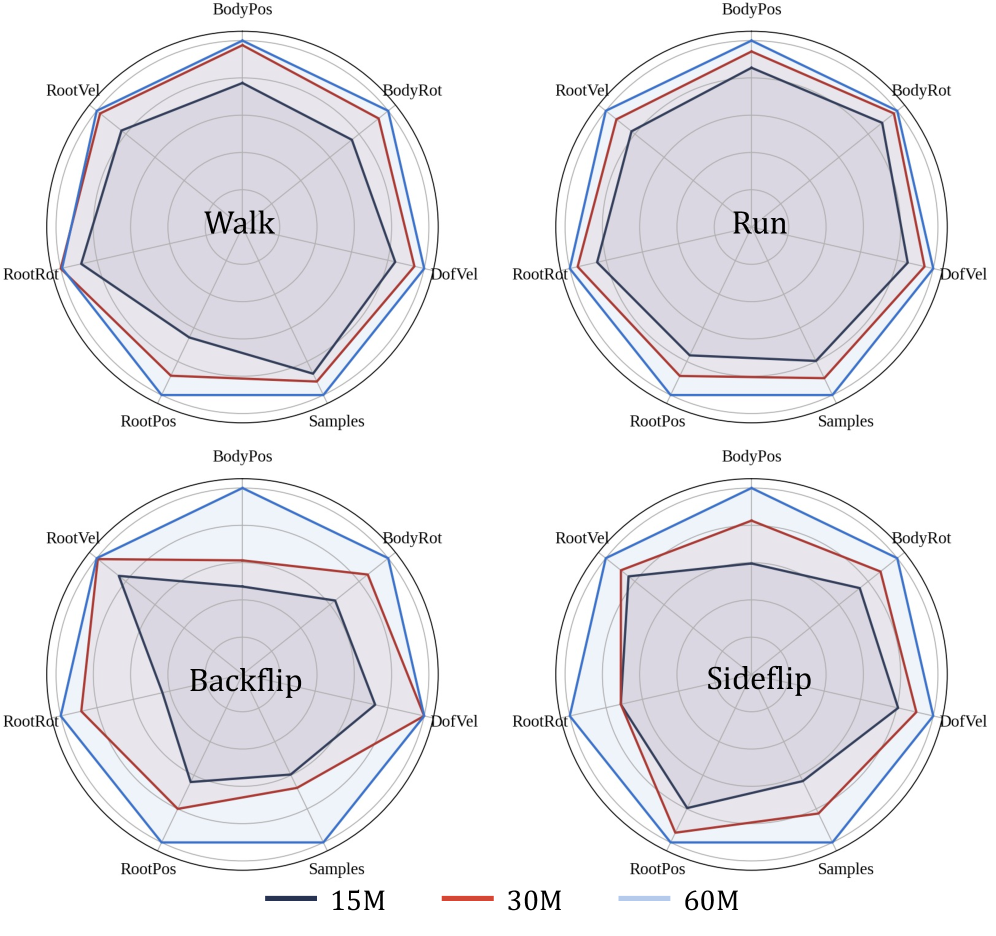
Experiments show PFM-HR improves single-motion and general motion tracking, especially on highly dynamic motions. The abstract keeps the write-up short (seven pages); the HTML figures include success/fail sequences and score traces over normalized rollout time.
A Human’s Take
Reward shaping is where a lot of humanoid RL still lives or dies. A frozen flow prior plus a geometry score is a cleaner story than “add more adversarial losses until it walks.” What I want next is an open checkpoint and a G1/H1 tracking recipe so other labs can stress-test PGS on their own motion libraries — not just the authors’ suite.