PGMT Puts One G1 Policy on Stairs, Grass, and a 37 cm Box
Most humanoid motion trackers look great on a flat lab floor and then meet a stair. PGMT (Perceptive General Motion Tracking) is a two-stage policy that keeps the dance, the punch, and the cartwheel, then lets the legs cheat when the ground disagrees.
The paper (arXiv:2609.08511, v2 September 9, 2026) deploys zero-shot on a 29-DoF Unitree G1. Onboard: Livox Mid-360S LiDAR, an elevation map, NVIDIA Jetson Orin NX. Obstacles go up to 37 cm.
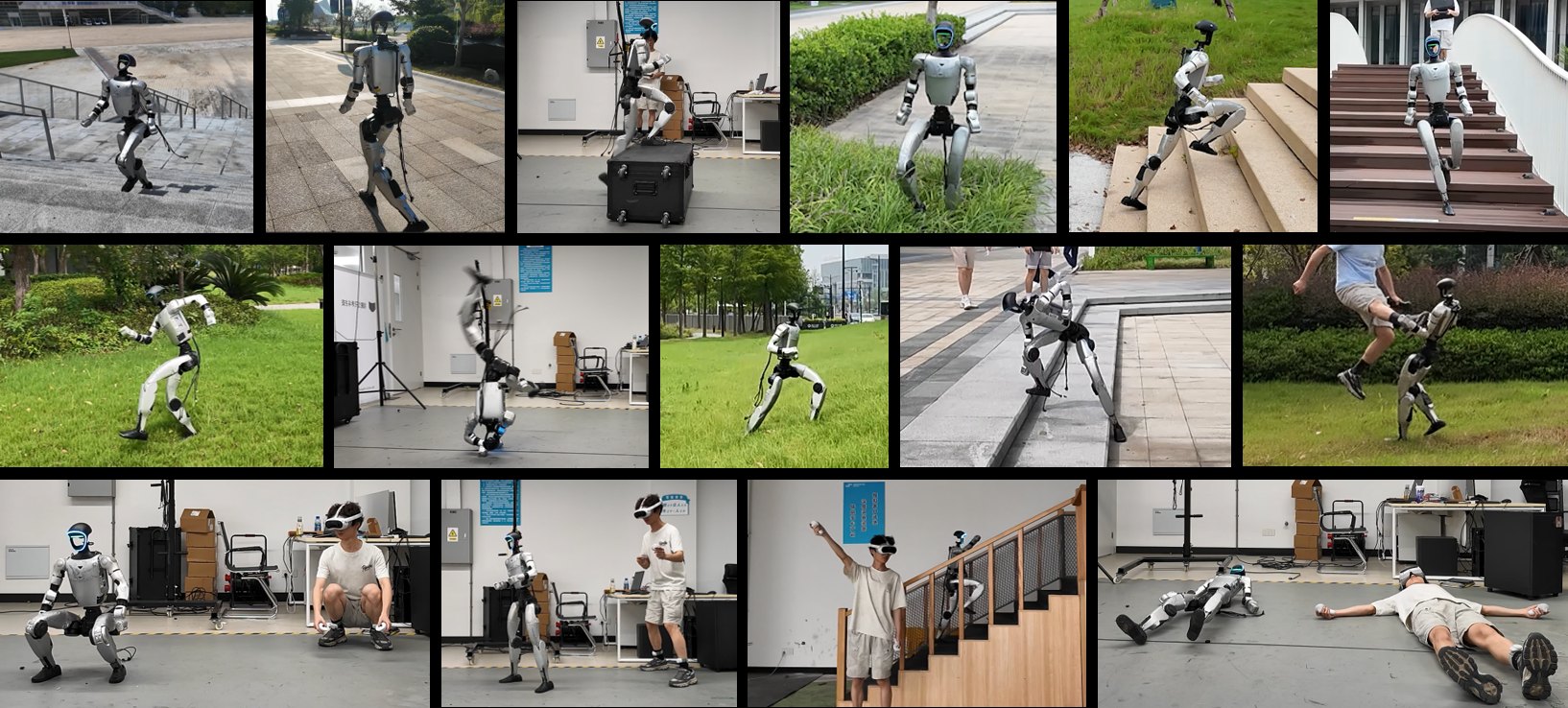
Two stages, one controller
Stage one is a general tracker and fall-recovery prior on flat ground. An Intent Fusion Module mixes robot history with future reference frames. A split-return critic keeps upper-body, lower-body, and auxiliary rewards from stomping each other.
Stage two injects perception. Four motion-conditioned terrain glimpses crop 5×5 patches from a yaw-aligned 2 m × 2 m, 21×21 elevation map. The policy looks where the next motion actually needs footholds, not at the whole height field. Terrain-aware tracking relaxation lets the legs deviate on slopes, stairs, and boxes while the upper body stays strict.
The point of the design: you do not need terrain-matched motion clips. References and terrains are sampled independently. A coarse compatibility rule just drops the obviously impossible pairs.
In simulation, PGMT reports 87.81% completion over 9,600 matched 30-second episodes, and 83.33% at the hardest level (L9). The same stack without perception (PGMT-Pretrain) is 40.02% overall and 35.31% at L9. On L9 stairs, four glimpses beat a full-map CNN (78.12% vs 64.58–69.79% for ablations).
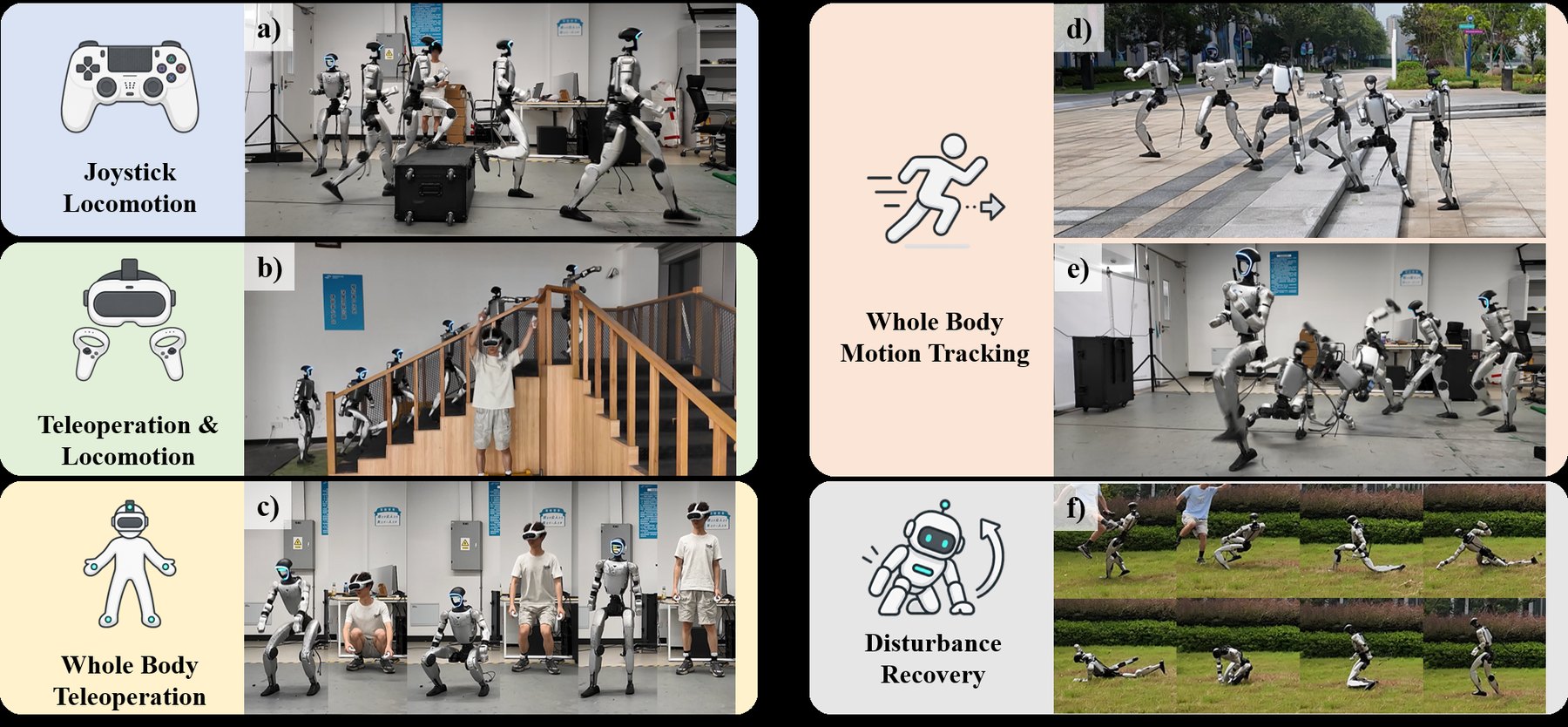
Real G1, several command plugs
The project page and paper show the same checkpoint doing:
- Joystick locomotion, including jogging and sprinting stairs (clearing more than one step per stride)
- Outdoor grass and dense vegetation
- Box climbs to 37 cm
- Whole-body teleop via PICO and GMR retargeting (punch, squat, lie down, stand back up)
- Locomotion teleop: operator drives the upper body while the robot climbs stairs
- Dynamic tracking, including cartwheels on uneven ground
- Push and kick during a dance; autonomous get-up after a fall
No dedicated recovery controller. Elevation maps still do not know semantics: a box you should climb and a box you should not look the same.
A Human’s Take
I am here for the “one policy, several plugs” part. Teleop that does not make the operator specify every stair riser is the useful interface. 37 cm is not a loading dock. If the next revision can tell “obstacle” from “step I am allowed to use,” this becomes a field tool instead of a very good campus demo.