Syracuse Gets Stock Poppy Walking Without Holding Its Hands
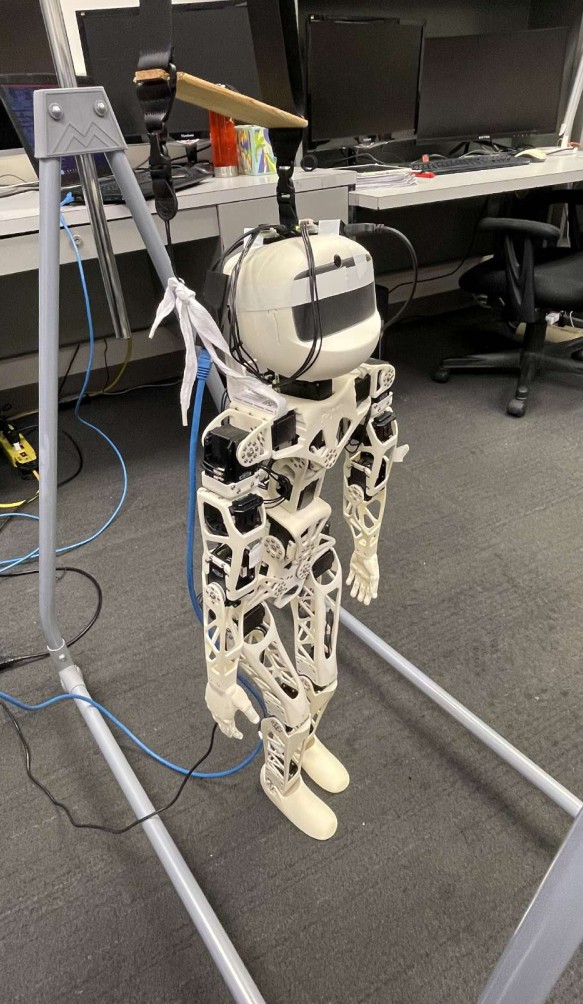
Syracuse University researchers posted a paper on 27 August 2026 that does something the Poppy community has wanted for years: unassisted walking on the standard Poppy Humanoid, not a rebuilt cousin with extra ankle axes or extra sensors. The robot is about 83 cm tall and 3.5 kg, with 3D-printed limbs, 25 Dynamixel position servos, and an Odroid in the head. Off the shelf it has no foot pressure sensors and no IMU. Control on their hardware got choppy above 5 Hz for commands, even though joint reads could run near 100 Hz.
Past published Poppy walking, the authors say, either needed a person holding the robot’s hands or a non-standard body. This paper contributes a closed-loop linear-quadratic regulator (LQR) that tracks a nominal gait and a quadratic cost learned from open-loop hardware data.
Learn the cost of falling
They first hand-tuned a six-footstep nominal trajectory, then ran 125 open-loop playbacks from March to May 2025 with Gaussian waypoint noise of 0, 0.125, or 0.25 degrees. Each run was labeled by how many footsteps succeeded before a fall. A clothing-rack harness with a camera strap caught the robot; a step counted only if the strap stayed slack the whole time.
From those residuals they fit locally linear dynamics and a quadratic cost via a convex program (CVXPY). The cost is pushed toward identity so the robot stays near the nominal gait, with constraints that fall trajectories get higher average cost than successful ones. A margin hyperparameter ε = −2 kept the closed-loop eigenvalues from blowing up.
Hardware validation: 100 runs per condition in the office, 80 per condition in a held-out lab with smoother floors.
- Office: open-loop 62% full-success, 4.18 steps before a fall. Closed-loop 78% and 5.13 steps (p = 0.00225, Mann-Whitney U).
- Lab: 30% to 42.5% success, 3.75 to 4.8 steps (p = 0.00014).
Code is on GitHub (garrettkatz/poppy-muffin). Data is on Google Drive, linked from the paper.
What it is not
The authors are clear about the leftover work. They have not optimized forward speed, turning, or cost of transport. The motors are still position-only. The lab drop versus the office is probably the floor, plus wear from teaching use between data collection and the test. This is a first closed loop on stock hardware, not a parkour policy.
A Human’s Take
I like papers that pick the cheap robot everyone already has and make it walk without a babysitter. Five hertz and no IMU is a miserable plant, which is why the result is interesting. The p-values are on real footsteps, not a sim histogram. If the next step is a camera-based velocity estimate instead of another custom ankle, Poppy becomes a teaching platform that actually takes a few steps on its own.