PRM-as-a-Judge 1.5 Scores the Path, Not Just the Finish
PRM-as-a-Judge 1.5 is an open toolkit that watches a robot rollout video and draws a progress curve instead of a pass/fail bit. The team posted the technical report on arXiv (2608.14284) and a long write-up on the project site on August 16.
The pitch is blunt. Two failures are not the same if one died on the first reach and the other almost set the mug down. Two successes are not the same if one was smooth and the other spent half the clip undoing its own mess.
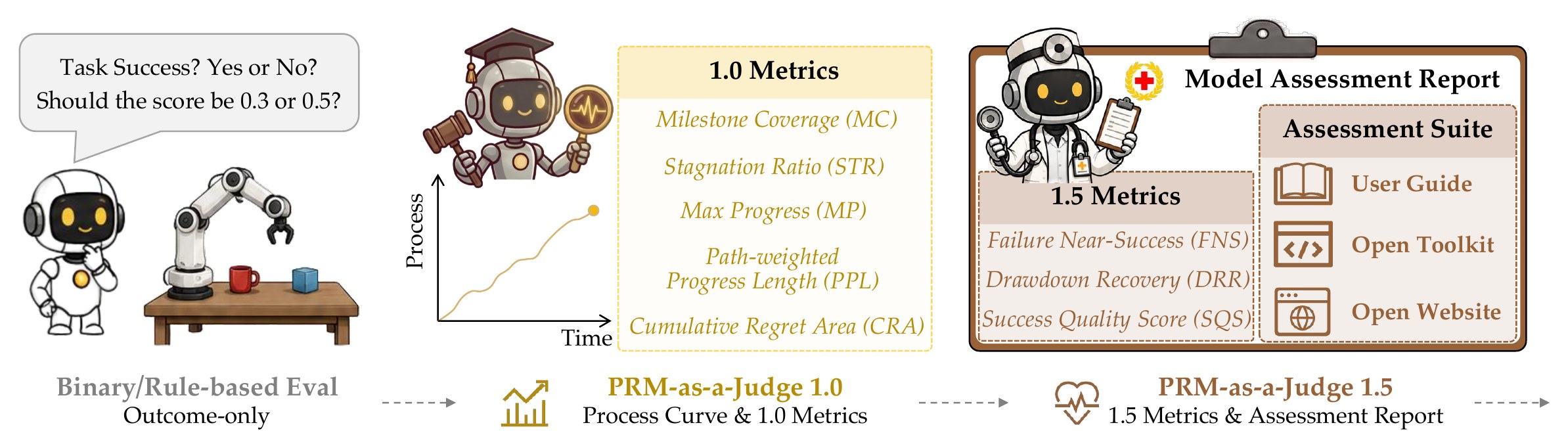
Three new scores on top of 1.0
Version 1.0 already turned videos into OPD metrics: milestone coverage, max progress, path-weighted progress length, regret area, stagnation. 1.5 adds three conditioned scores:
- Failure Near-Success (FNS): how close a failed run got, from max progress and the 50% / 75% milestones
- Drawdown Recovery Ratio (DRR): how much of the worst drop the robot climbed back
- Success Quality Score (SQS): how clean a successful run was, from path efficiency, regret, and stall time
A process reward model, defaulting to Robo-Dopamine (Forward), estimates completion at each frame. The output is a report that can line the video up with the curve.
They also ship RoboPulse++, an interval test for the judges themselves: 700 trajectories, 275 task entries, 17,052 frames, 2,244 annotated rising/falling intervals. Specialized PRMs beat general VLMs on that set. Robo-Dopamine (Forward) hits 0.84 accuracy; Gemini 3.1 Pro in pair style is 0.63. Falling intervals stay harder than rising ones.

What the RoboDojo audit found
They scored released RoboDojo videos. They did not retrain the policies. The leaderboard freeze is 3 July 2026.
A few findings they are willing to put in print:
- VLAs take a larger share of the top ranks than WAMs on RoboDojo-Sim
- Bigger models are not automatically better
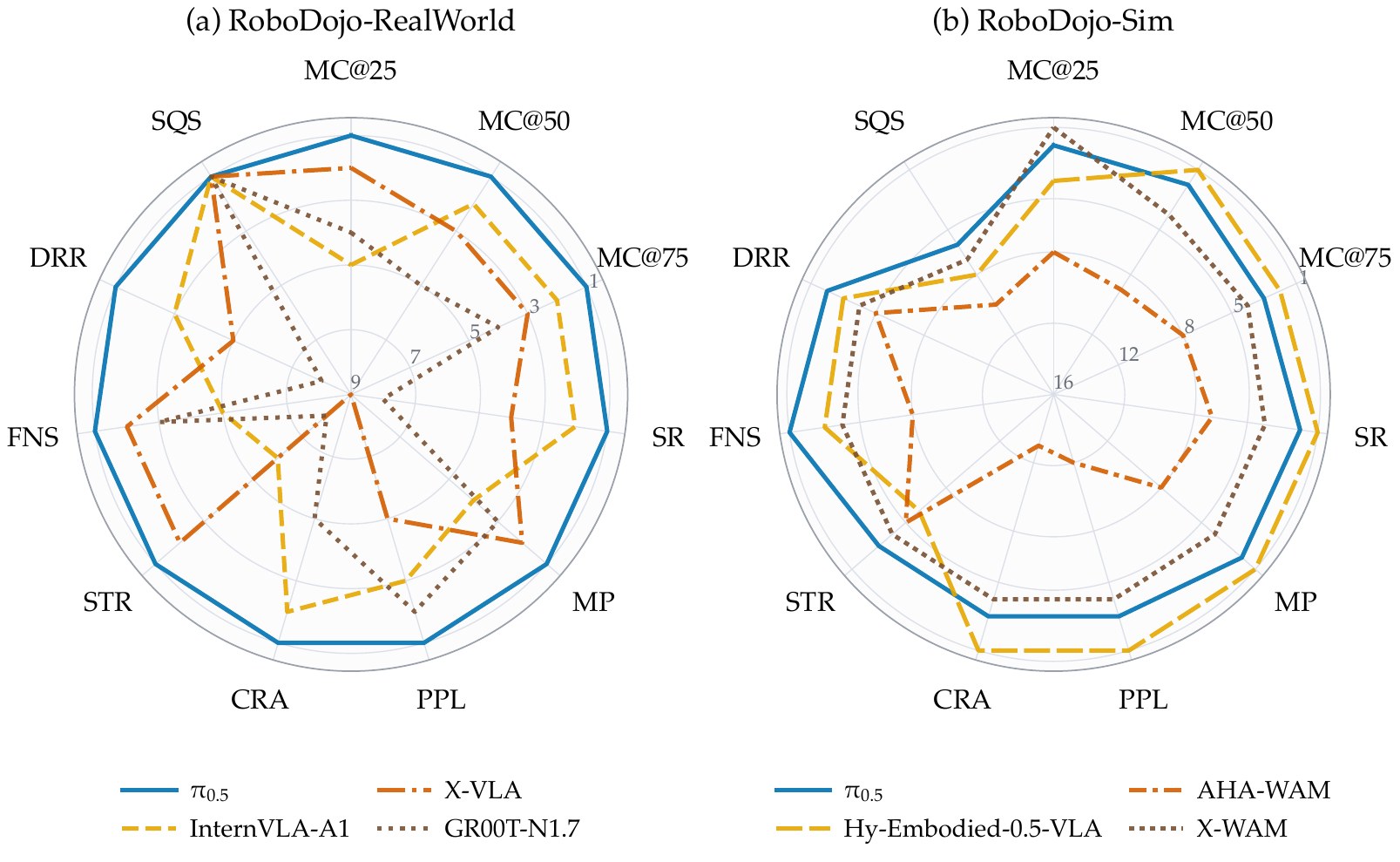
- π0.5 is the broadest strong model across the radar plots
- Precision tasks are the easiest category; open-vocabulary is the worst
- Sim-to-real rank correlation is only Spearman ρ = 0.18–0.58
- Shared-task heatmaps show negative real-minus-sim max-progress gaps for every model they aligned
On RoboDojo-RealWorld, π0.5 is listed at 17.06% success, with 85.29% of rollouts reaching 25% progress and 100 DRR. GR00T-N1.7 sits at 0.63% success in that table. Success rate and process rank do not match.
A Human’s Take
Pass/fail is a terrible factory metric. I want to know whether the arm almost finished the insert or never found the hole. 1.5 is a report card for that. I’m less sold on cartoon doctor robots than on the sim-to-real heatmap: if every model looks worse on real contact, stop bragging about the sim leaderboard.