ProxiDex Reads Hand-to-Object Distance Instead of Skin
Vision occludes the exact moment a fingertip kisses an object. Real tactile skins are a calibration headache. Yushan Bai, Boyu Zheng, and colleagues at the Chinese Academy of Sciences treat geometric proximity as the interaction state instead. ProxiDex, accepted at CoRL 2026, reconstructs a hand–object point cloud, turns distances into region-level cues, and uses those cues to steer a diffusion policy.
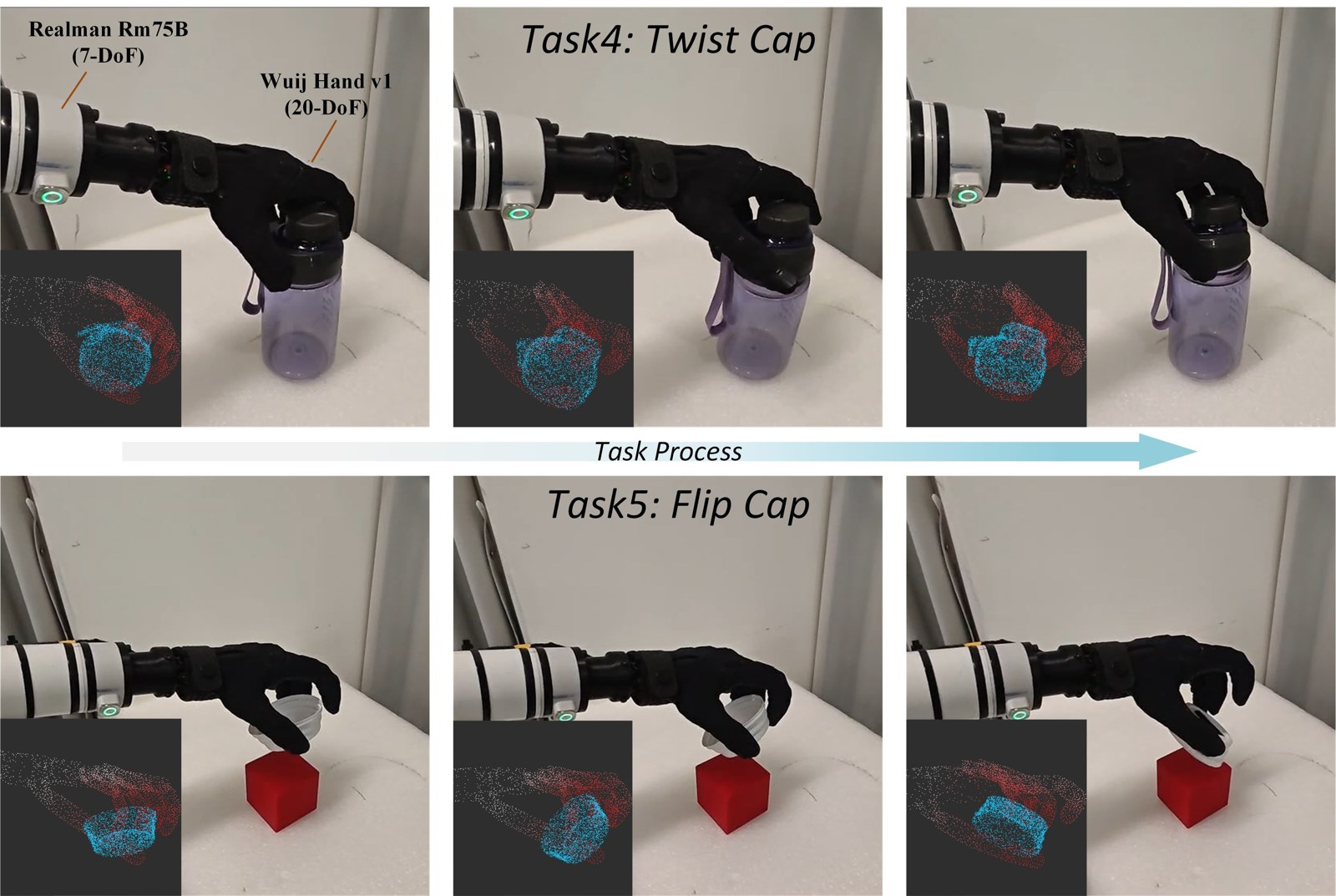
The hardware is a Realman RM75B 7-DoF arm, a RealSense L515, a CasBot-P1L (6 active DoF) for tabletop work, and a 20-DoF Wuji Hand V1 for contact-rich tasks.
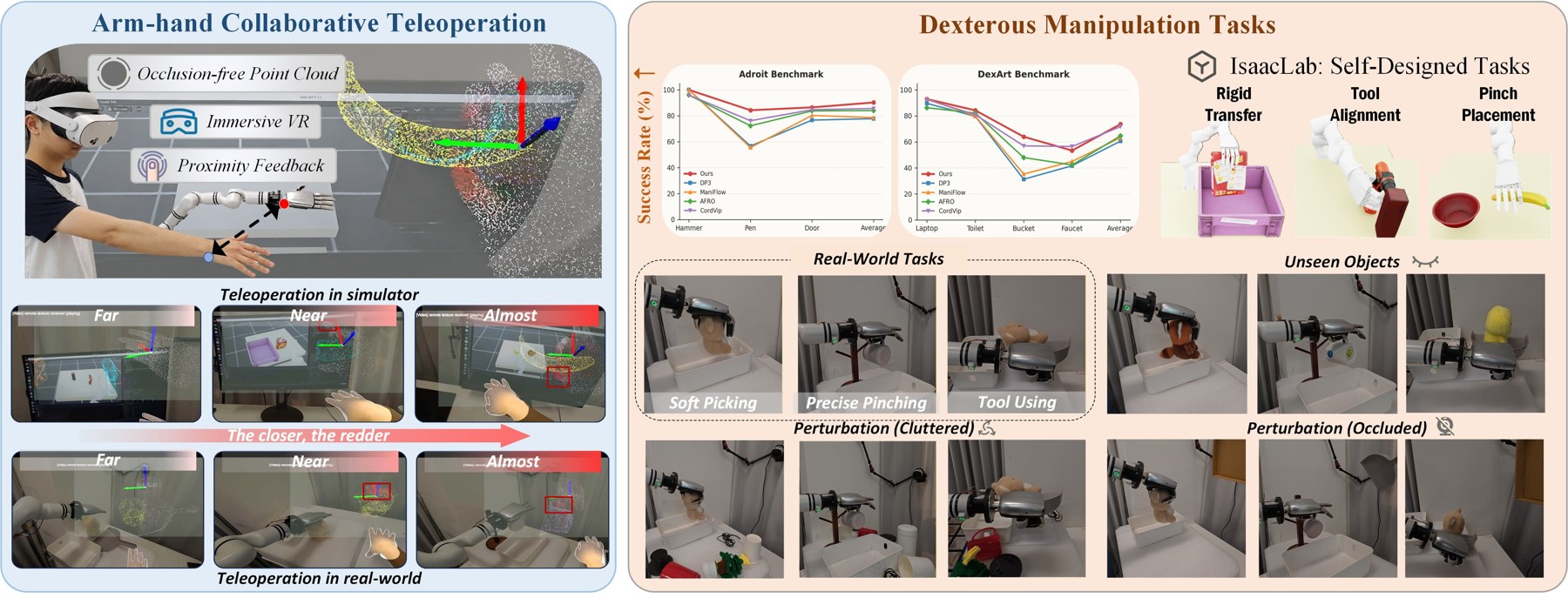
Distance as a stand-in for touch
Demonstrations come from VR arm-hand teleoperation. Grounded-SAM and SAM 3D rebuild the object from one image; FoundationPose++ tracks it. Hand and object surface points land in the robot base frame. Local distances collapse into a proximity vector per hand region. Palm response also labels the trajectory as approach versus contact.
A VAE compresses those proximity vectors. A DiT forward model predicts future observation latents from actions. An inverse module reads proximity changes out of latent differences. During policy learning the global point-cloud feature stays visible, while proximity tokens are causally masked and gated so they matter more once the hand is close.
If live vision disagrees with the forward model past a threshold, the system switches to what the paper calls dynamics-dream mode and rolls latents forward until the cameras make sense again. On the authors’ machine, pose tracking runs about 10 Hz, the policy about 28 Hz, and the forward model about 20 Hz.
Caps, clutter, and a banana pinch
In simulation, ten tasks across Adroit, DexArt, and custom Isaac Lab scenes, ProxiDex’s average success is 83.9%. That is 12.1 points over DP3, 9.7 over ManiFlow, 7.0 over AFRO, and 2.9 over CordViP, which already uses interaction point clouds.
On the real arm, 50 demonstrations per tabletop task, success counts from the paper’s Table 2:
- In distribution: pick 19/20, pinch 15/20, sweep 18/20
- Unseen objects: 32/40, 24/40, 29/40
- Perturbation: 22/30, 23/30, 22/30
- Contact-rich (Wuji Hand V1): twist cap 10/20, flip cap 11/20
- Overall average: 72.6%, versus 62.9% for CordViP and 40.0% for DP3
A 2×4 tactile array on the P1L fingertips is the sanity check. Proximity does not replace force. It does track how the hand-object gap shrinks before contact, which is enough for several of these tasks to stay competitive with the instrumented skin.
The authors list the failure modes themselves: the method needs decent object reconstruction, dream-mode drifts if occlusion lasts, and geometry still cannot measure real contact force.
A Human’s Take
I’m so here for a policy that paints the gap between finger and bottle instead of waiting on a new tactile bus. The Wuji cap-twist stills are the receipt: you can see the reconstructed cloud hug the bottle while the hand actually turns it. Just don’t call it touch. It is a well-instrumented guess about distance, and it still only flips a cap 11 times in 20. That’s honest enough to keep watching.