Ψ₀ (Psi-Zero): Open Foundation Model for Humanoid Loco-Manipulation
Ψ₀ (Psi-Zero) is an open vision-language-action foundation model aimed at the hard middle of humanoid work: loco-manipulation — walking while carrying, handing off, pouring, wiping, and placing. The paper (arXiv:2603.12263) is from USC’s Physical Superintelligence Lab with co-authors at NVIDIA and WorldEngine, accepted to RSS 2026.
The data bet
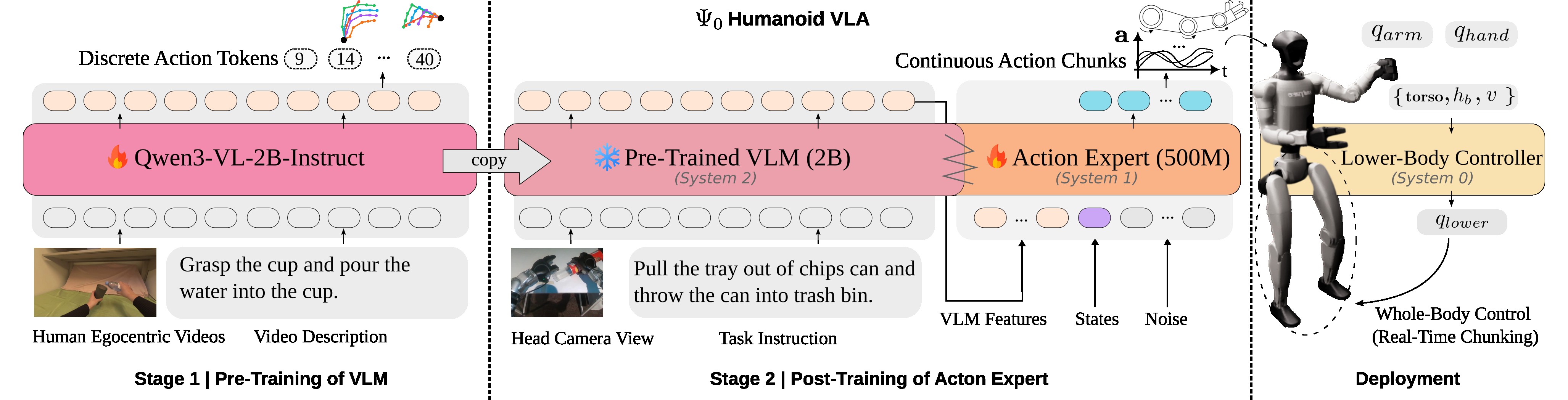
Most VLA pipelines dump human video and robot data into one co-training stew. Ψ₀ argues that is suboptimal: humans and humanoids do not share kinematics. The team stages learning instead:
- Pre-train a VLM backbone on high-quality egocentric human video (EgoDex, about 829 hours on the project page; the abstract rounds to ~800 hours)
- Post-train a flow-based action expert on real humanoid trajectories (Humanoid Everyday, about 31 hours / 260 tasks in 7 categories)
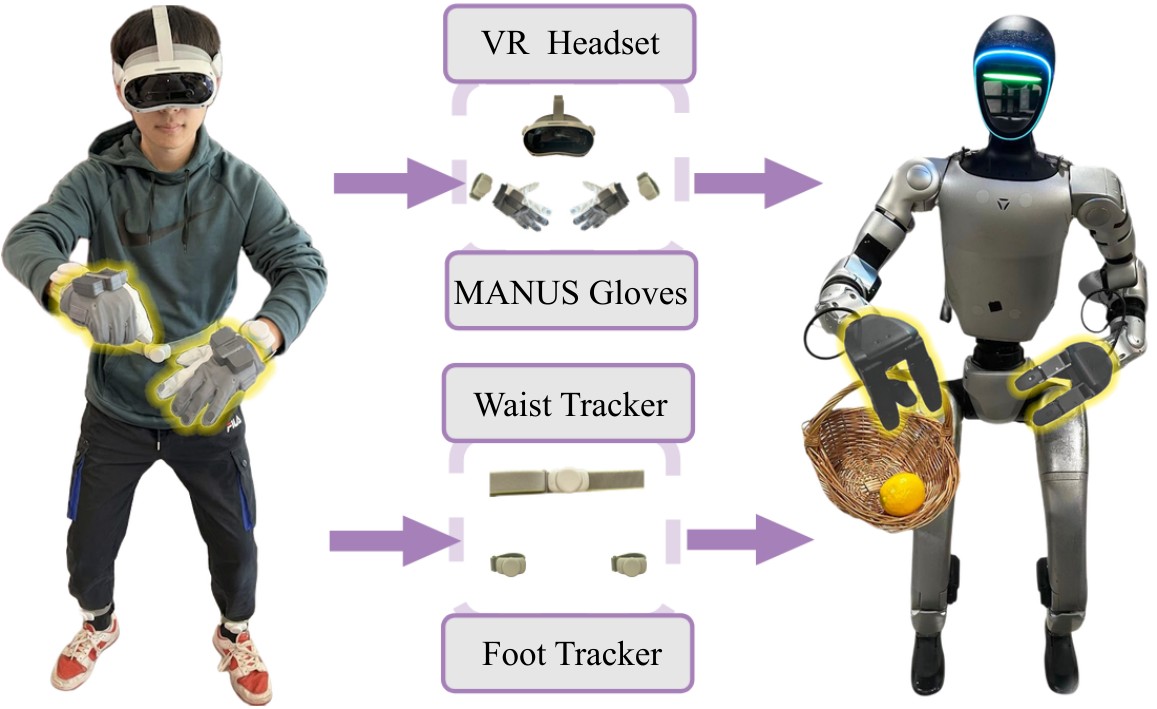
- Fine-tune on a small amount of in-domain teleop for target tasks
Architecture is three systems: Qwen3-VL-2B-Instruct as the vision-language backbone (~2.5B-class stack with a ~500M MM-DiT action expert), plus an RL lower-body tracker (AMO) for the 8-DoF lower-body chunk.
Real-robot scoreboard (from the project page)
On eight long-horizon tasks, Ψ₀ beats listed baselines including π0.5 and GR00T N1.6. Examples of success rates (out of 10 trials):
- Pick bottle, turn, pour into cup: 8/10 (GR00T N1.6: 4/10)
- Put toy in basket, hand to person: 9/10
- Hold lunch bag, squat, place on table: 9/10
- Pull tray and throw chip can: 5/10 (still ahead of most baselines at 0–1/10)
The abstract’s headline claim: best overall performance using about 800 hours of human video and 30 hours of robot data, outperforming baselines trained on more than 10× as much data by over 40% overall success rate across tasks.
What they are opening
The team says the full ecosystem is going open: data pipeline, foundation model weights, and a real-time action inference engine (with training-time real-time chunking to hide ~160 ms forward passes). Code is on GitHub under the Physical Superintelligence Lab org; models and data point to Hugging Face links on the project site.
A Human’s Take
I’m smiling at the data diet. Less “scrape the internet,” more “quality egocentric manipulation then a thin slice of real humanoid hours.” That is a friendlier recipe for labs that do not own a warehouse of robot teleoperators. The remaining question is the usual one: do the open weights reproduce the table outside the authors’ room layout?