A Coding Agent Beats Diffusion Policy at Push-T, Then Does A–Z
Push-T is the little T-block everyone uses to train pushing policies. Shuangyu Xie, Kaiyuan Chen, and Ken Goldberg at UC Berkeley asked a coding agent to write the controller instead of cloning 200 human demos.
The short paper (arXiv:2608.18227) uses Claude Code with Fable 5. The agent finds the gym simulator, fits a quasi-static contact model, and iterates. No demonstration dataset.
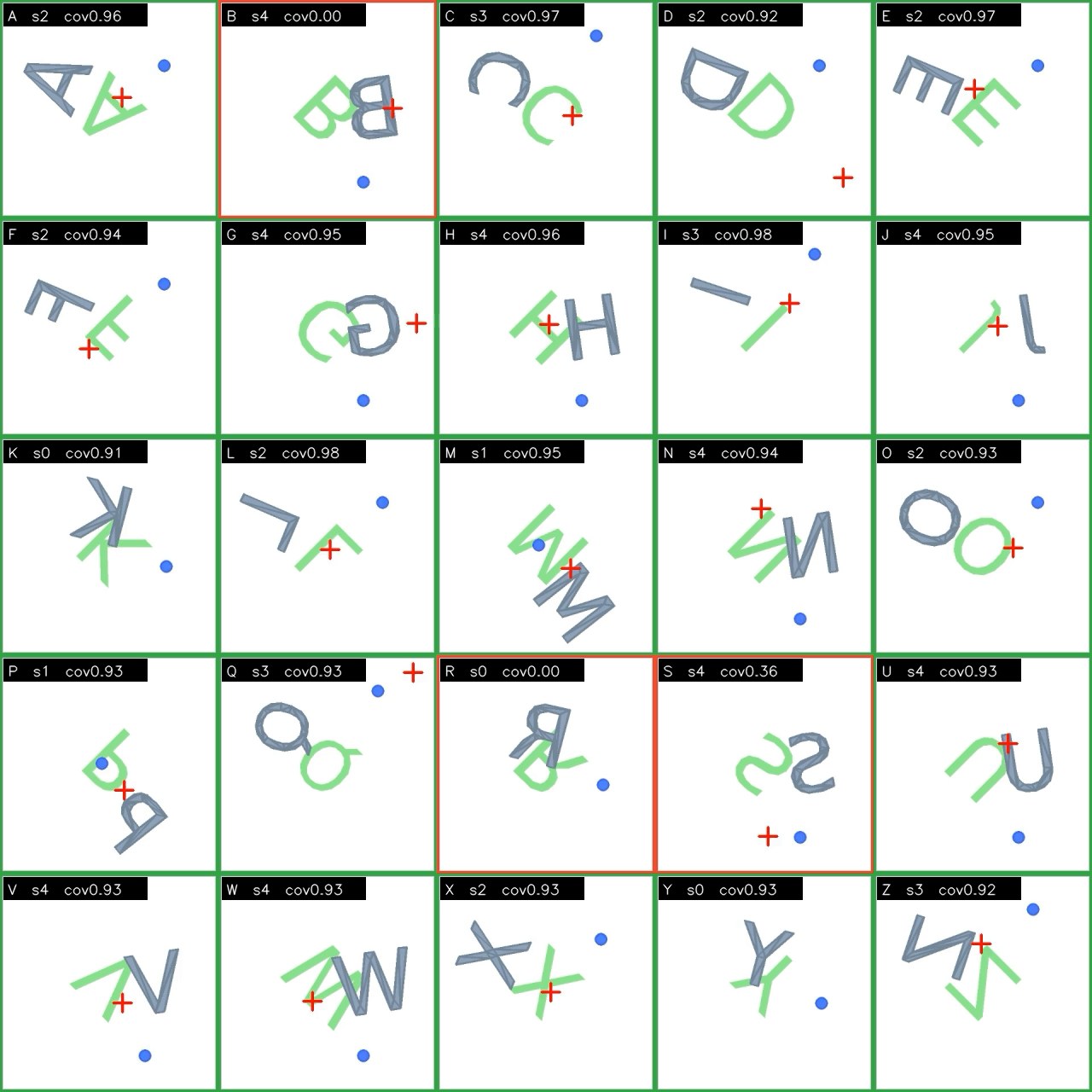
Push-T, no humans in the loop
On gym_pusht over 200 seeds, the public LeRobot Diffusion Policy checkpoint (trained on 200 demos) hits 62.5% success under the 95% coverage rule, 223.7 mean steps, 6.38 pushes.
The agent’s state controller hits 100%, 120.1 steps, 3.72 pushes. That is 46% fewer control steps than the learned policy. A later vision version, reading RGB instead of privileged pose, still reaches 97.2%.
The first controller is a four-phase state machine: plan, approach, push, retreat, with a discrete contact library for translation versus rotation.
Then the rest of the alphabet
They extend the block to A–Z. A v1 prompt gets 47.1%. Overnight self-refinement reaches 73.1%. After the agent reads failure logs and the sim source, it switches to MPC and finishes at 99.4% success with privileged state (650 episodes, 25 per letter). Vision MPC is 99.2%.
A classical Dubins pushing baseline, with an agent-written adapter, reaches 97.2%. The MPC still uses fewer than half as many pushes.
They port the vision MPC into simulated Franka Panda (89.8%) and UR5e (98.5%) arms without changing the contact reasoning.
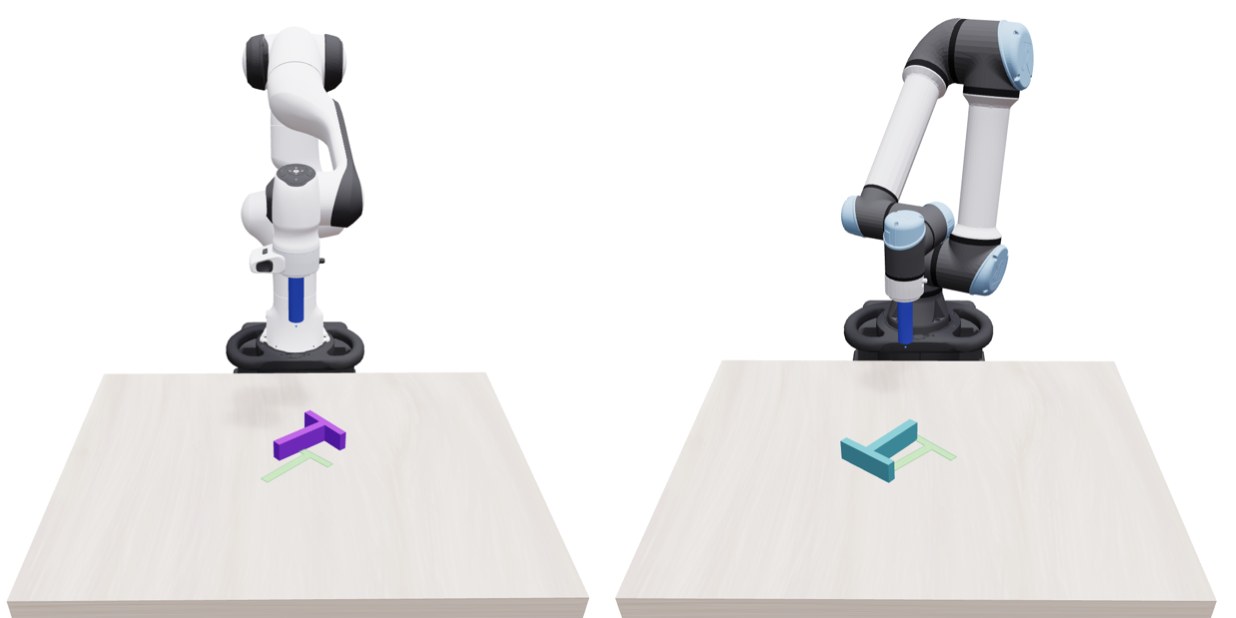
The bill: about 9.5 million output tokens, roughly $1,500–$2,000, and 221 hours in Claude auto mode with a human in the loop. The authors note the agent may be exploiting the simulator, and that this is not a real-robot result.
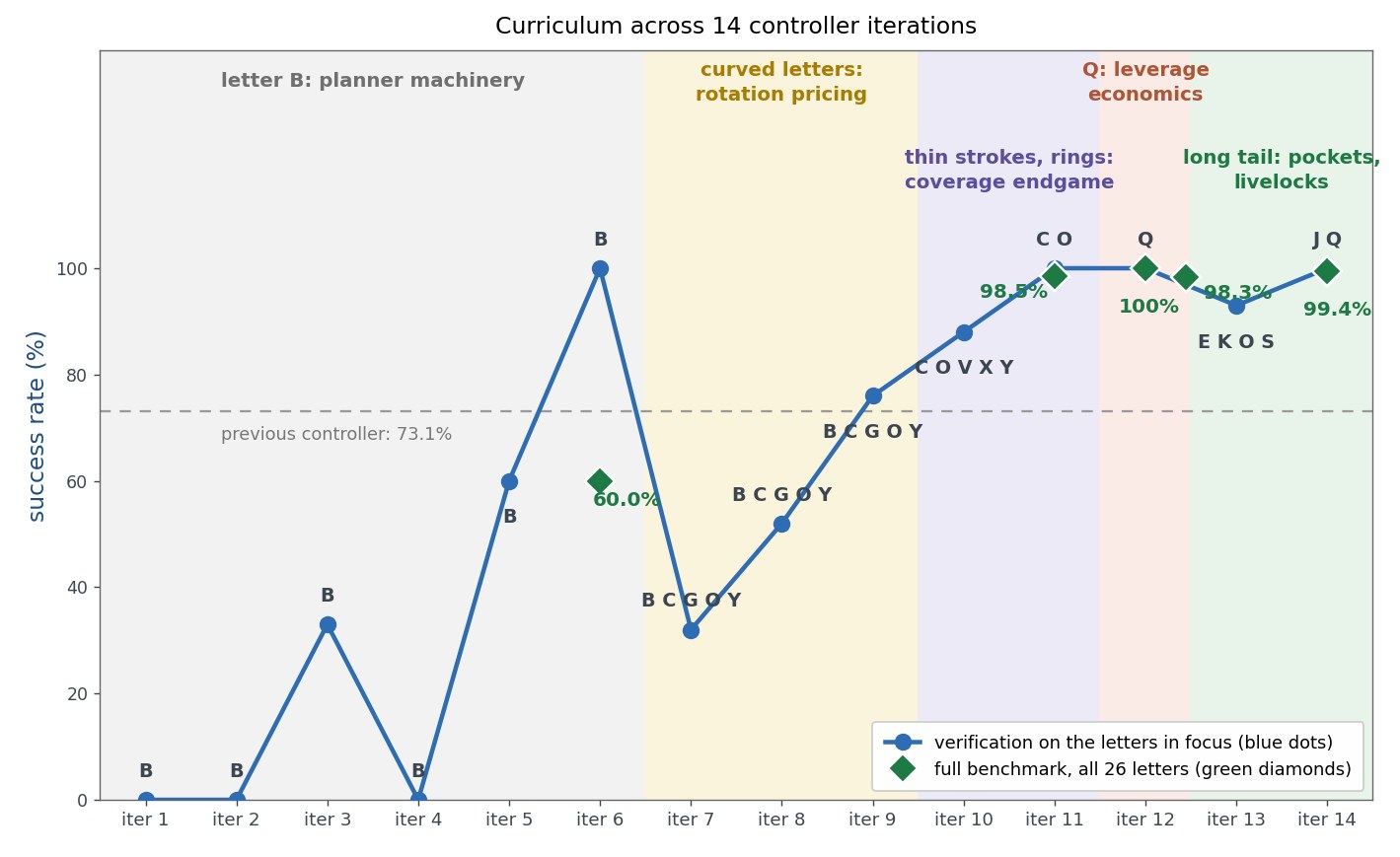
A Human’s Take
I will never get tired of a 2D T-block if the punchline is “the coding agent wrote a better pusher than the demo policy.” Geometry still works.
The honest line is in the limitations: the agent treated the gym as the world. Take that $2,000 controller to a real UR5e with a puck that chips, then we can argue.