RAI’s AthenaZero Learns Five Juggling Patterns in Minutes
Researchers at the Robotics and AI Institute in Cambridge posted a paper on 27 August 2026 showing a bimanual robot, AthenaZero, learning five three-ball juggling patterns on the real machine: cascade, tennis, half-shower, shower, and box. The prior model could not complete a single cycle of any pattern. With regularized memory-based learning and a precomputed mutually reachable set, the robot reaches those patterns in less than five minutes of real-world interaction, not counting the time a human spends picking up dropped balls.
Hands, balls, cameras
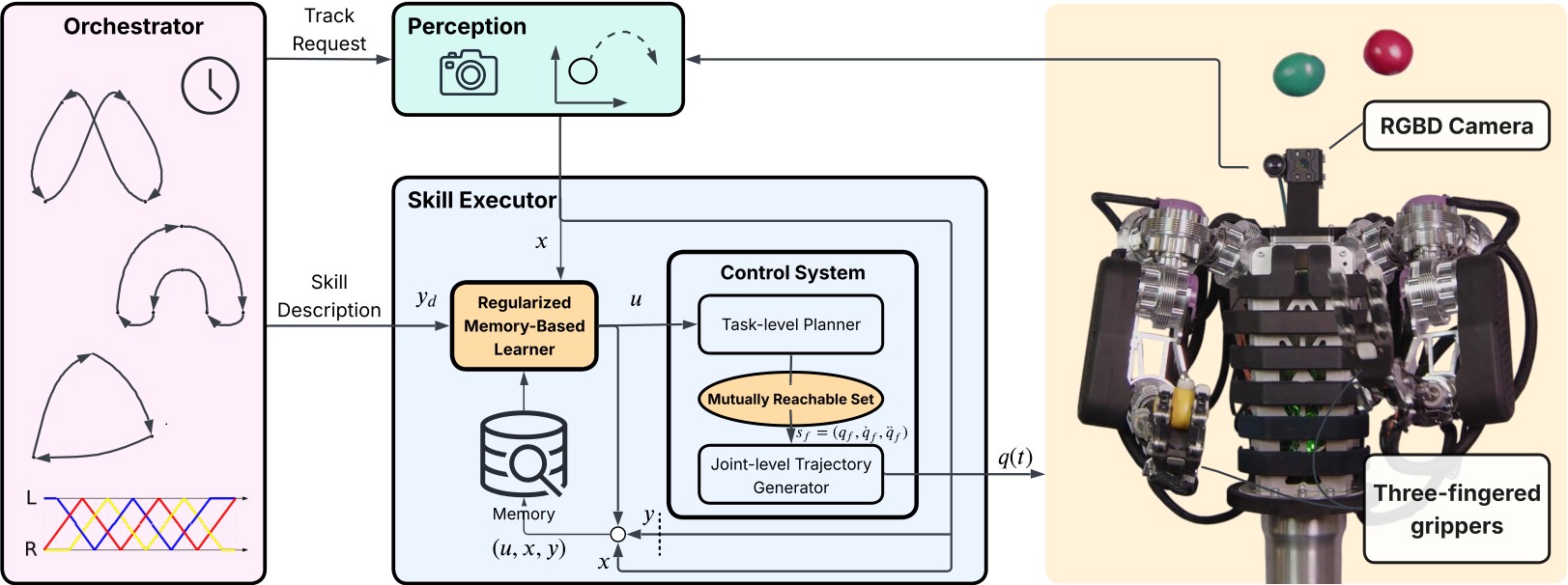
AthenaZero is a custom low-inertia bimanual platform. Each hand is a three-fingered gripper; each underactuated two-DoF finger is driven by a remote actuator through a Bowden cable, with a full open/close cycle in about 80 ms. The balls are Higgins Brothers HB #1003 beanbags, 130 g, 63.5 mm. A Lucid Helios2 Wide time-of-flight camera and a Lucid Triton RGB camera sit on the torso, synced at 30 Hz. End-to-end tracking latency is about 0.1 s.
The authors’ lesson is that a bad model is still useful. They keep the global prior for extrapolation where memory is thin, and fit a local model from accumulated throws where experience is dense. Learning starts immediately. There is no random-exploration warmup.
Cascade learning, excluding manual resets, takes 53 seconds of physical interaction on average. A tennis → half-shower → cascade sequence averages 75 seconds. Shower and box plateau around 30 s and 60 s of interaction. Across five from-scratch cascade trials, the robot consistently juggled by the 8th attempt and then repeated the performance three times, about five minutes of wall-clock time including resets.
Safety as a reachable set
Juggling near joint limits is where robots break themselves. A throw can be legal on its own and still leave an arm unable to catch without slamming a stop. The mutually reachable set (MRS) is a conservative inner approximation: any two states inside it can be connected in either direction under the robot’s position, velocity, acceleration, and jerk limits, using Ruckig for time-optimal trajectories.
A retrospective ablation over 7,578 planner queries found 89.0% of unconstrained solutions unsafe (unreachable, non-viable, or both). With MRS on, every solution stayed inside the set. Cascade and tennis sequences mostly failed as reachable-but-not-viable. Box failed the other way: viable but not reachable from the previous state.
Co-authors include Christopher G. Atkeson and Alfred A. Rizzi, names that go back to the paddle-juggling literature the paper cites.
A Human’s Take
Five patterns in minutes is a control result, not a circus act. The prior could not juggle at all, which is the honest baseline. What I like is the safety set: they measured how often a legal throw would have been a bad next catch, and it was most of the time. Dust and humidity still force the robot to re-learn. That is the real sentence for anyone shipping contact-rich hands.