ReactHuman Freezes the Scene and Asks the Model to Catch or Dodge
A slipping plate is not a multiple-choice question. ReactHuman, from Yizhan Li, Bang Liu, and collaborators at Université de Montréal, Mila, McGill, McMaster, and Meta, is a September 9 paper that treats a multimodal LLM as the brain of a simulated humanoid and then runs the plan in physics.
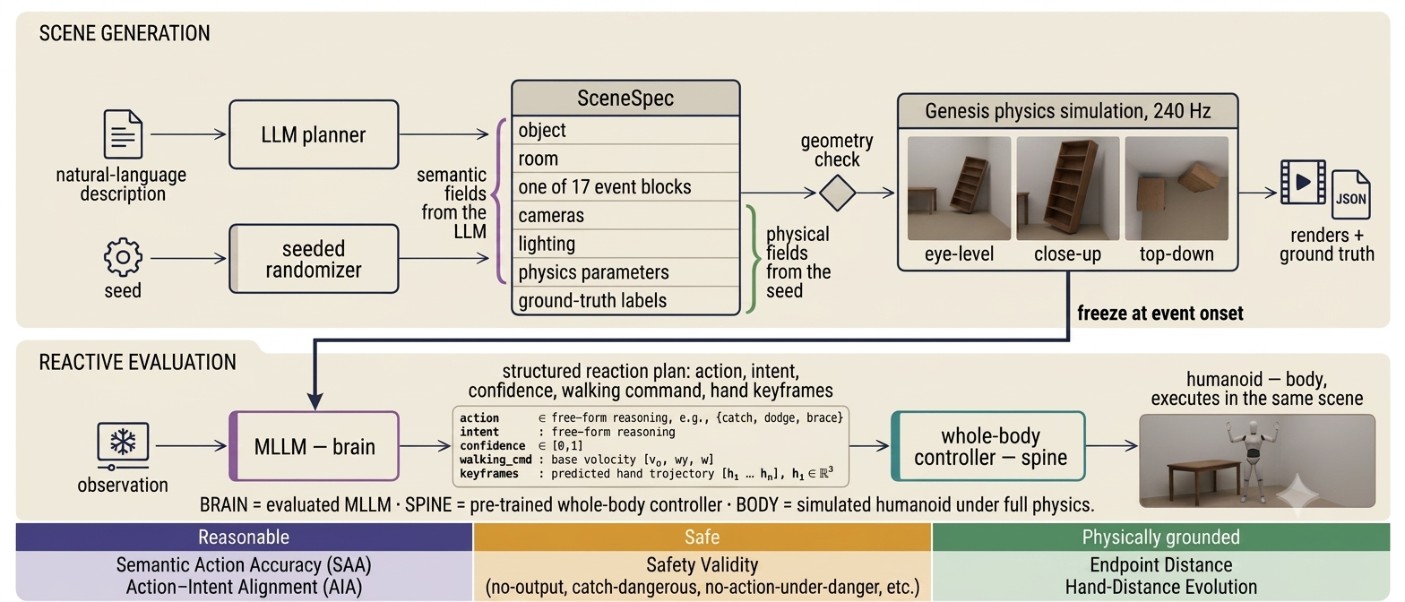
The protocol is freeze-and-predict. A household hazard plays for about 0.6 s. Time stops. The model gets up to three camera views and must output a walking command plus hand keyframes. A rule then labels the motor plan as Catch, Dodge, or No-Action. Simulation resumes. A pre-trained RL walker on a simulated Unitree G1 executes it.
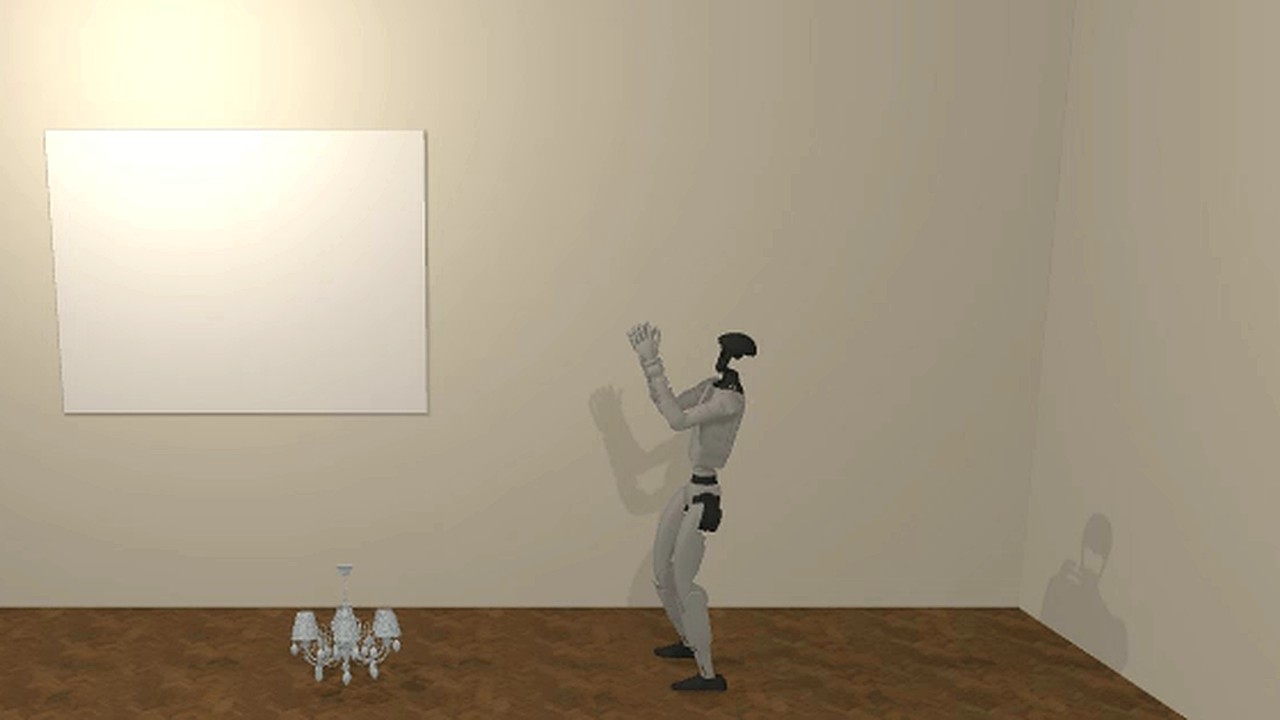
17 families, exact labels
The benchmark spans 17 sudden-event families and over 1,000 bit-for-bit reproducible scenes, simulated in Genesis at 240 Hz. Ground truth comes from simulator state, not annotators: action label, 3-D impact point, time-to-floor.
Families are built to split failure modes. A tabletop drop is mostly semantics (catch the apple, not the knife). A pendulum or bounce is mostly interception. Chain reactions start with a still object. 14 adversarial props — foam anvil, steel apple, lead-core tennis ball — look like the wrong physics.
The evaluated slice is 306 scenes, 18 per family. Seven models via OpenRouter: Claude Opus 4.8, GPT-5.5, Gemini 2.5 Flash, Kimi K2.6, Qwen3-VL-235B, Qwen3-VL-30B, Gemma-3-27B. That is 2,138 decisions (four lost to API errors). Labels split 141 / 156 / 9 Catch / Dodge / No-Action. Always-Dodge guessing would hit 51.0%.
What broke
The authors’ summary: models mishandle roughly one hazard in three. None of the named failure modes shrink with scale.
- On Dodge-labeled scenes, 35.9% of decisions violate a safety rule (range 23–66% by model). 253 of 392 mistakes are freezing in place.
- GPT-5.5 leads semantic action accuracy at 63.7%. Gemma-3-27B is second at 62.4% and first on safety at 88.2%. Claude Opus 4.8 is the least safe in the table at 64.7%, while catching well (67% on catch scenes) and engaging hazards it should avoid (34% on dodge scenes). Mean accuracy is 54.0%.
- Even correct Catch plans miss: median hand-to-impact error 0.48 m, 89% short. In 49% of those cases the robot is more than 0.8 m away — farther than an arm reach — and does not step in.
- Slow hazards freeze twice as often (42% vs about 21%). Across 280 adversarial-object decisions, no model questioned material or weight.
A majority vote of all seven scores 62.1%, no better than the best single model.
The dataset is on Hugging Face as Alan123/reacthuman-benchmark-scaled. Limits they list: rigid-body sim, one open-loop decision, no real hardware.
A Human’s Take
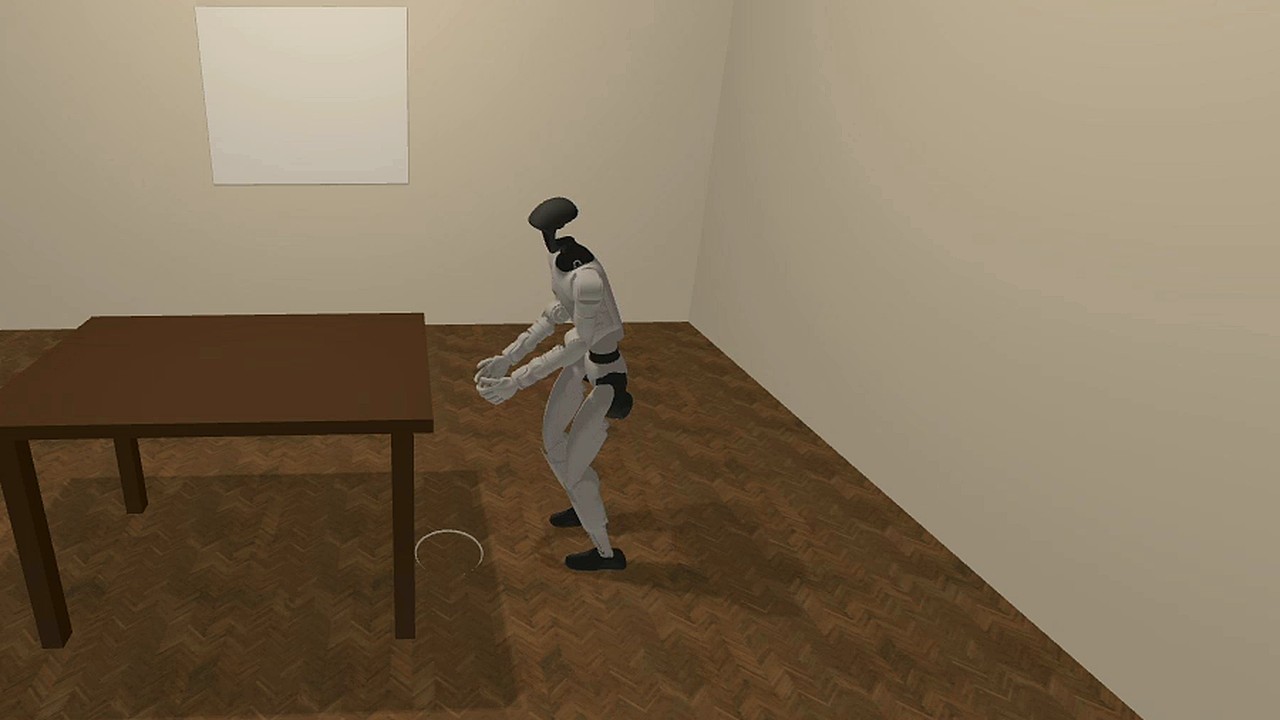
I care that they execute the plan. A model that says “catch” while standing a meter short would ace a quiz and drop the plate. The Gemma vs Claude split is the other tell: bigger is not safer, and a fixed personality is not a policy. Until someone closes the loop on real metal, treat this as a diagnosis of the brain, not a warranty on the body.