ReflexVLA Chases Moving Cubes Instead of Frozen Scenes
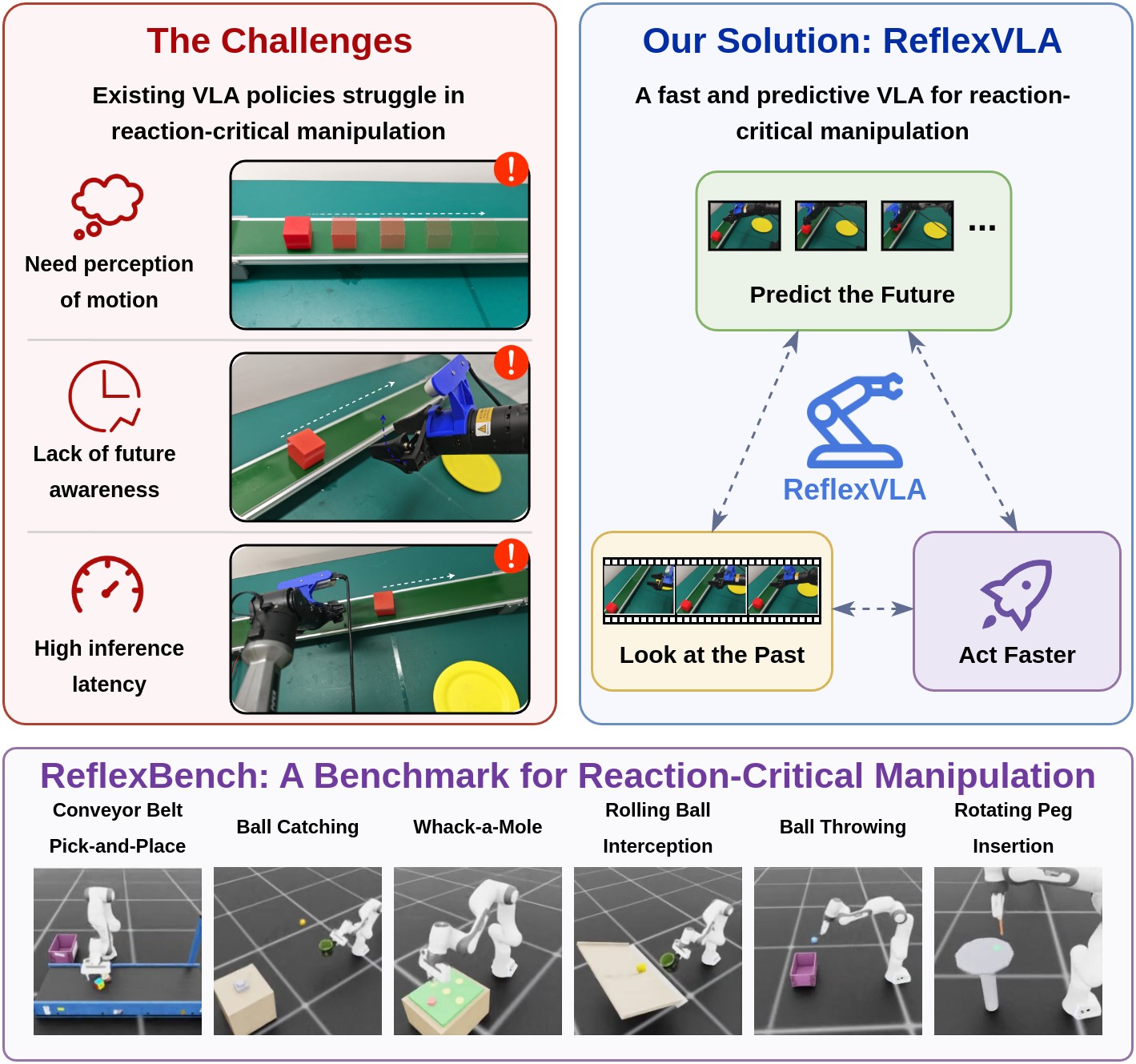
Most VLA scores come from worlds that politely freeze while the model thinks. Yuxuan Chen, Wanruo Zhang, and Xiao Li at Shanghai Jiao Tong University built ReflexBench so the belt keeps moving.
The benchmark has six tasks: conveyor pick-and-place, ball catching, whack-a-mole, rolling-ball intercept, ball throw, and a rotating peg. The sim does not pause for inference. You can run synchronous or asynchronous control and inject a chosen delay, including one scaled from real wall-clock latency by the simulator’s real-time factor.
A 1B model that looks ahead
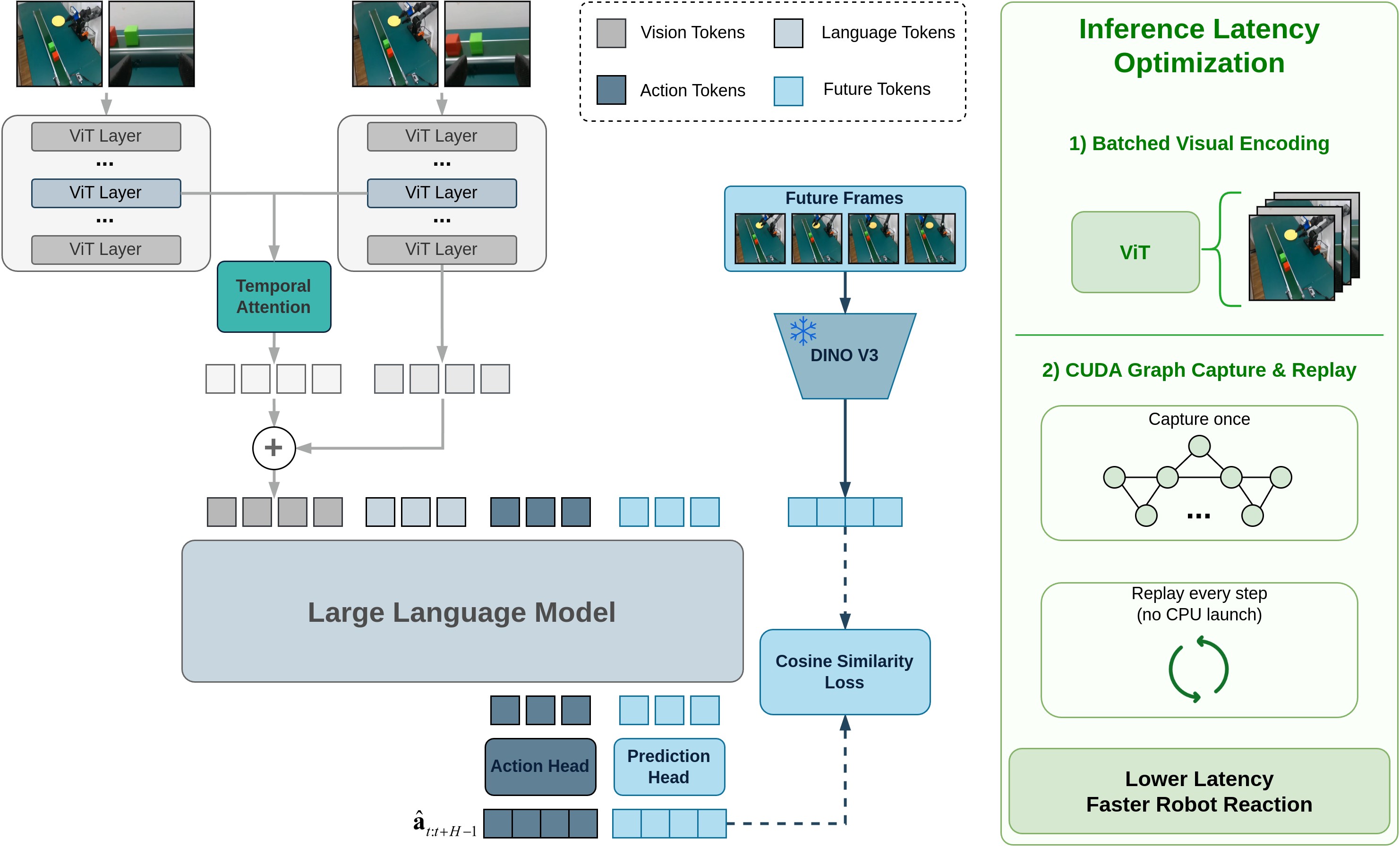
ReflexVLA sits on VLA-Adapter. Vision is DINOv2 + SigLIP at 224×224. Language is Qwen2.5-0.5B. The whole stack is 1B parameters.
Three add-ons:
- Latent future prediction against a frozen DINOv3 feature, one token per step of the action chunk
- Multi-frame temporal fusion inside the vision backbone so the language model still sees one frame’s worth of tokens
- Batched visual encode + CUDA Graph replay so the GPU is not relaunching kernels every cycle
They train one policy on 200 demos per task, chunk size 8, action horizon 2, async inference, on an RTX 5880 Ada. Each score is 150 eval episodes × three seeds.
Average ReflexBench success:
| Model | Params | Avg. |
|---|---|---|
| VLA-Adapter (backbone) | 1B | 30.3% |
| OpenVLA-OFT | 7B | 36.0% |
| π0.5 | 4B | 36.9% |
| PUMA | 4B | 50.2% |
| ReflexVLA | 1B | 50.4% |
Conveyor is the headline gap: 73.8% versus 36.8% for the backbone. Ball catching is still ugly for everyone (7.3%). On static LIBERO they hold 97.2%, next to VLA-Adapter’s 97.3%.
Ablations on conveyor: frozen future targets jump success from 36.8% to 62.8%; middle-layer temporal fusion reaches 71.7%; the CUDA-Graph path finishes at 73.8% and cuts latency from 125.1 ms to 65.0 ms.
Real Piper arm
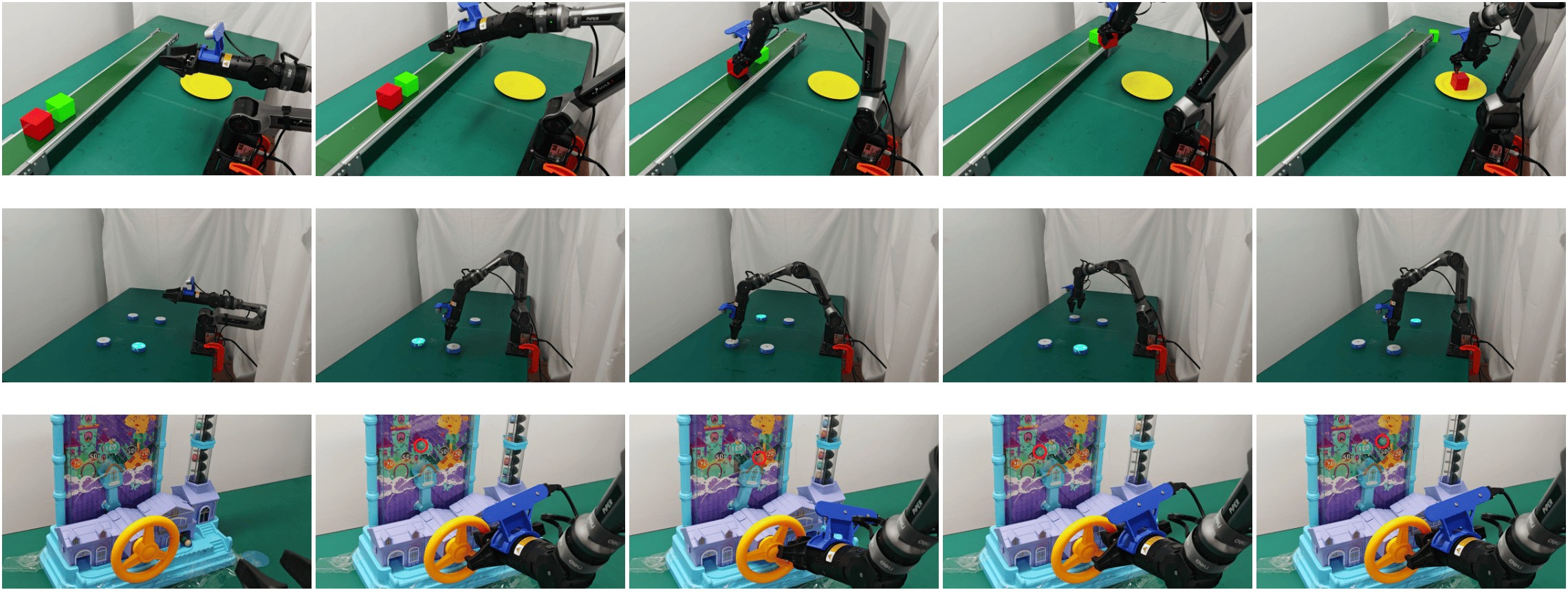
On an AgileX Piper they compare 20 trials each of conveyor pick, button mash, and ball catch:
- Conveyor: 16/20 (PUMA 13/20, SmolVLA 2/20)
- Buttons in 30 s: 22.5 (PUMA 20.8, SmolVLA 0.9)
- Balls of 10: 6.7 (PUMA 5.4, SmolVLA 3.8)
The authors flag two limits: the extras are fine-tunes, not pretraining, and they did not try fancier async schemes such as RTC.
A Human’s Take
I have wanted a VLA scoreboard that punishes thinking time. This is that board. Matching a 4B dynamic specialist at 1B, and doing it with a 65 ms graph replay, is the part I will steal. Catching is still a coin flip. If your robot’s job is a moving belt, this paper is more useful than another frozen-kitchen leaderboard.