Reward AI’s OM-1 Learns From a Glove, Not From Robot Teleop
Reward AI came out of stealth on September 14 with OM-1, a robot policy the company says is trained only on human manipulation data. No teleoperation. No on-robot experience. The same model is supposed to run on tabletop arms, industrial manipulators, and humanoids.
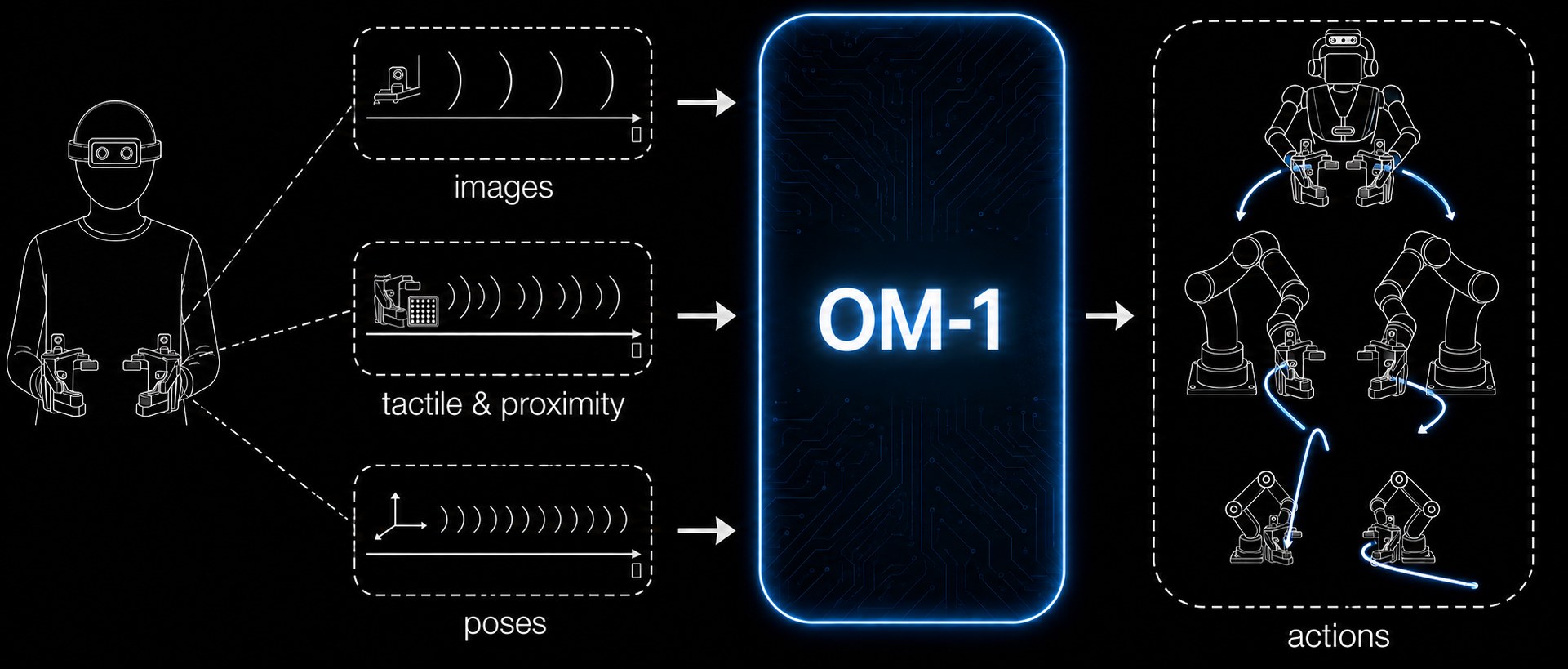
The hardware in the loop is Omnibody Hand, a wearable 7-DoF capture device built on the team’s Stanford DexCap work (RSS 2024, Chen Wang, C. Karen Liu, Li Fei-Fei and colleagues). People wear the glove and work at their own speed. OM-1 learns the motions and, Reward AI claims, picks up a new long-horizon task from less than 30 minutes of that data.
A 7-DoF glove, not a 22-DoF copy
Omnibody Hand is built around functions, not a joint-for-joint human copy:
- Thumb and index flexion for pinch and in-hand reorient
- Middle, ring, and little fingers moving together at the MCP joints for power grasps
- A distal flexion mechanism so different finger lengths do not need per-user link tweaks
The data layer pairs high-frequency tactile arrays, proximity sensors, and global-shutter in-hand cameras with hybrid tracking. Visual-inertial pose is augmented with electromagnetic sensing. On a two-stop overshoot test at eight speeds, Reward AI reports a 60% drop in mean overshoot at the highest speed, from 24.9 mm to 9.5 mm.
OM-1 eats those streams at each sensor’s native rate instead of downsampling everything to one clock, then outputs motion direction, speed, force, and grasp timing.
Control on its own clock
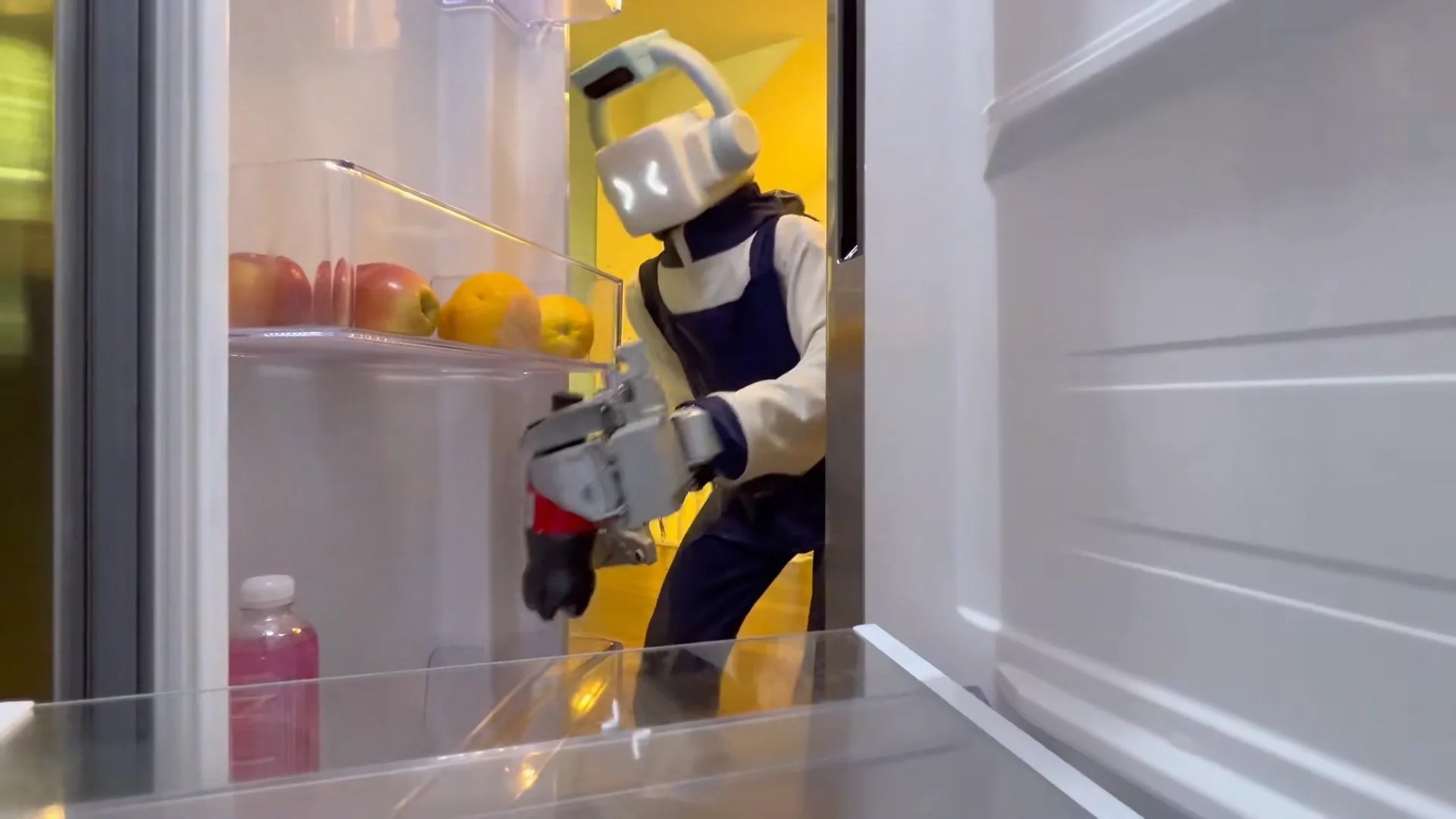
Under the policy sits a high-frequency control layer trained with RL in simulation. Reward AI says it absorbs delays, backlash, and unexpected loads so the transformer does not have to finish the next chunk before the robot can keep moving. The fridge demo is the example: pulling a closed door without knowing how hard it will fight.
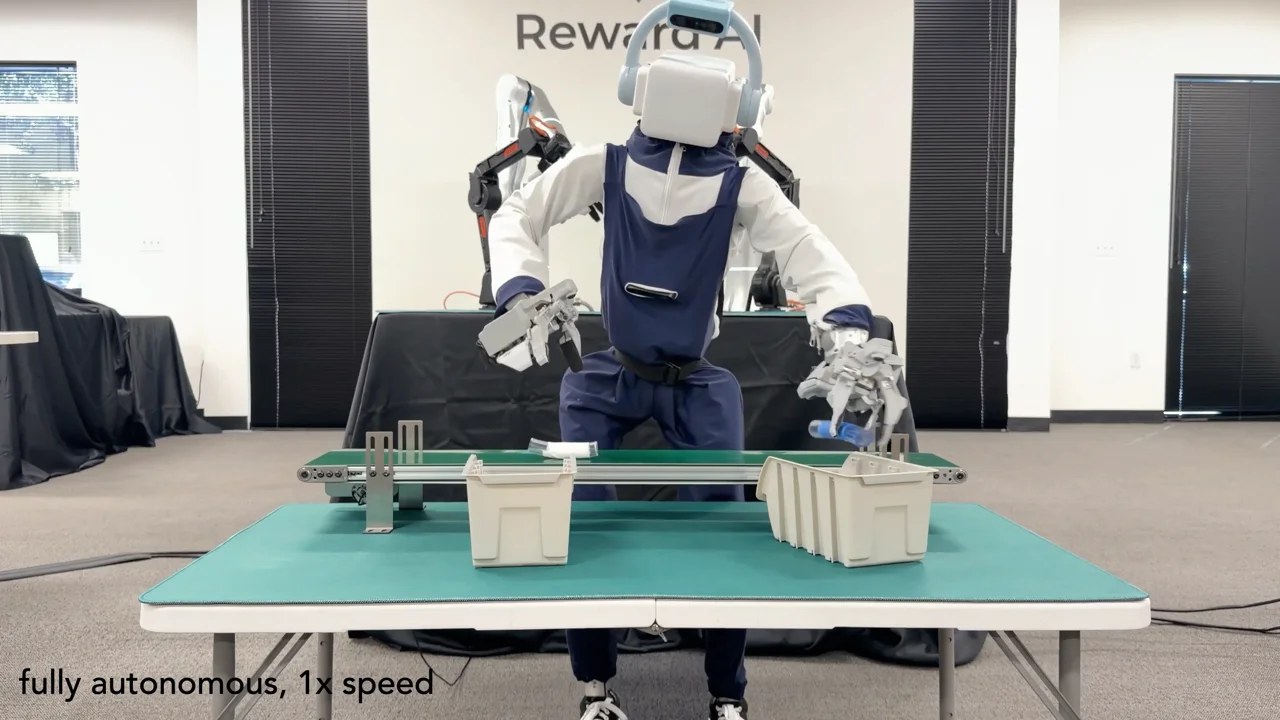
Demos on the blog and in Humanoids Daily’s write-up include RJ-45 unlatching, laundry folding, bartending, phone packaging, and a humanoid reaching into a refrigerator. Co-founder and CTO Chen Wang posted that the transfer across robots, without robot data or per-robot fine-tuning, is the part he cares about.
A Human’s Take
Training only on people wearing a glove is a clean bet: if the mapping holds, you stop paying for teleop farms. I want to see the same Ethernet-tab unlatch on a robot that was not in the launch reel, timed against a human, with the misses left in. Thirty minutes per new task is a number I will remember. The control layer is the part that has to keep it from looking great at 1x on camera and jittery on a real shift.