KUKA’s RHOAS Makes Hand-Guiding Push Back Without a Wrist Sensor
Teaching a cobot by dragging it around is still how a lot of demonstration data gets made. After a few hours, the operator is the worn-out part. A KUKA / TU Braunschweig team posted RHOAS on August 11: Robot Hand-guiding with Observer-based Active Support. The arm estimates the force you apply from its own joint-torque sensors and then helps you in that direction. No extra wrist force-torque sensor.
The paper is accepted at RO-MAN 2026. The work was done at KUKA’s Augsburg lab on a 7-DoF LWR iiwa (7 kg payload).
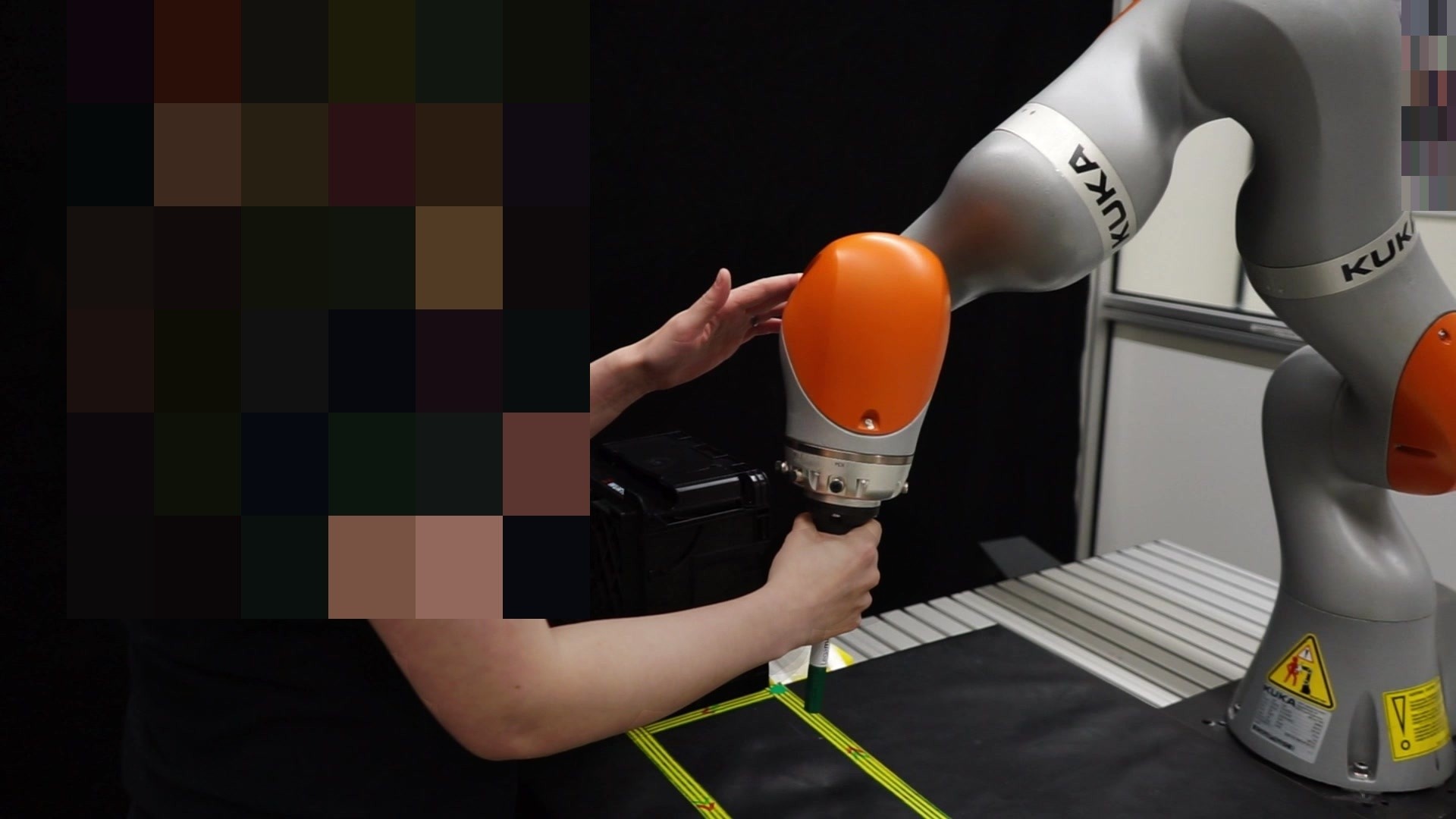
Treat the human as the controller
Most industrial hand-guiding just cancels gravity. Some research setups add a wrist sensor and an admittance loop. Passivity-based compliance assumes the environment is passive. The authors say hand-guiding is the opposite: the person is actively driving the robot.
RHOAS uses a momentum observer on the elastic joint torques, maps those to a spatial force at the tool, then:
- Low-pass filters at 5 Hz (human control is cited as under 22 Hz)
- Scales the estimate down near singularities via a confidence factor
- Drops the gravity-axis component so residual gravity-comp error is not amplified
- Turns the cleaned force into a desired Cartesian velocity and tracks it
- Optionally adds a small “reflex” torque in the same direction
Redundancy is used as damping in the nullspace so the operator does not have to babysit the elbow.
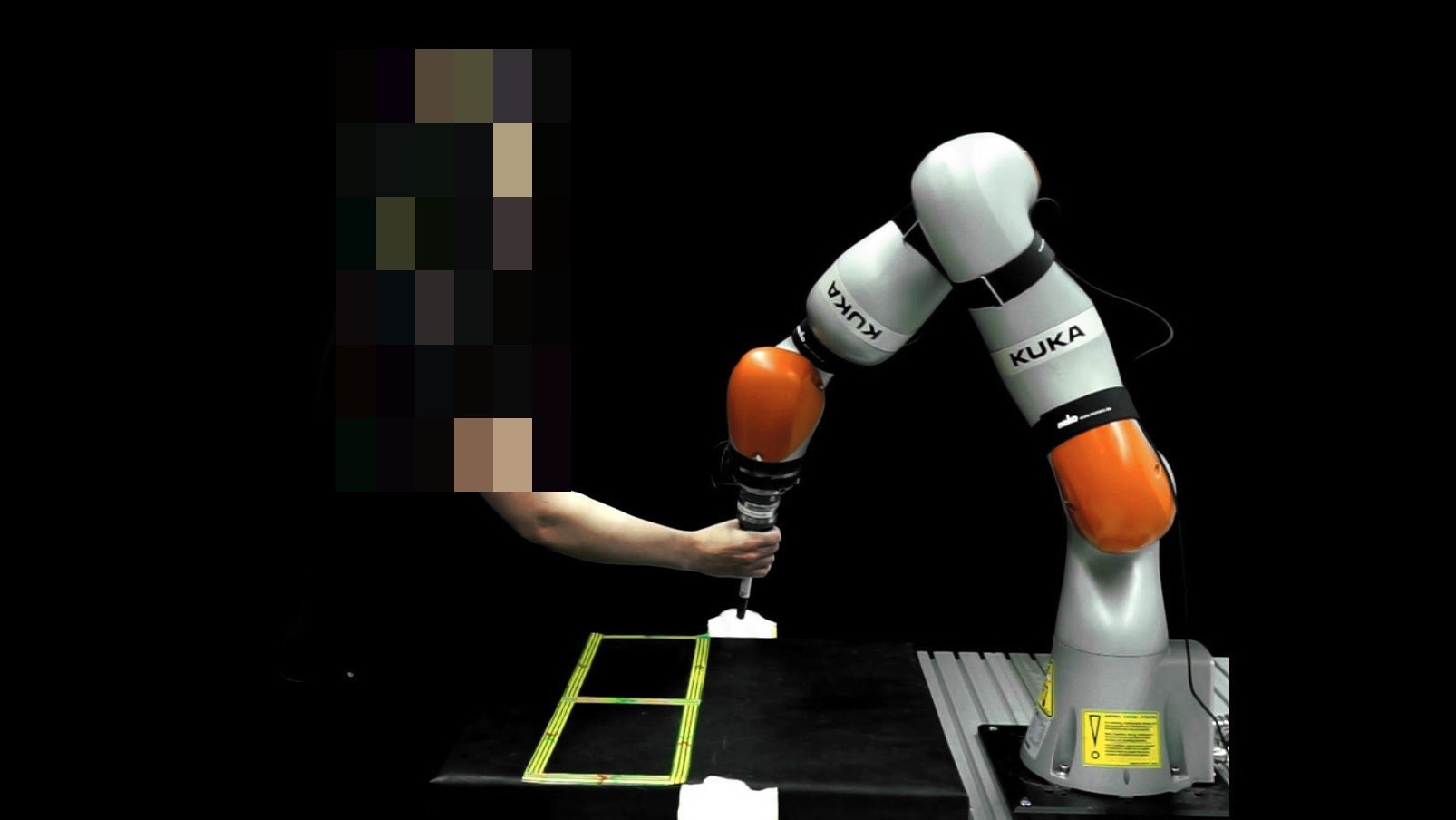
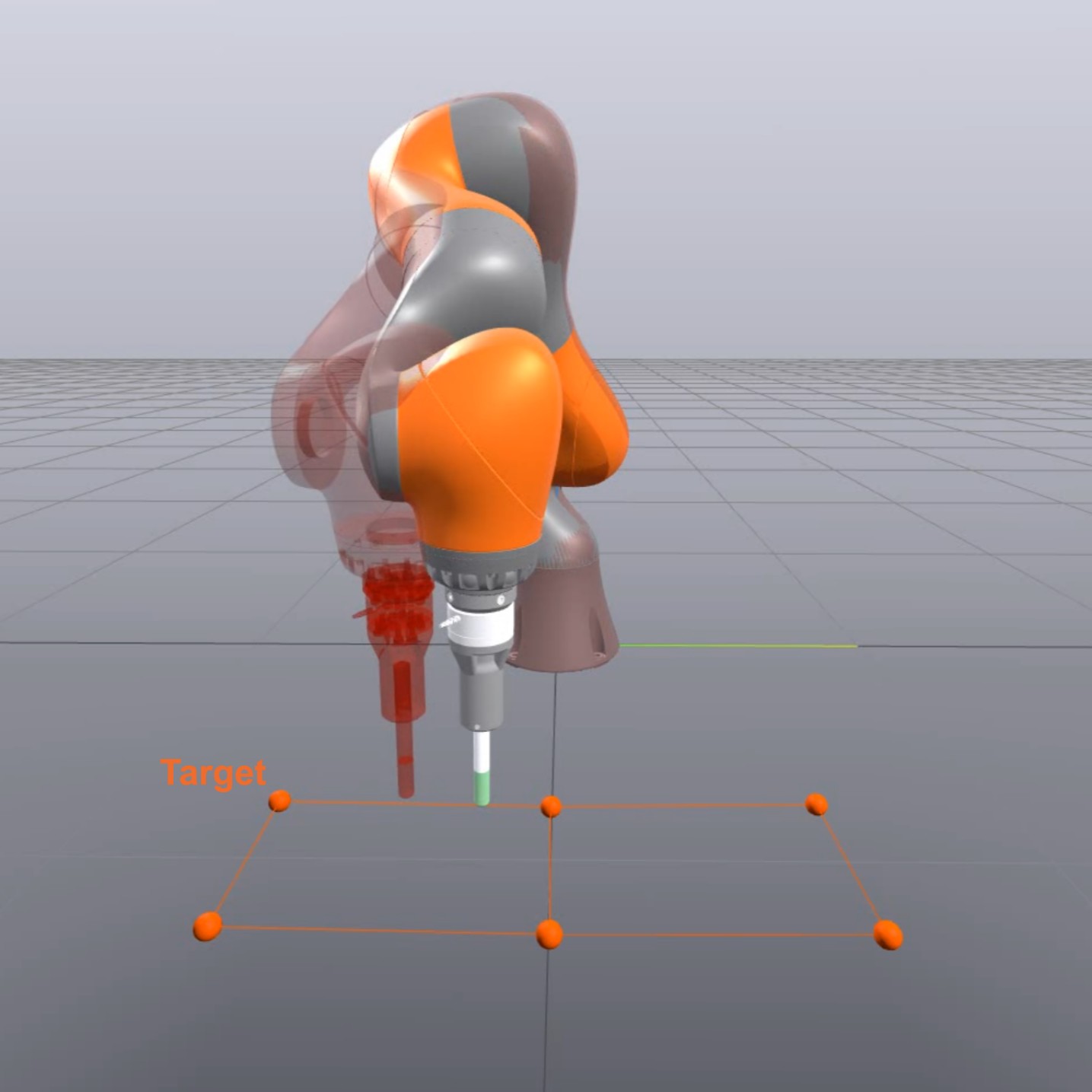
Sixteen people, two nasty tasks
Sixteen participants ran a precision path-trace and a fast box-tap. Controllers were blinded and shuffled. Each person did 32 runs, 256 trials in all. A wrist ATI Mini 58 logged force for scoring only; it was not in the control loop. Update rate on the Fast Research Interface was 55 ms.
Compared with factory gravity-comp and an estimate-based adaptive-damping baseline:
- Normalized human energy dropped (overall 23.6% / 23.5% of a user’s own energy on the two RHOAS variants vs 26.3% / 26.5% on the baselines; ANOVA p < 10⁻⁴)
- Raw agility energy: about 184 J on RHOAS vs 222 J on gravity-comp
- Users ranked RHOAS better, especially on the fast task (p < 10⁻⁵)
- Missed metronome beats trended down; that quality gap was not statistically significant
The paper is honest about the cheap tricks: they do not assist along gravity, they shut off near singularities, and they have only shown this on one iiwa.
A Human’s Take
If you are paying people to drag a 7-DoF arm for a dataset, the interesting number is not a new imitation-learning score. It is whether the operator is still accurate on hour three. RHOAS gets there with sensors the robot already has. I want the same controller on a second brand of cobot, and I want to see whether the 5 Hz filter still feels honest when someone slams the tool into a stop. Until then, this is the right kind of factory paper: less fatigue, same hardware.