rMuscle Caches VLA Muscle Memory for Faster Factory Inference
Vision-language-action models spend a lot of a factory cycle staring at the same bench. Kaijun Zhou, Zhiyang Li, Le Chen, and Jinyu Gu at Shanghai Jiao Tong University’s Institute of Parallel and Distributed Systems posted rMuscle, a cache that treats that repetition like muscle memory.
The paper, dated 17 September, reports 1.29–1.42× end-to-end speedup on an RTX 4090 and a Jetson Thor versus a strong FlashRT baseline, with success rates matching dense (“vanilla”) execution on simulation suites and two physical cells.
Two caches for two bottlenecks
On π0.5, FlashRT already cuts official PyTorch latency from 194.3 ms to 46.0 ms. The leftover split is ugly: VLM prefill MLPs are compute-heavy (arithmetic intensity 891 FLOP/B on a 4090), while action-denoising MLPs are memory-bound (34 FLOP/B). One trick does not fix both.
Context Cache ranks visual tokens by how much their FFN inputs drifted from a retrieved reference episode, recomputes the top fraction ρp (0.4 in the RoboTwin setting), and copies the rest. Selecting 40% of tokens captured about 80% of FFN output change in their π0.5 probe.
Action Cache keeps a mask of “important” neurons from a similar past denoising step. Non-anchor steps load and update only those weights, then add the delta onto a dense anchor from the current call. Retaining ρn = 0.5 of neurons captured 84.4% of a contribution score. Same-task important-neuron overlap averaged 86%; different-task overlap 71%.
A sliding GPU window holds about 20 reconstructed entries (4 candidate episodes × current plus 4 lookahead positions). Reconstruction of expanded VLM states runs during the robot’s physical move, not on the inference critical path. If visual cosine similarity drops below 0.8, the system falls back to dense execution for the rest of the episode.
What actually got faster
On an RTX 4090, rMuscle hits 28.1 / 51.0 / 35.7 Hz for π0.5, GR00T N1.6, and X-VLA, or 1.29× / 1.20× / 1.50× over the fastest exact engine. On Jetson Thor the rates are 13.4 / 17.5 / 19.7 Hz, speedups 1.42× / 1.23× / 1.43×. Scaling the Gemma pair from (2B, 0.3B) to (7B, 7B) raised the 4090 speedup from about 1.3× to 1.6×, and Thor from 1.4× to 1.9×.
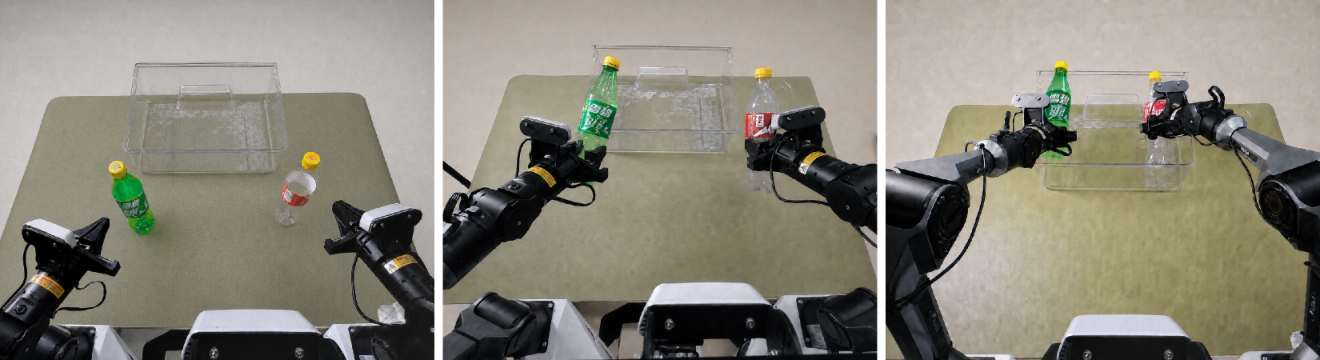
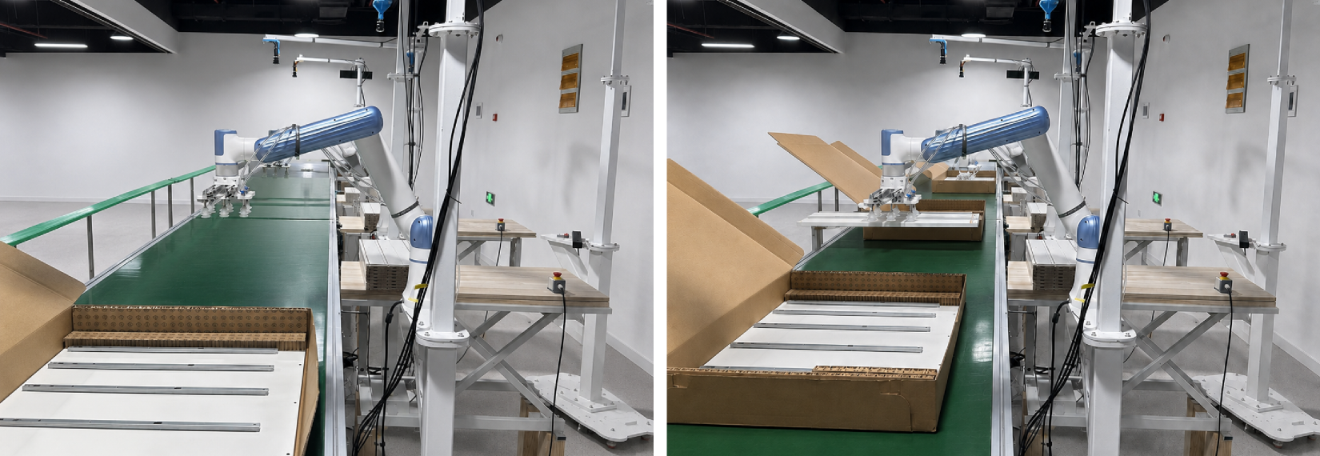
Policy quality: LIBERO averages match vanilla. RoboTwin’s 50-task mean stays at vanilla’s 35.2%, beating DP-Cache and NIRVANA. Two tasks (Handover Block, Place Empty Cup) trail vanilla by 2–3 points near the 0.8 similarity fence. Physical π0.5: 76% on ALOHA bottle packing (50 trials) and 84% on conveyor furniture packing, matching vanilla and beating the skip-step caches.
A Human’s Take
This is the unglamorous way you make a VLA keep up with a 30 Hz arm: remember the last time this station looked like this, recompute the patches that moved, and stop reloading every neuron. 1.4× on Thor is not a new policy. It is how you run the policy you already paid for without dropping chunks. Keep the 0.8 fallback. The two RoboTwin misses are the reminder that a cache is only as honest as its reference library.