RoboNaldo: Unitree G1 Scores Sub-Meter Humanoid Soccer Shots on Grass
A humanoid that can put a soccer ball on target is a hard physics problem: whole-body balance, high-impulse contact, and accuracy under timing pressure. RoboNaldo, from researchers at the University of Hong Kong, CUHK, and Archon Robotics (OpenDriveLab), claims the first general-case humanoid shooting policy with less-than-one-meter average target error outdoors.
The paper is on arXiv (2606.11092); the project page and demo video show a Unitree G1 on grass with onboard sensing—no external motion-capture cage.
The trick: one human kick, three RL stages
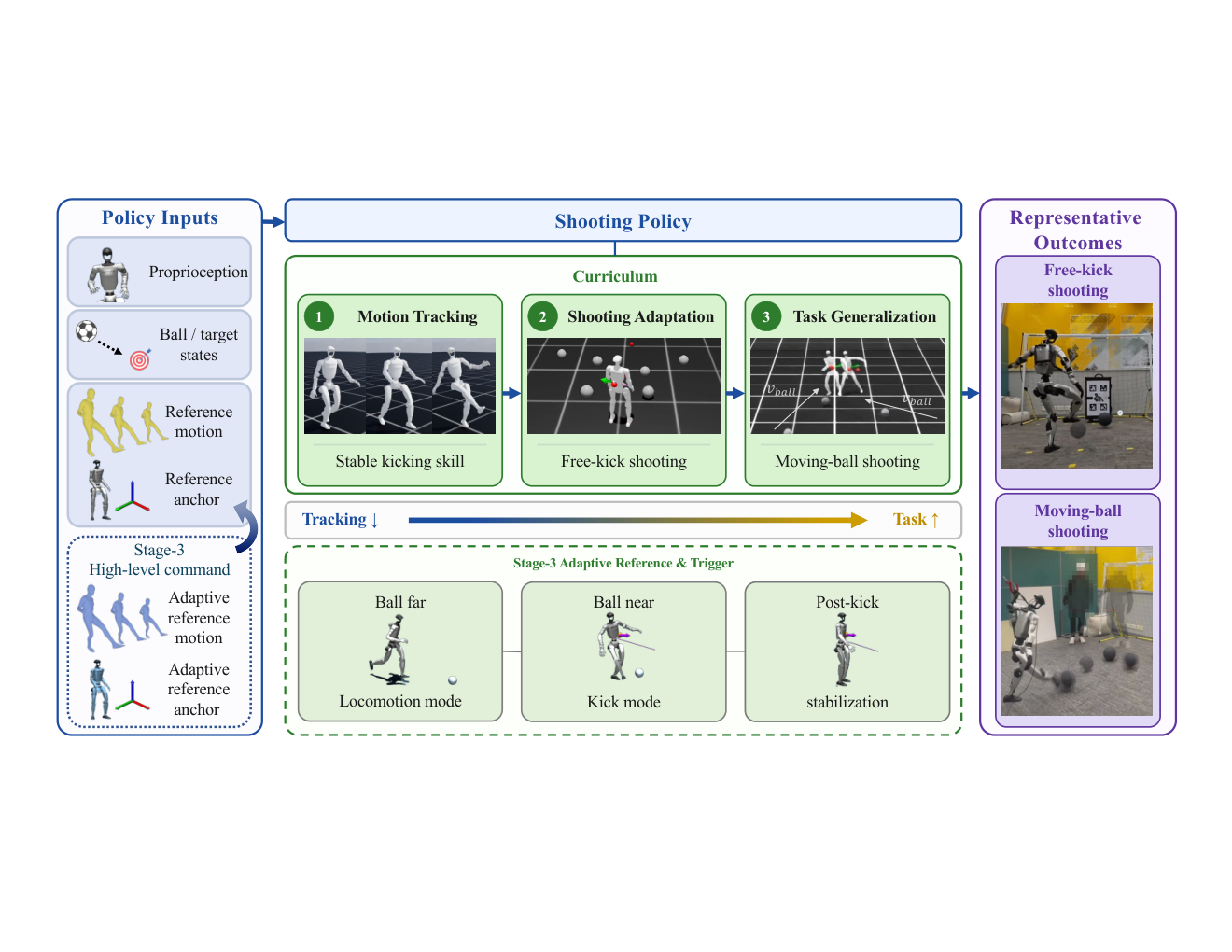
Pure motion-tracking RL is stable but stuck on a fixed reference. Pure task-reward RL struggles to discover a valid kick from scratch. RoboNaldo uses a three-stage motion-guided curriculum built on a single human kick:
- Motion tracking — learn a stable whole-body kicking prior from the reference.
- Shooting adaptation — RL fine-tunes deviations for stationary balls at varied positions (free-kick regime).
- Task generalization — co-train with a kick-timing and locomotion planner so the same low-level policy can one-touch moving balls.
A high-level heuristic planner drives the kick trigger during training; other high-level controllers can reuse the low-level policy at inference.
Numbers that stick
From the authors’ abstract and project write-up (verified on the paper and project page):
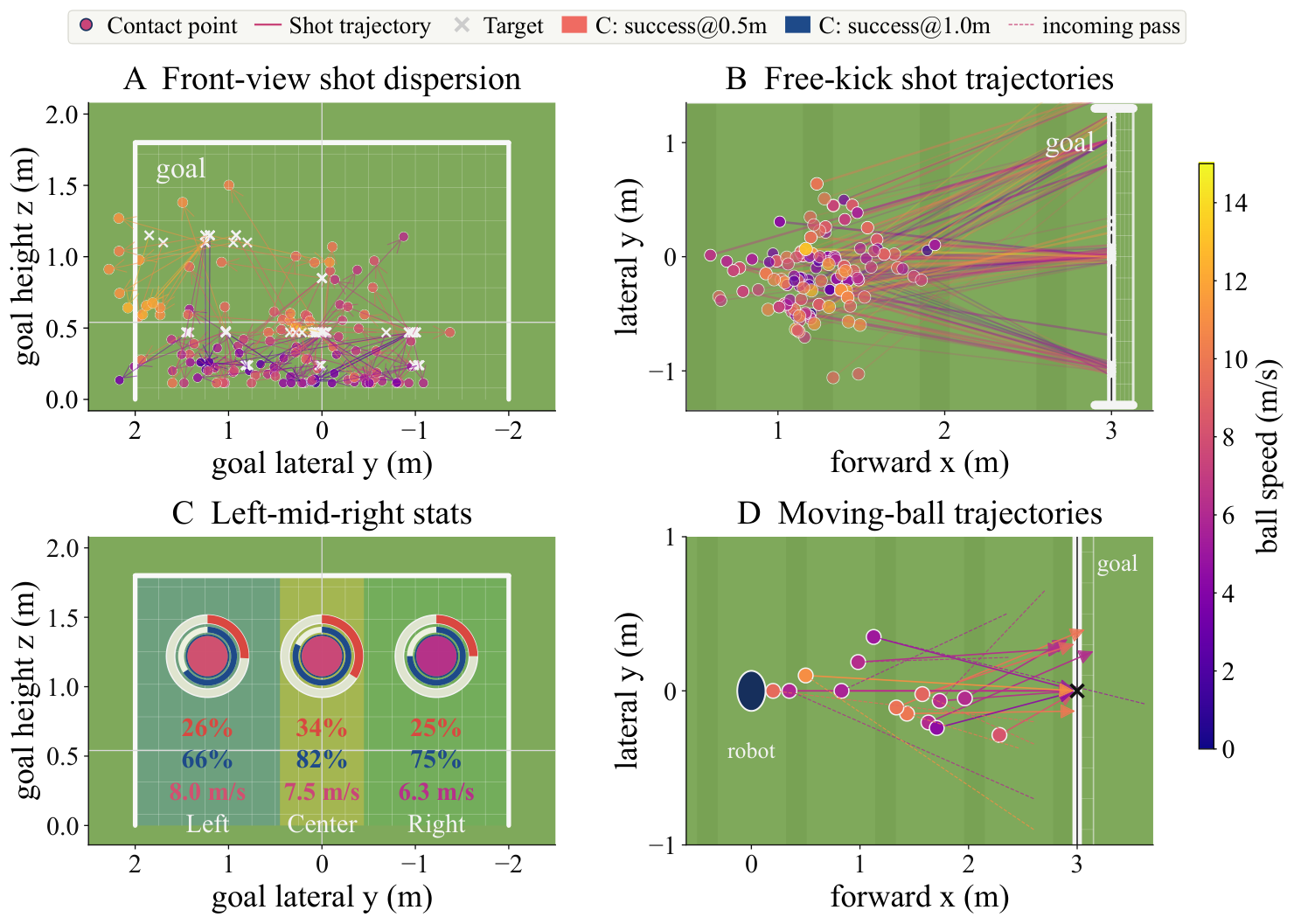
- Simulation: free-kick shot error 48.6% lower and shoot velocity 2.96× vs prior baselines.
- Real Unitree G1 (onboard perception, ~3 m range): average target error 0.73 m (free-kick) and 0.86 m (moving ball).
- Best reported shot: about 17 cm from a 3 m target.
- Post-contact ball speed: 13.10 m/s — described as 59–71% of reported professional open-play shot speed.
- Terrain demos include artificial soccer/hockey fields and natural grass.
Why robot nerds should care
Soccer shooting is a stress test for high-impulse whole-body contact under egocentric vision. Getting sub-meter accuracy from three meters with a commercial G1 and onboard sensors is a stronger claim than a scripted kick in a lab cage. Code is listed on the project GitHub for the simulation training stack.
A Human’s Take
I’m so here for sports as a benchmark when the metrics are honest: mean error, ball speed, terrain. RoboNaldo isn’t “robots will replace strikers”—it’s proof that curriculum RL can keep a motion prior while still adapting to ball motion and timing. Next receipt I want is third-party replications on other G1 fleets, and whether the same stack generalizes to pass-and-shoot chains, not just one-touch set pieces.