RoboSeg Maps Handles and Spouts From One Wrist Camera
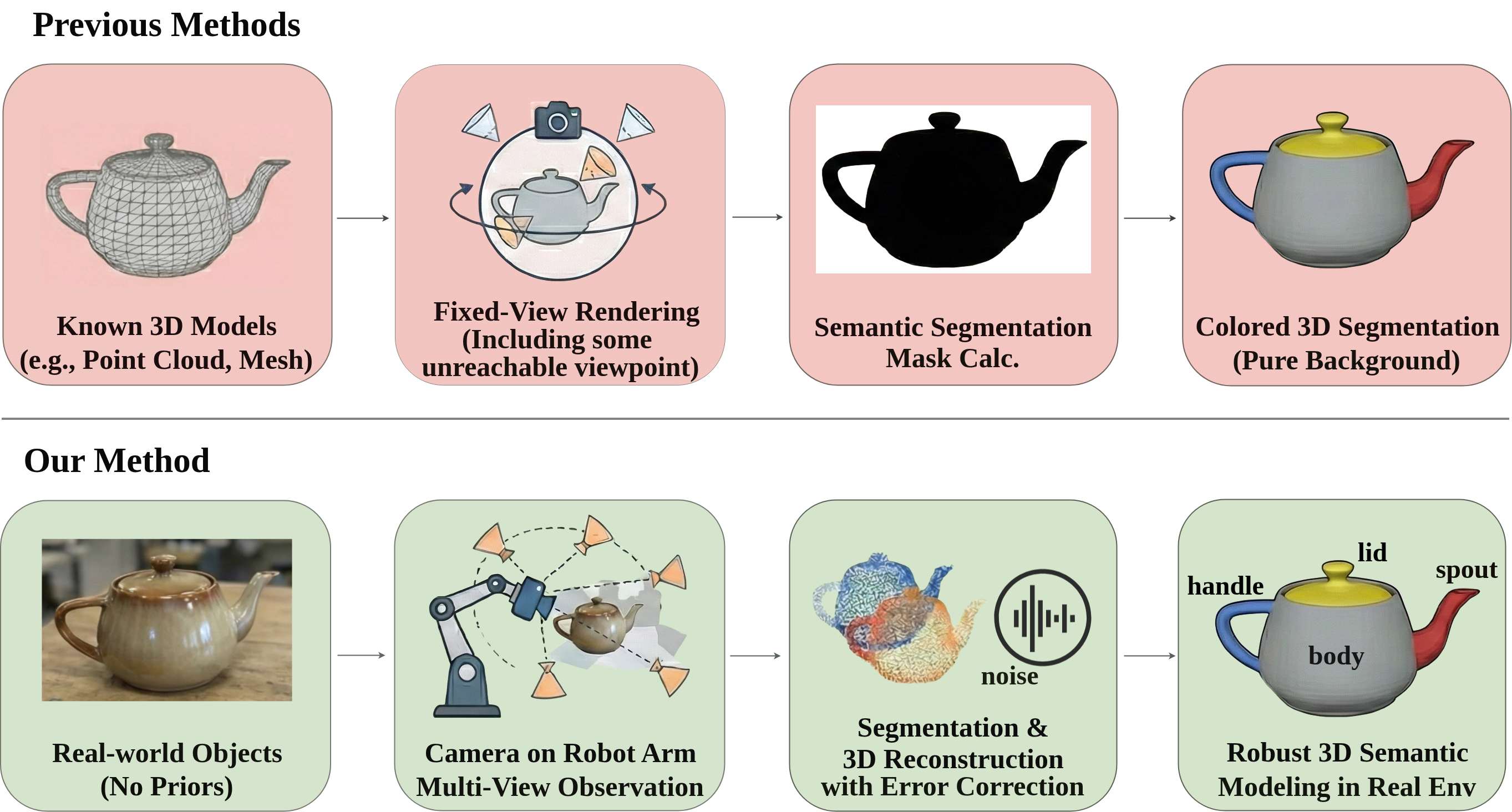
Grasping a watering-can handle is not the same problem as grasping its spout. Category labels and raw point clouds do not tell a robot which contact region matches a language task. Offline 3D part methods often assume a finished mesh first — which a tabletop arm does not have when it first sees the object.
RoboSeg, from Zhaochen Lan and Mengxiang Lin at Beihang University (arXiv:2608.09778, Aug 10, 2026), builds a part-labeled map online from a single eye-in-hand RGB-D camera, then indexes grasp proposals by those parts.
Pipeline
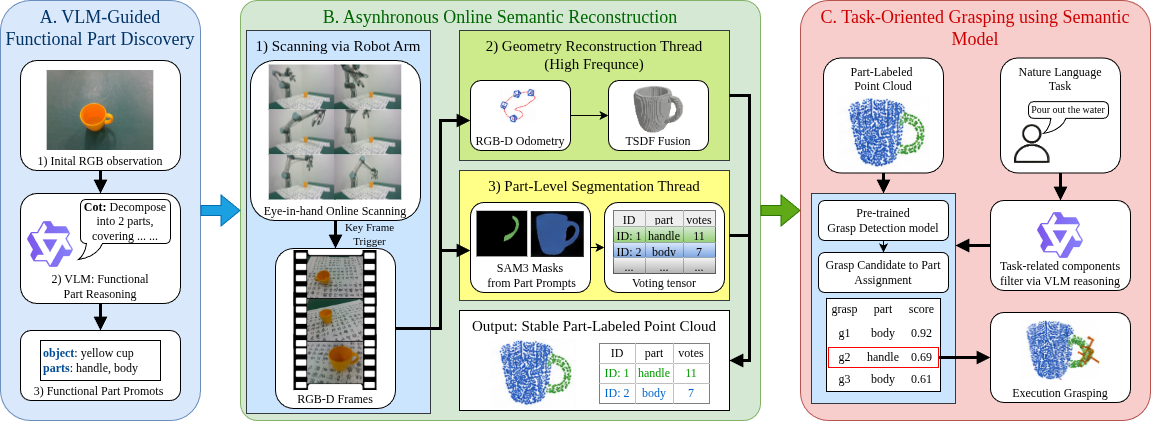
Hardware is a UR5 with an Intel RealSense D435i wrist camera. At start, Qwen3-VL looks at the first RGB frame and returns a short list of functional parts (for example, “watering can handle”). Scanning then runs two asynchronous threads:
- Geometry: high-rate RGB-D odometry and TSDF fusion
- Semantics: keyframe SAM3 masks for those part prompts, projected into voxels
Voxel-level temporal voting (top-3 instance IDs per voxel) dampens label flicker. After the scan, AnyGrasp proposes 6-DoF candidates on the reconstructed cloud; each candidate is tagged with the dominant part under the gripper close region, and the task language filters to the requested part.
Numbers
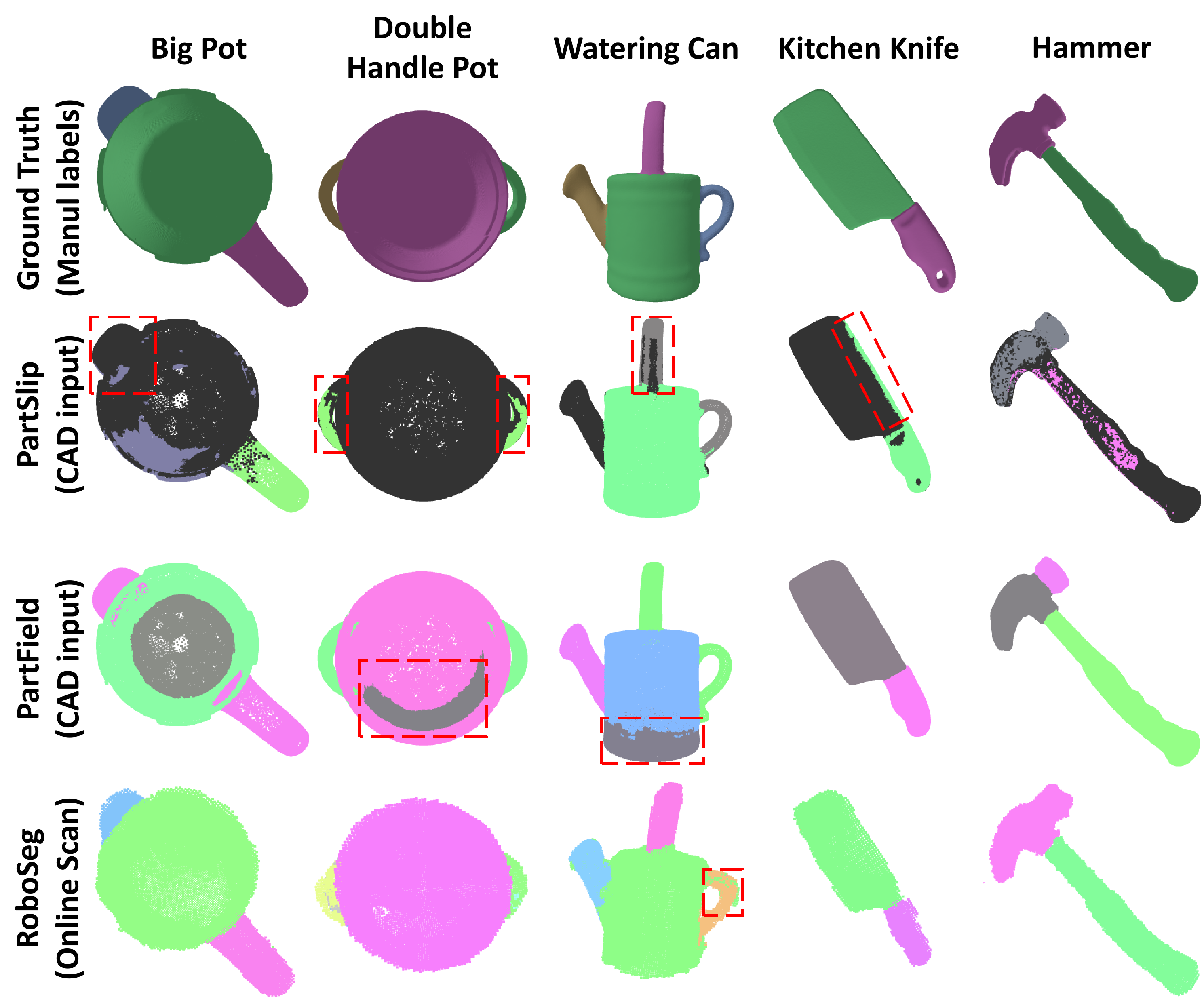
On manually labeled objects (Big Pot, Double Handle Pot, Watering Can, Kitchen Knife, Hammer), RoboSeg reports 83.4% mean part IoU. In a 24-trial physical pilot over eight object–task conditions (three repeats each), the executed grasp contacted the requested part in 24/24 trials. Combined physical lift + correct part succeeded in 21/24 trials; the three misses still touched the right part but failed the stable lift — pointing at grasp mechanics, not semantic routing. Unfiltered AnyGrasp top-1 matched the target part in only 4/8 conditions on recorded proposals, while semantic filtering selected a target-part candidate in 8/8.
A Human’s Take
Semantic indexing on top of an off-the-shelf grasp detector is the right layering. You keep AnyGrasp for geometry and use the part map as a filter — that is how I want factory cells to grow features without rewriting the whole stack. Twenty-four trials is a pilot, not a production yield study, and thin blades still hurt physical success. If they open the code with the VLM prompt and voting config, this becomes a useful default for “grasp the handle, not the blade” demos.