RoboSPA: Pick the Third-Farthest Bottle, Then Remember What You Hid
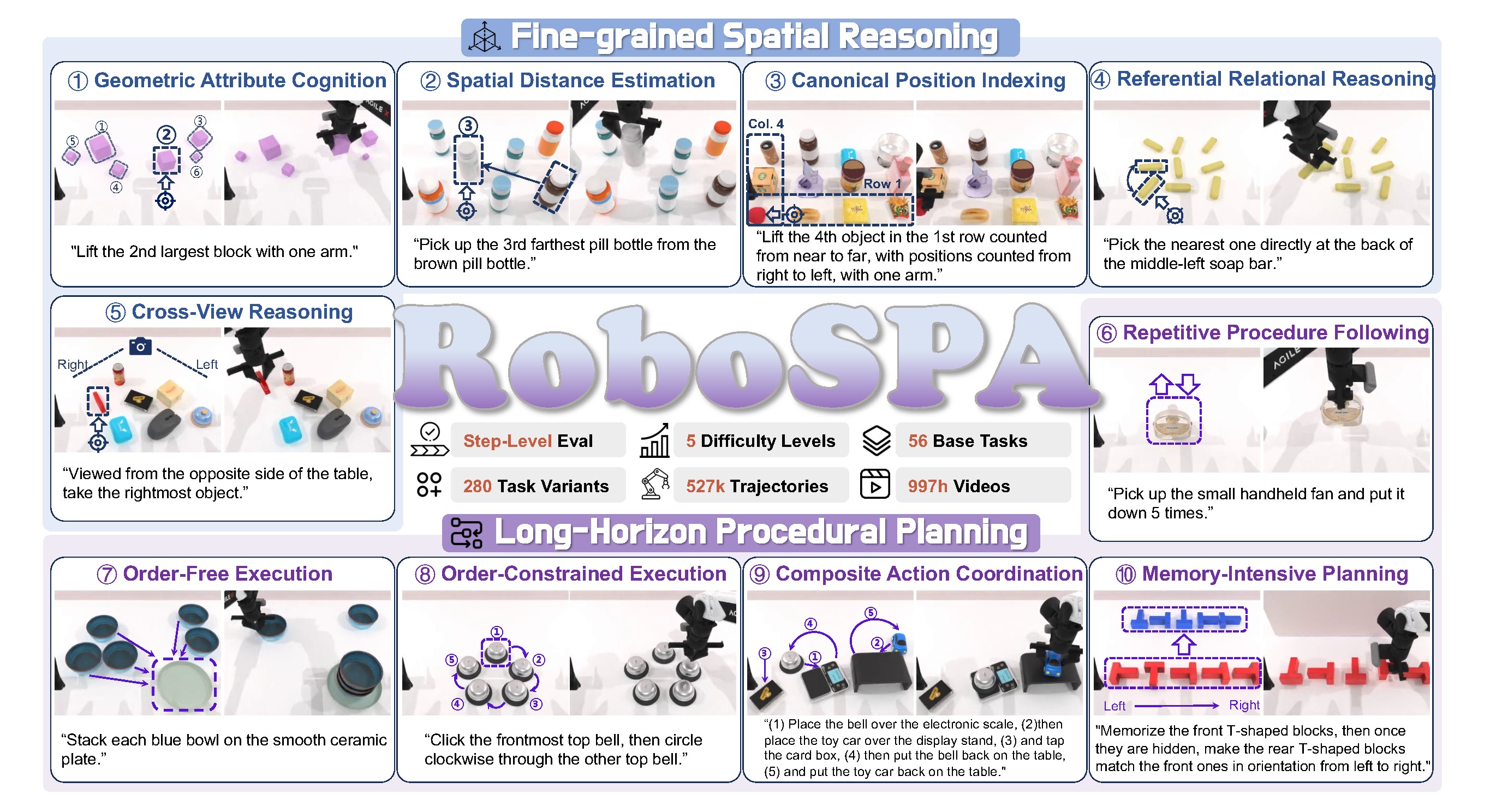
“Pick the ketchup” is easy. “Pick the third-farthest pill bottle from the brown one” is the test. RoboSPA (Robot Spatial-Procedural Assessment), arXiv:2609.05324, landed 4 September and is accepted at EMNLP 2026. Zhejiang University and partners built it on RoboTwin 2.0.
The corpus: 527K trajectories, 997 hours of interaction video, 108 million timesteps, 56 base tasks, 280 variants, 5 embodiments (Aloha-AgileX, ARX-X5, Piper, Franka, UR5). 463K of those runs are domain-randomized.
Two axes, five notches
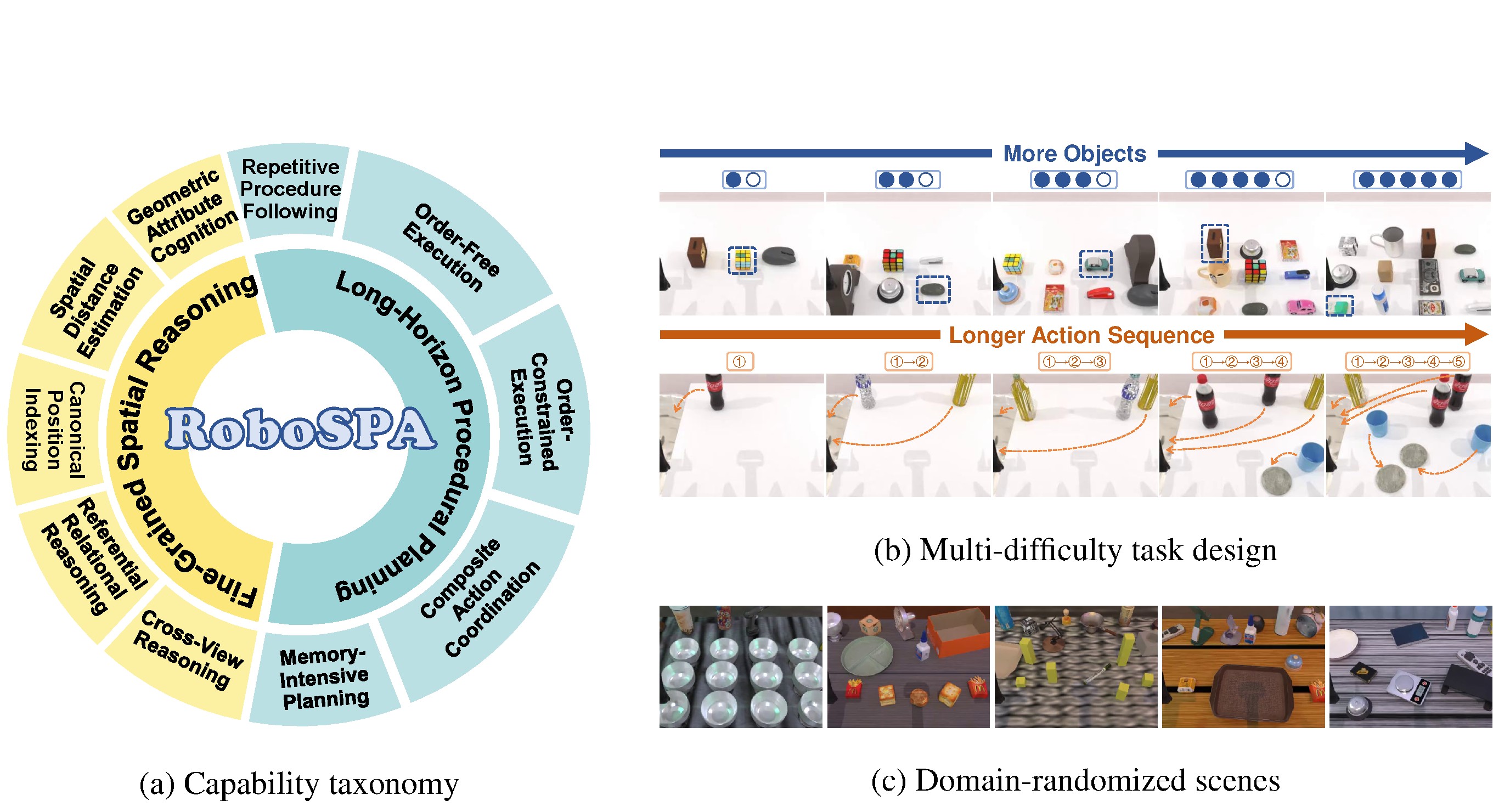
Fine-grained spatial reasoning covers geometric attributes, distance, row-column indexing, referential relations, and cross-view prompts. Long-horizon procedural planning covers repeats, order-free piles, ordered sequences, composite action chains, and memory (hide the blocks, then match the ones in back).
Each base task has levels L1–L5. Spatial variants add lookalike candidates. Procedural variants add steps. Metrics besides success rate: ONTA (chance-corrected target pick) and Progress Score (fraction of subgoals done).
Paper protocol on clean Aloha-AgileX: 50 successful expert demos per variant, train on all five levels (250 demos) per base task, 100 eval rollouts with unseen instructions.
L5 is a cliff
Single-task results on clean scenes:
| Model | L1 success | L5 success |
|---|---|---|
| RDT | 16.8% | 6.9% |
| GO-1 | 25.1% | 8.8% |
| π0.5 | 55.2% | 22.3% |
| X-VLA | 50.4% | 19.9% |
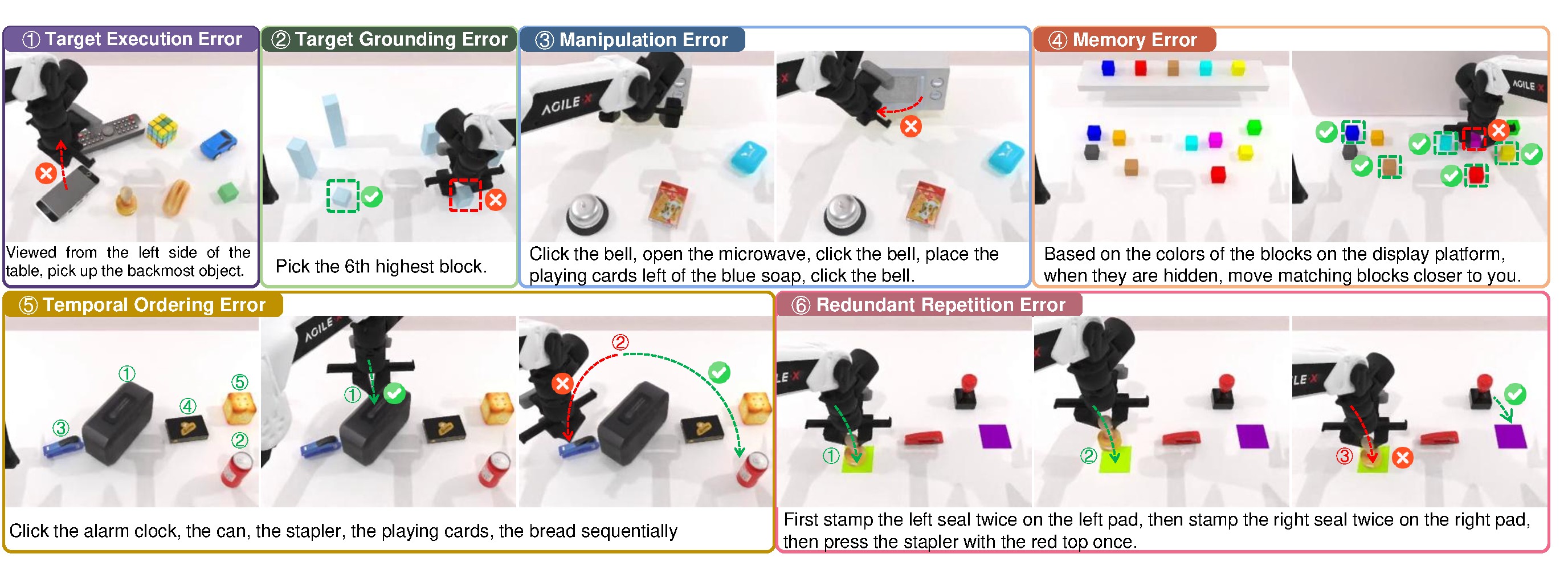
Every evaluated model stays under 25% overall at L5. Spatial ONTA sits near chance when the cue is a relation, not a category. Progress Score beats final success: the policy starts the recipe and dies on a later step. Memory-intensive L5 is a wipe.
Code, configs, and a Hugging Face dump are up. This is a diagnostic, not a leaderboard for warehouse humanoids. The arms are tabletop dual-arm setups.
A Human’s Take
I am tired of 90% on pick-the-red-cup. Asking for the fourth object in row one, counted right to left, is closer to how people actually talk to a robot. If π0.5 is the high-water mark at 22% on L5, the model is still guessing which bottle you meant.