CMU Team Captures Real Clinician Bathing Demos for Soft-Hand Transfer
Bathing is one of the activities of daily living that decides independence, and caregiver supply is not keeping up. Robot-assisted bathing has been demoed before, but most stacks lean on idealized protocols or debris-cleanup metrics instead of how clinicians actually wipe, support, and re-position a person.
A Carnegie Mellon and University of Pittsburgh team (Lakshmipathy, King, Erickson, Pollard, and co-authors) posts “High Fidelity Capture, Reconstruction, and Transfer of Human Demonstrations for Robot-Assisted Bathing” to arXiv on Aug 10, 2026 (arXiv:2608.09127), accepted at RSS 2026. The contribution is a capture pipeline that treats contact regions as the core primitive, a clinician–subject dataset, and transfer onto a soft multi-finger hand on a robot arm.
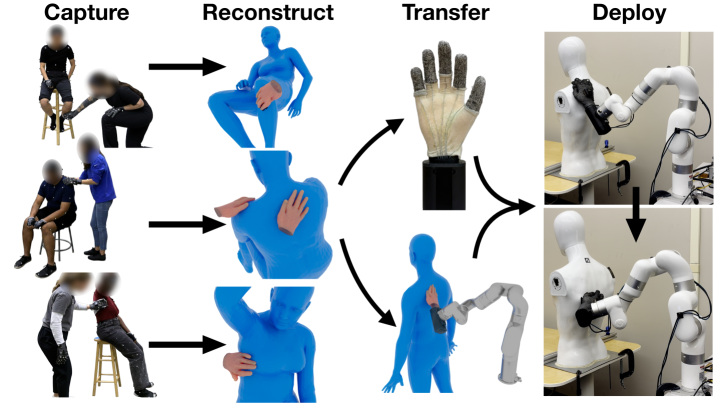
Dataset and reconstruction
Three trained clinicians and six able-bodied subjects produced 128 captures and about 257,000 frames. Subjects wore optical markers; clinicians wore commercial tactile gloves (65 taxels per hand) with protective grip material, tracked by a 20-camera Vicon Vantage-V16 volume. Captures span body parts (arms, legs, back, neck, face under limits), limited vs full assistance, and mild vs strong pressure.
Raw MoSh++ fits left finger contortions and hand–body gaps. The authors add a constrained hand skeleton pass and a contact-match optimization that pulls active taxels to the body surface. Median contact L2 distance drops from 1.714 cm (MoSh++) to 0.536 cm with their pipeline on a 10-demo sample.
Soft hand and mannequin deployment
They design and control a tendon-driven soft DexKit hand from demonstration poses, mount it on a UFACTORY xArm 7, and retarget wrist motion via barycentric body contacts onto a mannequin fitted with SMPL-X. Open-loop playback often pressed too hard or lost contact. Closing the loop with the same tactile glove style — matching online pressure sum to the demonstration — reduced unsafe peaks and mannequin shake versus open loop, though absolute taxel distributions still differ from the human hand.
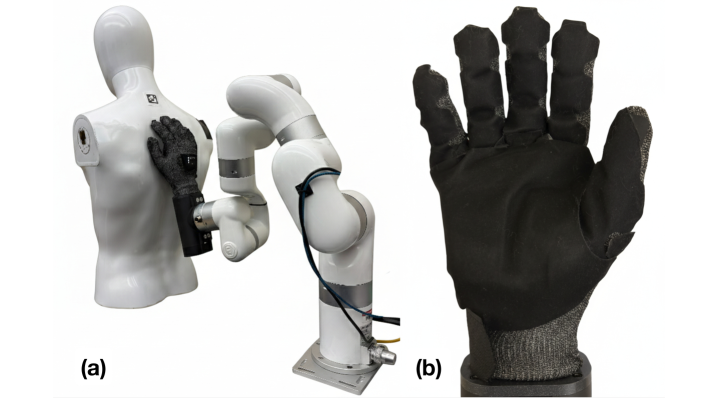
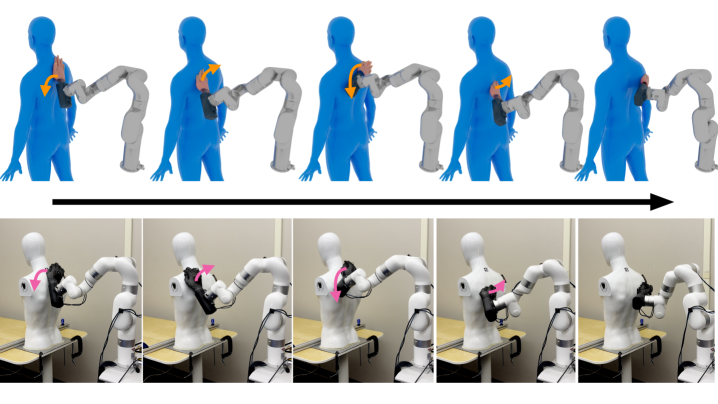
The authors state materials will be publicly released for pHRI research, and they are explicit that the system is not ready for human subjects yet: online whole-body pose estimation, shear forces, and material mismatch between soft robot hands and human taxel maps remain open.
A Human’s Take
This is the kind of dataset I want more of: messy, contact-rich, clinician-sourced, with the failure modes written down. Contact as a processing primitive is an elegant way around glove-vs-skin geometry fights. The closed-loop pressure matching is a practical safety patch, not a finished controller, and the paper does not pretend otherwise. When the code and captures drop, the useful test will be whether another lab can retarget a different soft hand without redoing the entire Vicon circus.