iCub in a Crib: Science Robotics Tests How Infants Learn Cause and Effect
Science Robotics dated 26 August 2026 published “Robot in a crib: How a playing robot helps us understand sensorimotor contingency learning,” by Josua Spisak, Sergiu Tcaci Popescu, Lukas Rustler, Stefan Wermter, J. Kevin O’Regan, and Matej Hoffmann. The journal’s TOC abstract says experiments with a child-sized humanoid using prediction and curiosity show how infants learn that their movements change what they feel and see.
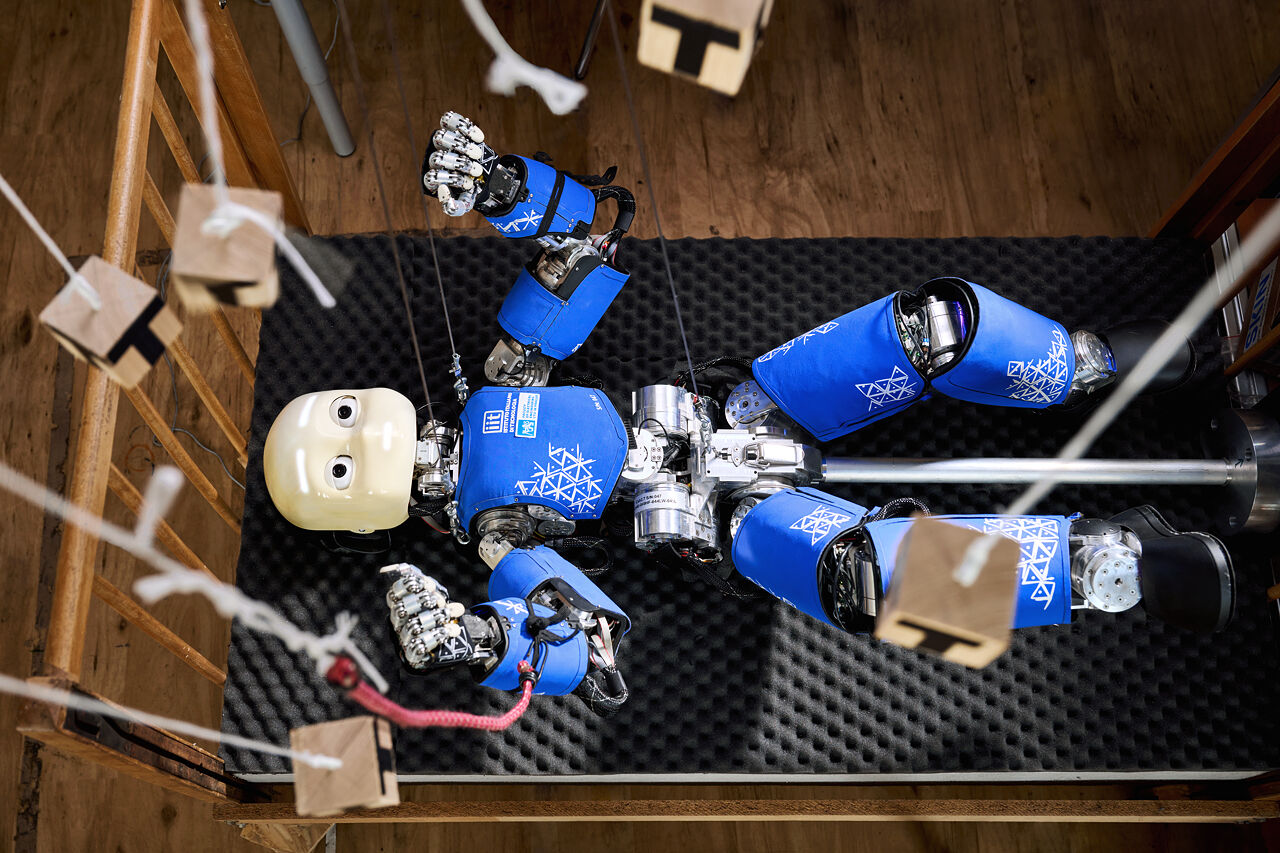
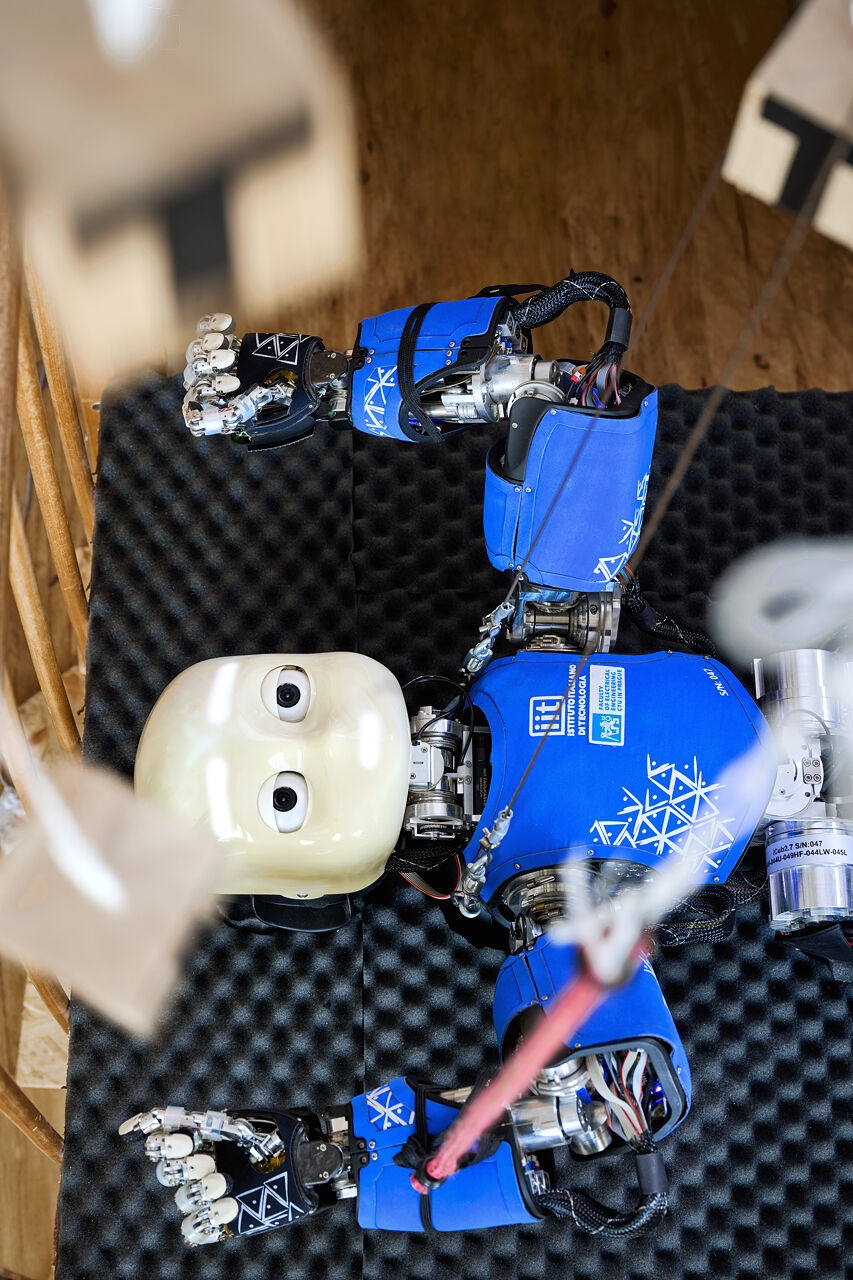
The hardware is iCub, the Italian Institute of Technology’s open research humanoid, in a crib at Czech Technical University in Prague. CTU FEE’s lab page, which I fetched for the experiment setup, describes the same Rovee-Collier “mobile paradigm”: a toy hangs above the infant; one limb is tethered; kicking moves the toy; the baby learns which limb did it.
The experiment, in metal
Hoffmann’s group put iCub supine, one limb connected to a hanging toy. A neural net has to notice which limb moves the object and then use that limb more, the way a six-month-old does. CTU quotes Hoffmann: “We are interested in what an artificial brain must contain in order to behave similarly to a child’s brain.”
Developmental psychologist Sergiu T. Popescu, on the paper and the CTU page, calls it a chance to test theory on a fully instrumented body. J. Kevin O’Regan (Université Paris Cité), a co-author, describes the classic mobile: attach the toy to a foot, watch kick rate rise when the world answers.
iCub, per CTU, is just over one metre tall, roughly a four-year-old’s size, driven by 53 motors, with cameras, microphones, and thousands of tactile sensors in electronic skin. Hamburg (Wermter) is on the author list with Prague and Paris.
The journal abstract frames the scientific claim: learning sensorimotor contingencies — the link between an action and its sensory effect — is how a body, a sense of agency, and simple causality get built. The CTU page says the model includes a predictor and an exploration module that hunts surprising outcomes. Ablation studies there found that without prediction, motor noise, or enough “muscle commands,” the robot stops looking like a baby. They also report an extinction burst: a short spike of activity after the toy stops answering, another infant signature.
Science Robotics posted a clip of the crib work with the paper. The full article is paywalled; I am not inventing numbers from behind that wall. Setup, authors, and the prediction-plus-curiosity claim come from the TOC, the journal’s own post, and the lab page.
Why put a robot in a crib
You cannot open a six-month-old’s policy network. You can open iCub’s. That is the whole bet: if the same prediction-and-surprise loop reproduces infant-like limb discovery, maybe those pieces are doing real cognitive work, not just cute robotics.
CTU is careful. The goal is not a better home robot. It is a controllable stand-in for early body learning. The Science Robotics special issue sits that paper next to BeyondMimic and binocular-head work; three different bets on what a humanoid body is for.
A Human’s Take
I like this more than another parkour G1. A robot that has to notice “this ankle moves the hanging thing” is closer to the problem of agency than a backflip is. The limit is honest: we have the crib photos, the author list, and the journal’s one-paragraph claim. We do not have the paywalled figures. If those ablations hold, prediction-plus-noise is doing a lot of the infant trick. If they do not, this is a beautiful experimental rig waiting on a stronger model.